Institut National de la Santé et de la Recherche Médicale, Inserm UMRS1170, 114 Rue Edouard Vaillant, 94805 Villejuif, France; Paris-Saclay University, Villejuif, France; Gustave Roussy, 114 Rue Edouard Vaillant, 94805 Villejuif, France; Department of Obstetrics and Gynecology, Tongji Hospital, Tongji Medical College, Huazhong University of Science and Technology, Wuhan, P.R. China.
Institut National de la Santé et de la Recherche Médicale, Inserm UMRS1170, 114 Rue Edouard Vaillant, 94805 Villejuif, France; Paris-Saclay University, Villejuif, France; Gustave Roussy, 114 Rue Edouard Vaillant, 94805 Villejuif, France.
Stem Cell Reports. 2019 Aug 13;13(2):274-290. doi: 10.1016/j.stemcr.2019.06.002. Epub 2019 Jul 18.
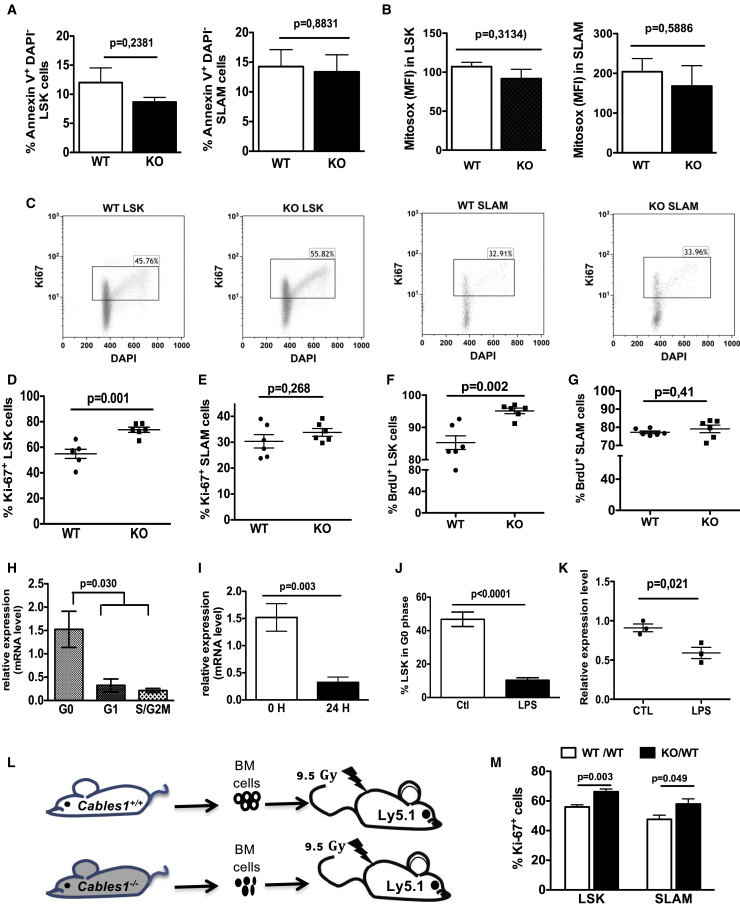
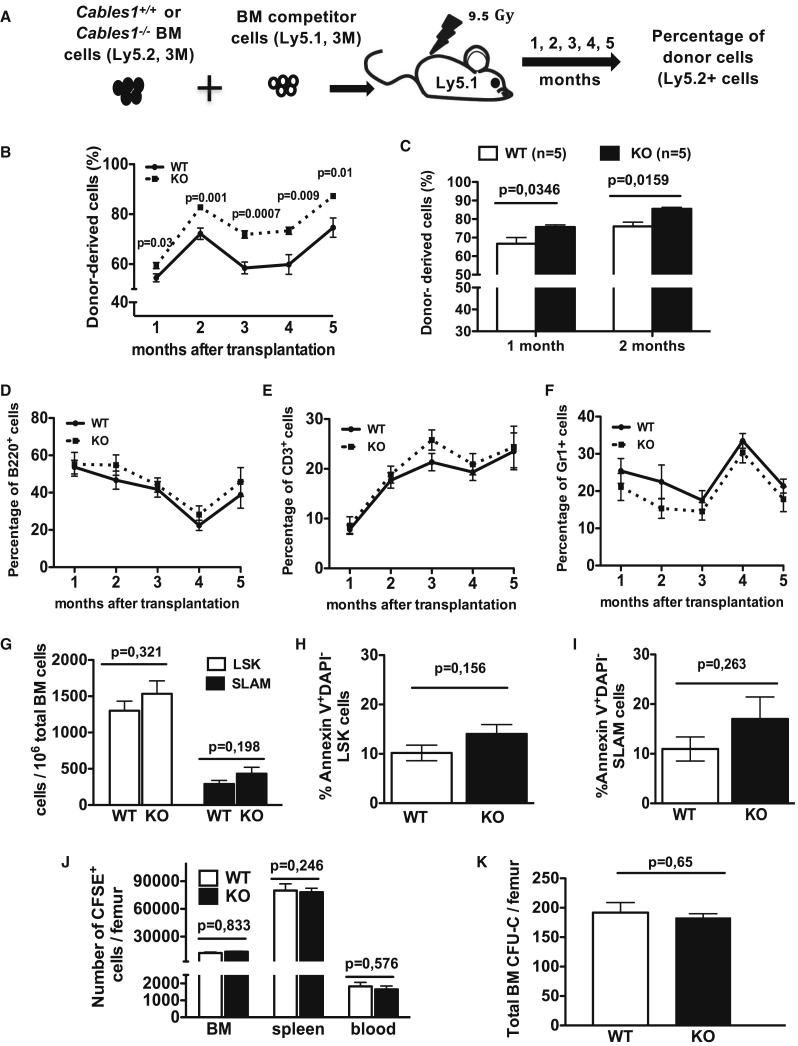
Bone marrow (BM) niche cells help to keep adult hematopoietic stem cells (HSCs) in a quiescent state via secreted factors and induction of cell-cycle inhibitors. Here, we demonstrate that the adapter protein CABLES1 is a key regulator of long-term hematopoietic homeostasis during stress and aging. Young mice lacking Cables1 displayed hyperproliferation of hematopoietic progenitor cells. This defect was cell intrinsic, since it was reproduced in BM transplantation assays using wild-type animals as recipients. Overexpression and short hairpin RNA-mediated depletion of CABLES1 protein resulted in p21 up- and downregulation, respectively. Aged mice lacking Cables1 displayed abnormalities in peripheral blood cell counts accompanied by a significant reduction in HSC compartment, concomitant with an increased mobilization of progenitor cells. In addition, Cables1 mice displayed increased sensitivity to the chemotherapeutic agent 5-fluorouracil due to an abnormal microenvironment. Altogether, our findings uncover a key role for CABLES1 in HSC homeostasis and stress hematopoiesis.
骨髓(BM)龛细胞通过分泌因子和诱导细胞周期抑制剂帮助维持成人造血干细胞(HSCs)处于静止状态。在这里,我们证明衔接蛋白 CABLES1 是应激和衰老期间长期造血稳态的关键调节因子。缺乏 Cables1 的年轻小鼠表现出造血祖细胞的过度增殖。这种缺陷是细胞内在的,因为在用野生型动物作为受者进行 BM 移植实验中重现了该缺陷。CABLES1 蛋白的过表达和短发夹 RNA 介导的耗竭分别导致 p21 的上调和下调。缺乏 Cables1 的老年小鼠表现出外周血细胞计数异常,同时 HSC 区室显著减少,伴随着祖细胞的异常动员。此外,由于异常的微环境,Cables1 小鼠对化疗药物 5-氟尿嘧啶表现出更高的敏感性。总之,我们的研究结果揭示了 CABLES1 在 HSC 稳态和应激造血中的关键作用。