Center for Shared Decision Making and Collaborative Care Research, Division of Medicine, Oslo University Hospital, Oslo, Norway.
Department of Psychiatry and Psychology, College of Medicine and Science, Mayo Clinic, Rochester, MN, USA.
Transl Behav Med. 2020 Aug 7;10(3):770-780. doi: 10.1093/tbm/ibz062.
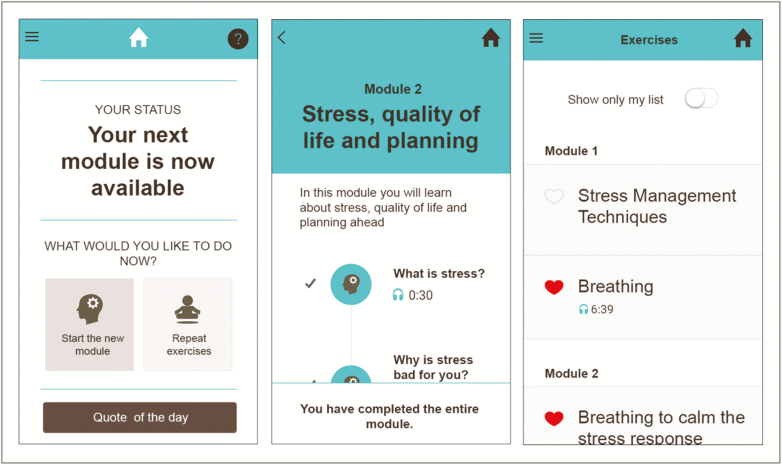
Psychosocial eHealth intervention programs for cancer survivors are still in their infancy, with inconsistent findings so far in the scientific literature. The aim of this study was to explore system use, usefulness, ease of use, and preliminary effects of Stress Proffen, an app-based cognitive-behavioral stress management intervention for patients with cancer. A feasibility pilot project tested the intervention with cancer survivors (N = 25). The intervention contained (a) one face-to-face introduction session, (b) 10 app-based modules with stress management educational material and exercises, and (c) one follow-up phone call. Post-intervention interviews were conducted and user log-data were extracted. Outcome measures-Perceived Stress Scale (PSS), Anxiety and Depression (Hospital Anxiety and Depression Scale [HADS]), Health-Related Quality of Life (HRQoL; SF-36), and Self-Regulatory Fatigue (SRF-18)-were completed at baseline and post-intervention. Participants were primarily women (84%), age 34-71 (mean 48) and represented a variety of cancer diagnoses (majority breast cancer: 40%). Twenty-two participants completed all (pre-post) questionnaires. Sixteen participants (67%) completed at least 7 of 10 modules within the 8-week study period. Post-intervention interviews described StressProffen as providing a new, appreciated, and easily accessible stress management tool for the cancer survivors. Dependent/paired t-tests showed significant pre-post intervention effects with significant decrease in stress (p = .008), anxiety (p = .019), and self-regulatory fatigue (p = .025), and improved HRQoL (Role Physical, General Health, Vitality, and Role Emotional, all p's <.01). App-based stress management interventions such as StressProffen can provide appreciated support for cancer survivors, should be easy to use, can provide significant stress reduction, and improve emotional well-being. Further testing in a randomized controlled trial is warranted and is in progress. Clinicaltrials.gov: NCT0293961.
精神心理电子健康干预方案在癌症幸存者中仍处于起步阶段,目前在科学文献中发现的结果并不一致。本研究旨在探索 StressProffen 的系统使用情况、有用性、易用性和初步效果,StressProffen 是一款基于应用程序的认知行为应激管理干预应用程序,适用于癌症患者。一项可行性试点项目对 25 名癌症幸存者进行了干预测试。该干预措施包括:(a)一次面对面的介绍课程;(b)10 个基于应用程序的模块,包含应激管理教育材料和练习;(c)一次随访电话。干预后进行访谈,并提取用户日志数据。使用以下测量工具评估结果:感知应激量表(PSS)、焦虑和抑郁(医院焦虑和抑郁量表 [HADS])、健康相关生活质量(SF-36)和自我调节疲劳(SRF-18),在基线和干预后完成。参与者主要为女性(84%),年龄 34-71 岁(平均 48 岁),代表多种癌症诊断(多数为乳腺癌:40%)。22 名参与者完成了所有(前后)问卷。16 名参与者(67%)在 8 周的研究期间完成了 10 个模块中的至少 7 个。干预后访谈描述 StressProffen 为癌症幸存者提供了一种新的、值得赞赏的、易于获得的应激管理工具。依赖/配对 t 检验显示,干预后应激(p =.008)、焦虑(p =.019)和自我调节疲劳(p =.025)显著降低,健康相关生活质量(角色身体、一般健康、活力和角色情感,均 p <.01)显著改善。像 StressProffen 这样的基于应用程序的应激管理干预措施可以为癌症幸存者提供有价值的支持,应该易于使用,可以显著减轻压力,改善情绪健康。需要进一步在随机对照试验中进行测试,目前正在进行中。Clinicaltrials.gov:NCT0293961。