Department of Digital Health Research, Division of Medicine, Oslo University Hospital, Oslo, Norway.
Department of Psychiatry and Psychology, College of Medicine and Science, Mayo Clinic, Rochester, Minnesota.
Cancer Med. 2020 Jun;9(11):3775-3785. doi: 10.1002/cam4.3000. Epub 2020 Apr 3.
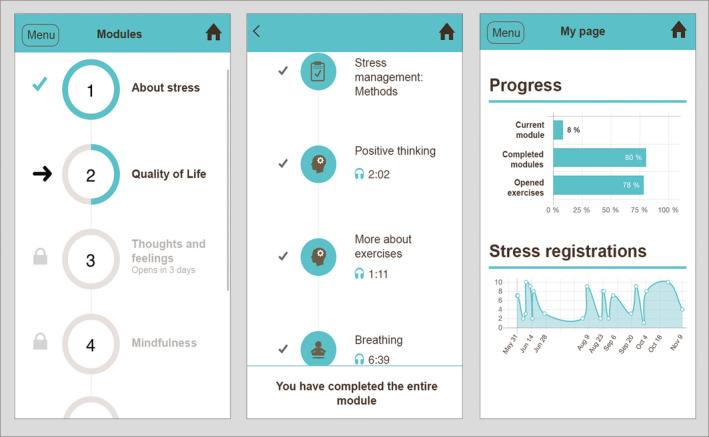
In-person cognitive-behavioral stress-management interventions are consistently associated with reduced cancer distress. However, face-to-face delivery is an access barrier for many patients, and there is a need to develop remote-delivered interventions. The current study evaluated the preliminary efficacy of an application (app)-based cancer stress-management intervention, StressProffen, in a randomized controlled trial.
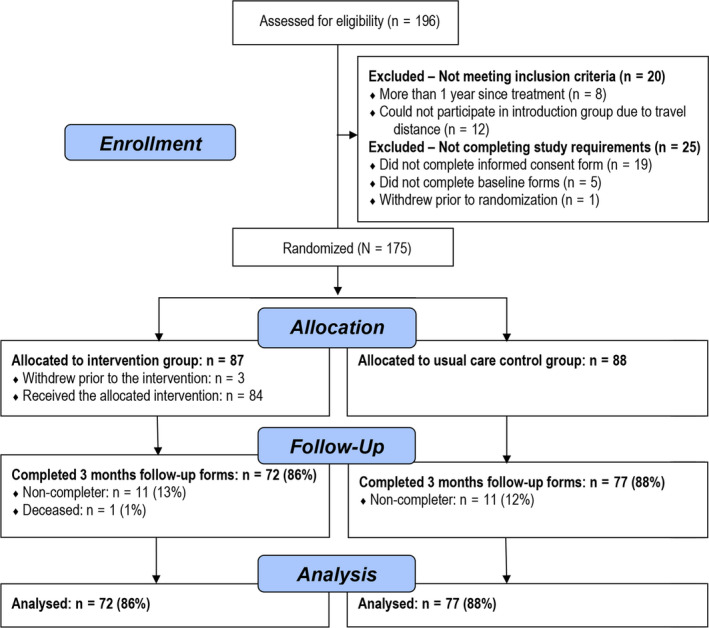
Cancer survivors, maximum 1-year posttreatment (N = 172), were randomized to StressProffen (n = 84) or a usual care control group (n = 88). Participants received a blended delivery care model: (a) one face-to-face introduction session, (b) 10 app-based cognitive-behavioral stress-management modules, and (c) follow-up phone calls at weeks 2-3 and 6-7. Outcome measures included stress (Perceived Stress Scale), anxiety and depression (Hospital Anxiety Depression Scale), and health-related quality of life (HRQoL; Short-Form Health Surveys [SF-36]) at 3-months post-intervention, analyzed with change scores as dependent variables in linear regression models.
Participants were primarily women (82%), aged 20-78 years (mean 52, SD 11.2), with mixed cancer types (majority breast cancer; 48%). Analysis of 149 participants completing questionnaires at baseline and 3 months revealed significant intervention effects: decreased stress (mean difference [MD] -2.8; 95% confidence interval [CI], [-5.2 to -0.4]; P = .022) and improved HRQoL (Role Physical MD = 17.7, [CI 3.7-31.3], P = .013; Social Functioning MD = 8.5, [CI 0.7-16.2], P = .034; Role Emotional MD = 19.5, [CI 3.7-35.2], P = .016; Mental Health MD = 6.7, [CI 1.7-11.6], P = .009). No significant changes were observed for anxiety or depression.
Digital-based cancer stress-management interventions, such as StressProffen, have the potential to provide easily accessible, effective psychosocial support for cancer survivors.
面对面的认知行为压力管理干预措施与癌症患者的压力减轻密切相关。然而,对于许多患者来说,面对面的交流是一种障碍,因此需要开发远程干预措施。本研究通过随机对照试验评估了基于应用程序(app)的癌症压力管理干预措施 StressProffen 的初步疗效。
癌症幸存者(最多在治疗后 1 年内)(N=172)被随机分为 StressProffen 组(n=84)或常规护理对照组(n=88)。参与者接受混合交付护理模式:(a)一次面对面介绍课程;(b)10 个基于应用程序的认知行为压力管理模块;(c)在第 2-3 周和第 6-7 周进行后续电话随访。在干预后 3 个月时,使用线性回归模型分析变化分数作为因变量的压力(感知压力量表)、焦虑和抑郁(医院焦虑抑郁量表)和健康相关生活质量(SF-36 简短健康调查)等指标。
参与者主要为女性(82%),年龄在 20-78 岁之间(平均 52 岁,标准差 11.2),患有多种癌症类型(多数为乳腺癌,占 48%)。对 149 名基线和 3 个月时完成问卷的参与者进行分析,发现干预有显著效果:压力降低(平均差异 [MD] -2.8;95%置信区间 [CI],[-5.2 至-0.4];P=0.022)和生活质量提高(生理职能 MD=17.7,CI [3.7-31.3],P=0.013;社会功能 MD=8.5,CI [0.7-16.2],P=0.034;情感职能 MD=19.5,CI [3.7-35.2],P=0.016;心理健康 MD=6.7,CI [1.7-11.6],P=0.009)。焦虑或抑郁没有显著变化。
基于数字的癌症压力管理干预措施,如 StressProffen,具有为癌症幸存者提供易于获取、有效的社会心理支持的潜力。