Department of Geriatrics and Gerontology, National Taiwan University Hospital, No.1, Changde Street, Taipei 10048, Taiwan.
Institute of Epidemiology and Preventive Medicine, College of Public Health, National Taiwan University, No. 17 Xu-Zhou Road, Taipei 10055, Taiwan.
Nutrients. 2019 Jul 20;11(7):1666. doi: 10.3390/nu11071666.
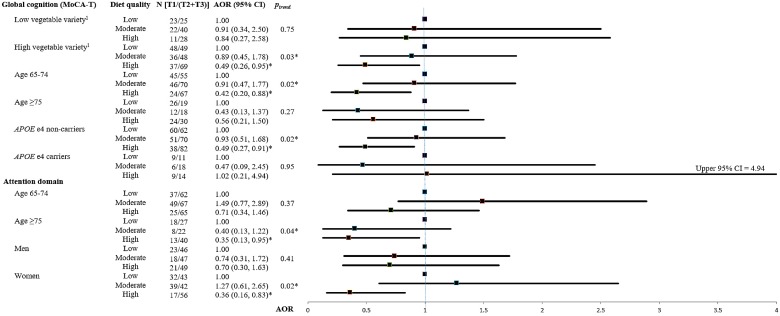
Diet quality plays an important role in dementia prevention. It remains unclear how the joint effect of vegetable variety and diet quality affects cognition. This study aimed to explore the association of diet quality and vegetable variety with cognitive decline in older adults. This prospective cohort study (2011-2015) included 436 community-dwelling elders in Taipei. Diet quality, assessed by the modified Alternative Healthy Eating Index (mAHEI), was computed from a food frequency questionnaire at baseline (2011-2013). Vegetable variety indicated the number of different vegetable groups, adjusted for vegetable quantity. Multivariable linear and logistic regression models were used to explore the association of diet quality and vegetable variety with the decline of global and domain-specific cognition over two years. Our findings suggest that high diet quality (the highest tertile of mAHEI) was associated with a lower risk of both global cognitive decline (adjusted odds ratio (AOR) = 0.54, confidence interval (CI) = 0.31-0.95) and decline of attention domain (AOR = 0.56, CI = 0.32-0.99) compared with low diet quality. In elders with high vegetable variety, high diet quality was associated with a lower risk of global cognitive decline (AOR = 0.49, CI = 0.26-0.95). We therefore concluded that high diet quality along with diverse vegetable intake was associated with a lower risk of cognitive decline in older adults.
饮食质量在预防痴呆症方面起着重要作用。目前尚不清楚蔬菜种类和饮食质量的综合效应如何影响认知。本研究旨在探讨饮食质量和蔬菜种类与老年人认知能力下降的关系。这项前瞻性队列研究(2011-2015 年)纳入了台北市 436 名社区居住的老年人。饮食质量通过改良替代健康饮食指数(mAHEI),根据基线时(2011-2013 年)的食物频率问卷进行评估。蔬菜种类表示不同蔬菜组的数量,根据蔬菜量进行调整。采用多变量线性和逻辑回归模型探讨饮食质量和蔬菜种类与两年内全球和特定领域认知下降的关系。我们的研究结果表明,高饮食质量(mAHEI 的最高三分位)与全球认知下降(调整后的优势比(AOR)=0.54,95%置信区间(CI)=0.31-0.95)和注意力域下降(AOR=0.56,95%CI=0.32-0.99)的风险降低相关,与低饮食质量相比。在蔬菜种类较高的老年人中,高饮食质量与全球认知下降的风险降低相关(AOR=0.49,95%CI=0.26-0.95)。因此,我们得出结论,高饮食质量与多样化的蔬菜摄入与老年人认知能力下降的风险降低相关。