ANSES, French Agency for Food, Environmental and Occupational Health and Safety, Fougères Laboratory, Toxicology of contaminants unit, 10 B rue Claude Bourgelat, Fougères, 35306, France.
ANSES, French Agency for Food, Environmental and Occupational Health and Safety, Fougères Laboratory, Analysis of residues and contaminants unit, 10 B rue Claude Bourgelat, Fougères, 35306, France.
Sci Rep. 2019 Jul 22;9(1):10548. doi: 10.1038/s41598-019-47114-7.
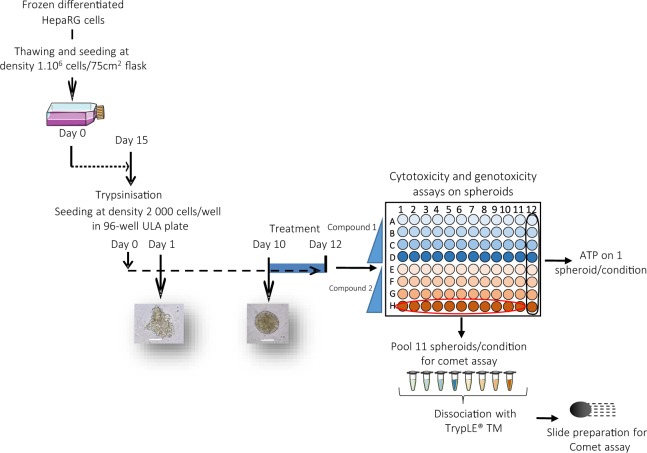
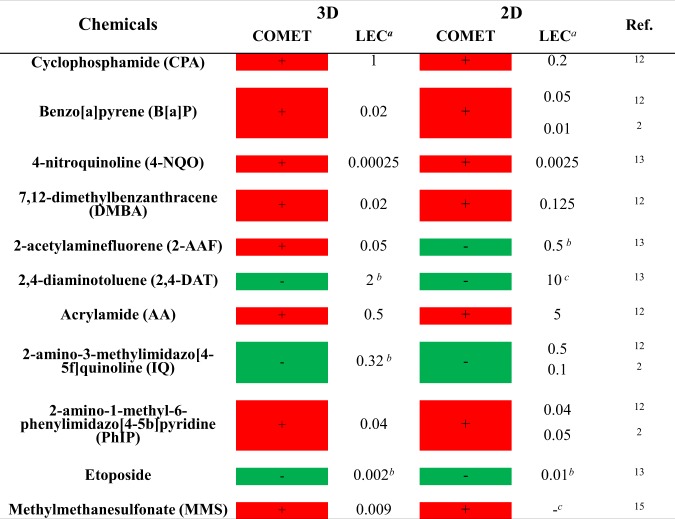
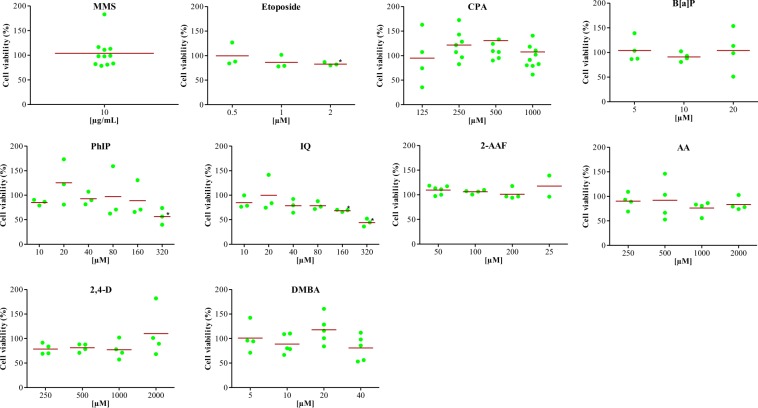
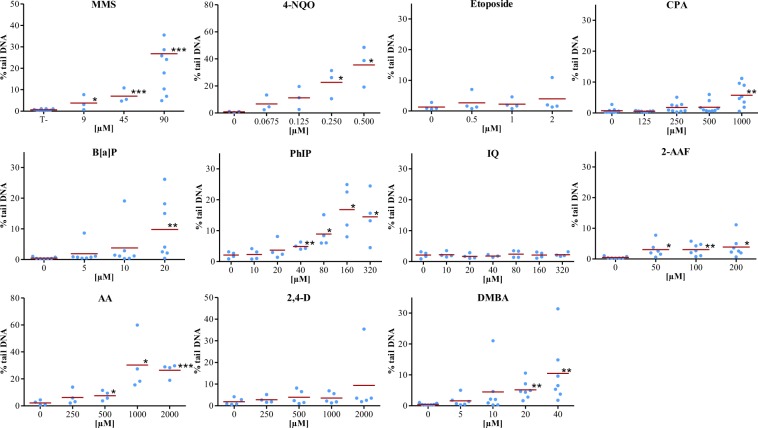
Many efforts have been made in the last 30 years to develop more relevant in vitro models to study genotoxic responses of drugs and environmental contaminants. While 2D HepaRG cells are one of the most promising models for liver toxicology, a switch to 3D cultures that integrate both in vivo architecture and cell-cell interactions has occurred to achieve even more predictive models. Preliminary studies have indicated that 3D HepaRG cells are suitable for liver toxicity screening. Our study aimed to evaluate the response of HepaRG spheroids exposed to various genotoxic compounds using the single cell gel electrophoresis assay. HepaRG spheroids were used at 10 days after seeding and exposed for 24 and 48 hours to certain selected chemical compounds (methylmethansulfonate (MMS), etoposide, benzo[a]pyrene (B[a]P), cyclophosphamide (CPA), 7,12-dimethylbenz[a]anthracene (DMBA), 2-acetylaminofluorene (2-AAF), 4-nitroquinoline (4-NQO), 2-amino-1-methyl-6-phenylimidazo[4,5-b]pyridine (PhIP), 2-amino-3-methylimidazo[4,5-f]quinolone (IQ), acrylamide, and 2-4-diaminotoluene (2,4-DAT)). After treatment, the comet assay was performed on single cell suspensions and cytotoxicity was determined by the ATP assay. Comet formation was observed for all compounds except IQ, etoposide and 2,4-DAT. Treatment of spheroids with rifampicin increased CYP3A4 activity, demonstrating the metabolic capacity of HepaRG spheroids. These data on genotoxicity in 3D HepaRG spheroids are promising, but further experiments are required to prove that this model can improve the predictivity of in vitro models to detect human carcinogens.
在过去的 30 年中,人们做出了许多努力来开发更相关的体外模型,以研究药物和环境污染物的遗传毒性反应。虽然 2D HepaRG 细胞是肝毒理学最有前途的模型之一,但为了实现更具预测性的模型,已经出现了向整合体内结构和细胞间相互作用的 3D 培养物的转变。初步研究表明,3D HepaRG 细胞适合用于肝脏毒性筛选。我们的研究旨在使用单细胞凝胶电泳测定法评估暴露于各种遗传毒性化合物的 HepaRG 球体的反应。HepaRG 球体在接种后 10 天使用,并分别暴露于选定的化学化合物(甲磺酸甲酯(MMS)、依托泊苷、苯并[a]芘(B[a]P)、环磷酰胺(CPA)、7,12-二甲基苯并[a]蒽(DMBA)、2-乙酰氨基芴(2-AAF)、4-硝基喹啉(4-NQO)、2-氨基-1-甲基-6-苯基咪唑[4,5-b]吡啶(PhIP)、2-氨基-3-甲基咪唑[4,5-f]喹啉(IQ)、丙烯酰胺和 2,4-二氨基甲苯(2,4-DAT))24 和 48 小时。处理后,对单细胞悬浮液进行彗星试验,并通过 ATP 测定法测定细胞毒性。除 IQ、依托泊苷和 2,4-DAT 外,所有化合物均观察到彗星形成。用利福平处理球体增加了 CYP3A4 活性,证明了 HepaRG 球体的代谢能力。这些关于 3D HepaRG 球体遗传毒性的研究数据很有前景,但需要进一步的实验来证明该模型可以提高体外模型检测人类致癌物的预测性。