Manchester Centre for Health Psychology, School of Health Sciences, University of Manchester, Manchester, M13 9PL, United Kingdom.
Nightingale Centre, Manchester University NHS Foundation Trust, Manchester, M23 9LT, United Kingdom.
Br J Cancer. 2019 Aug;121(4):351-358. doi: 10.1038/s41416-019-0524-4. Epub 2019 Jul 23.
This is the first review to identify, appraise and synthesise women's experiences of having a false-positive breast screening test result.
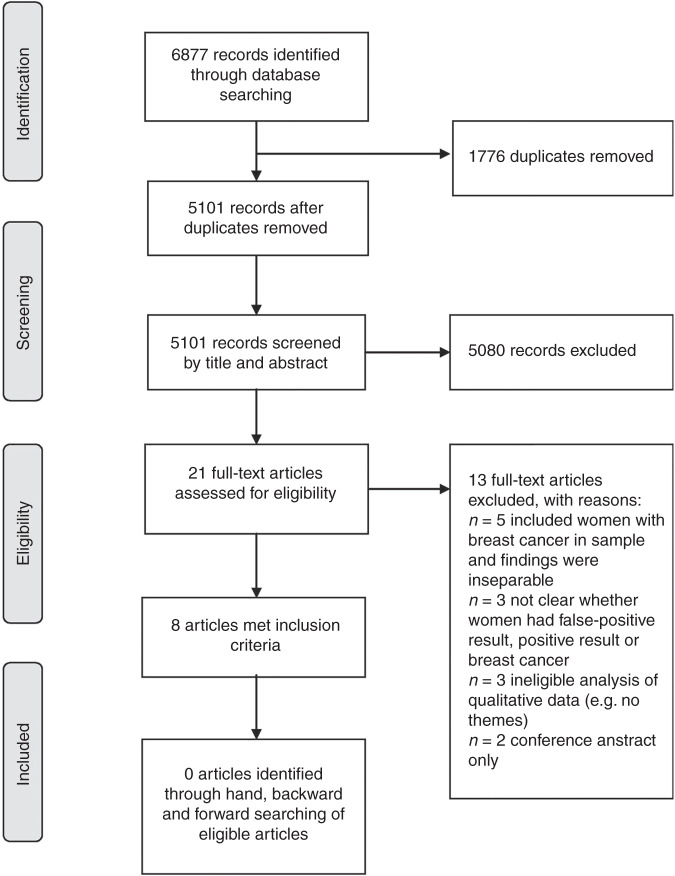
We systematically searched eight databases for qualitative research reporting women's experiences of receiving a false-positive screening test result. Two reviewers independently screened articles. Eight papers reporting seven studies were included. Study quality was appraised. Data were thematically synthesised.
Women passively attended screening in order to prove their perceived good health. Consequently, being recalled was unexpected, shocking and disempowering: women felt without options. They endured great uncertainty and stress and sought clarity about their health (e.g. by scrutinising the wording of recall letters and conversations with healthcare professionals). Their result was accompanied by relief and welcome feelings of certainty about their health, but some received unclear explanations of their result, contributing to lasting breast cancer-related worry and an ongoing need for further reassurance.
The organisation of breast screening programmes may constrain choice for women: they became passive recipients. The way healthcare professionals verbally communicate results to women may contribute to lasting breast cancer-related worry. Women need more reassurance, emotional support and answers to their questions before and during screening assessment, and after receiving their result.
这是第一项旨在识别、评价和综合女性对假阳性乳房筛查检测结果的体验的综述。
我们系统地在 8 个数据库中搜索定性研究,以报告女性对假阳性筛查检测结果的体验。两名评审员独立筛选文章。最终纳入 8 篇报告 7 项研究的论文。评价了研究质量。对数据进行了主题综合。
女性为了证明自己所谓的健康,被动地参加了筛查。因此,被召回是出乎意料、令人震惊和剥夺权力的:女性感到别无选择。她们承受着巨大的不确定性和压力,并寻求对自己健康状况的明确信息(例如,仔细审查召回信的措辞以及与医疗保健专业人员的对话)。检测结果呈阳性后,她们感到如释重负,对自己的健康状况感到安心,但有些人没有得到明确的检测结果解释,这导致了持续的与乳腺癌相关的担忧,以及对进一步保证的持续需求。
乳房筛查项目的组织可能限制了女性的选择:她们成为了被动的接受者。医疗保健专业人员与女性口头沟通检测结果的方式可能会导致持续的与乳腺癌相关的担忧。女性在筛查评估之前、期间和之后需要更多的保证、情感支持和对她们问题的答案。