Department of Gastroenterology, The First Affiliated Hospital, College of Medicine, Zhejiang University, 79 Qingchun Road, Hangzhou, 310003, China.
Department of Gastroenterology, Yuyao People's Hospital, Yuyao, China.
Gastric Cancer. 2020 Jan;23(1):126-132. doi: 10.1007/s10120-019-00992-2. Epub 2019 Jul 22.
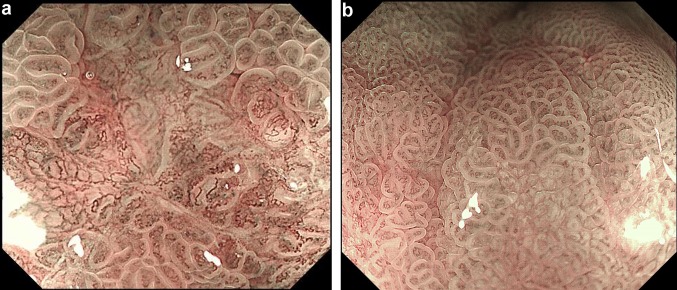
Magnifying endoscopy with narrow band imaging (M-NBI) has been applied to examine early gastric cancer by observing microvascular architecture and microsurface structure of gastric mucosal lesions. However, the diagnostic efficacy of non-experts in differentiating early gastric cancer from non-cancerous lesions by M-NBI remained far from satisfactory. In this study, we developed a new system based on convolutional neural network (CNN) to analyze gastric mucosal lesions observed by M-NBI.
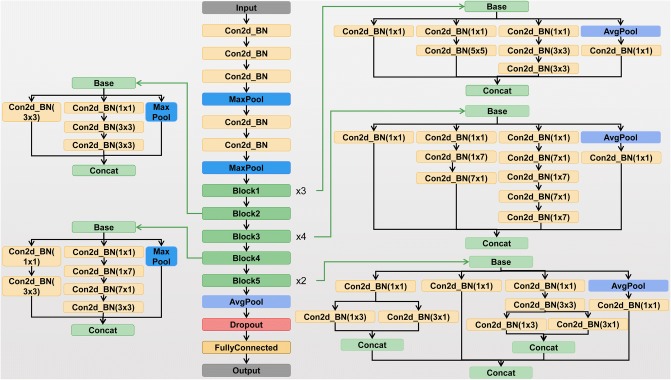
A total of 386 images of non-cancerous lesions and 1702 images of early gastric cancer were collected to train and establish a CNN model (Inception-v3). Then a total of 341 endoscopic images (171 non-cancerous lesions and 170 early gastric cancer) were selected to evaluate the diagnostic capabilities of CNN and endoscopists. Primary outcome measures included diagnostic accuracy, sensitivity, specificity, positive predictive value, and negative predictive value.
The sensitivity, specificity, and accuracy of CNN system in the diagnosis of early gastric cancer were 91.18%, 90.64%, and 90.91%, respectively. No significant difference was spotted in the specificity and accuracy of diagnosis between CNN and experts. However, the diagnostic sensitivity of CNN was significantly higher than that of the experts. Furthermore, the diagnostic sensitivity, specificity and accuracy of CNN were significantly higher than those of the non-experts.
Our CNN system showed high accuracy, sensitivity and specificity in the diagnosis of early gastric cancer. It is anticipated that more progress will be made in optimization of the CNN diagnostic system and further development of artificial intelligence in the medical field.
窄带成像放大内镜(M-NBI)通过观察胃黏膜病变的微血管结构和黏膜表面结构,已被应用于检查早期胃癌。然而,非专家通过 M-NBI 区分早期胃癌与非癌性病变的诊断效能仍远未令人满意。在本研究中,我们开发了一种基于卷积神经网络(CNN)的新系统,用于分析 M-NBI 观察到的胃黏膜病变。
共收集了 386 张非癌性病变图像和 1702 张早期胃癌图像,用于训练和建立 CNN 模型(Inception-v3)。然后,共选择了 341 张内镜图像(171 张非癌性病变和 170 张早期胃癌)来评估 CNN 和内镜医生的诊断能力。主要观察指标包括诊断准确性、敏感度、特异度、阳性预测值和阴性预测值。
CNN 系统诊断早期胃癌的敏感度、特异度和准确率分别为 91.18%、90.64%和 90.91%。CNN 与专家在诊断的特异度和准确率方面无显著差异。然而,CNN 的诊断敏感度明显高于专家。此外,CNN 的诊断敏感度、特异度和准确率均明显高于非专家。
我们的 CNN 系统在诊断早期胃癌方面具有较高的准确性、敏感度和特异度。预计在优化 CNN 诊断系统和进一步开发医学人工智能方面将取得更多进展。