Kasthurirathne Suranga N, Biondich Paul G, Grannis Shaun J, Purkayastha Saptarshi, Vest Joshua R, Jones Josette F
Center for Biomedical Informatics, Regenstrief Institute, Indianapolis, IN, United States.
Indiana University Fairbanks School of Public Health, Indianapolis, IN, United States.
J Med Internet Res. 2019 Jul 22;21(7):e13809. doi: 10.2196/13809.
As the most commonly occurring form of mental illness worldwide, depression poses significant health and economic burdens to both the individual and community. Different types of depression pose different levels of risk. Individuals who suffer from mild forms of depression may recover without any assistance or be effectively managed by primary care or family practitioners. However, other forms of depression are far more severe and require advanced care by certified mental health providers. However, identifying cases of depression that require advanced care may be challenging to primary care providers and health care team members whose skill sets run broad rather than deep.
This study aimed to leverage a comprehensive range of patient-level diagnostic, behavioral, and demographic data, as well as past visit history data from a statewide health information exchange to build decision models capable of predicting the need of advanced care for depression across patients presenting at Eskenazi Health, the public safety net health system for Marion County, Indianapolis, Indiana.
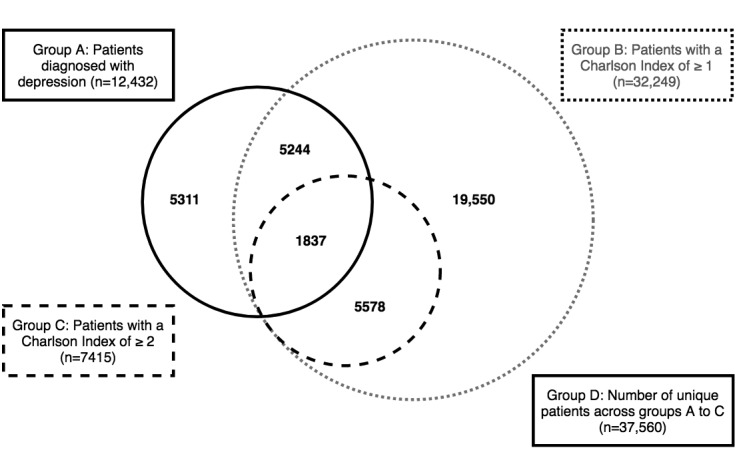
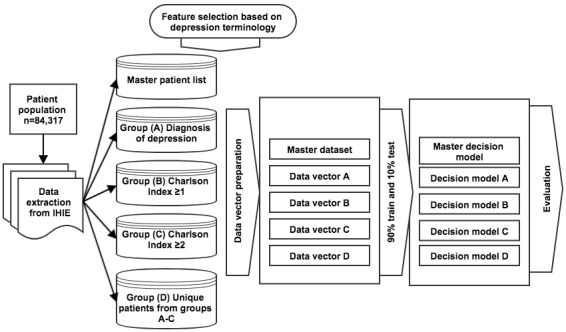
Patient-level diagnostic, behavioral, demographic, and past visit history data extracted from structured datasets were merged with outcome variables extracted from unstructured free-text datasets and were used to train random forest decision models that predicted the need of advanced care for depression across (1) the overall patient population and (2) various subsets of patients at higher risk for depression-related adverse events; patients with a past diagnosis of depression; patients with a Charlson comorbidity index of ≥1; patients with a Charlson comorbidity index of ≥2; and all unique patients identified across the 3 above-mentioned high-risk groups.
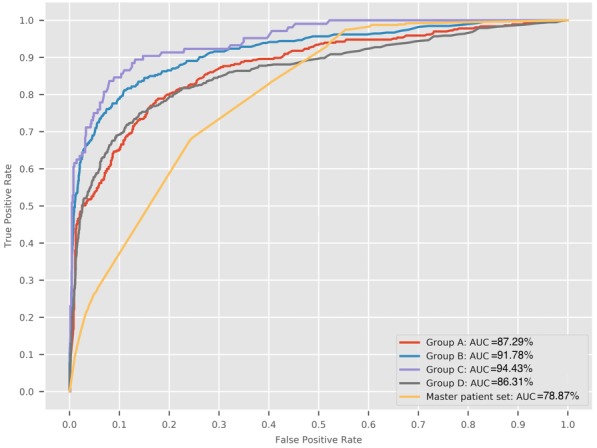
The overall patient population consisted of 84,317 adult (aged ≥18 years) patients. A total of 6992 (8.29%) of these patients were in need of advanced care for depression. Decision models for high-risk patient groups yielded area under the curve (AUC) scores between 86.31% and 94.43%. The decision model for the overall patient population yielded a comparatively lower AUC score of 78.87%. The variance of optimal sensitivity and specificity for all decision models, as identified using Youden J Index, is as follows: sensitivity=68.79% to 83.91% and specificity=76.03% to 92.18%.
This study demonstrates the ability to automate screening for patients in need of advanced care for depression across (1) an overall patient population or (2) various high-risk patient groups using structured datasets covering acute and chronic conditions, patient demographics, behaviors, and past visit history. Furthermore, these results show considerable potential to enable preventative care and can be easily integrated into existing clinical workflows to improve access to wraparound health care services.
作为全球最常见的精神疾病形式,抑郁症给个人和社区带来了重大的健康和经济负担。不同类型的抑郁症带来不同程度的风险。患有轻度抑郁症的个体可能无需任何帮助即可康复,或由初级保健医生或家庭医生有效管理。然而,其他形式的抑郁症则更为严重,需要获得认证的心理健康提供者提供的高级护理。然而,对于技能广泛而非深入的初级保健提供者和医疗团队成员来说,识别需要高级护理的抑郁症病例可能具有挑战性。
本研究旨在利用一系列全面的患者层面诊断、行为和人口统计学数据,以及来自全州健康信息交换的既往就诊历史数据,构建决策模型,以预测印第安纳波利斯市马里恩县公共安全网医疗系统埃斯凯纳齐健康中心就诊的患者中,哪些需要针对抑郁症的高级护理。
从结构化数据集中提取的患者层面诊断、行为、人口统计学和既往就诊历史数据,与从未结构化自由文本数据集中提取的结果变量合并,并用于训练随机森林决策模型,以预测(1)总体患者群体以及(2)抑郁症相关不良事件风险较高的各类患者亚组中,哪些患者需要针对抑郁症的高级护理;既往诊断为抑郁症的患者;查尔森合并症指数≥1的患者;查尔森合并症指数≥2的患者;以及在上述三个高风险组中识别出的所有独特患者。
总体患者群体包括84317名成年(年龄≥18岁)患者。其中共有6992名(8.29%)患者需要针对抑郁症的高级护理。高风险患者组的决策模型曲线下面积(AUC)得分在86.31%至94.43%之间。总体患者群体的决策模型AUC得分相对较低,为78.87%。使用约登指数确定的所有决策模型的最佳敏感性和特异性方差如下:敏感性=68.79%至83.91%,特异性=76.03%至92.18%。
本研究表明,利用涵盖急性和慢性疾病情况、患者人口统计学、行为及既往就诊历史的结构化数据集,能够自动筛查(1)总体患者群体或(2)各类高风险患者群体中需要针对抑郁症进行高级护理的患者。此外,这些结果显示出在实现预防性护理方面具有相当大的潜力,并且可以轻松整合到现有的临床工作流程中,以改善获得全面医疗服务的机会。