Giannini Lucia A A, Xie Sharon X, Peterson Claire, Zhou Cecilia, Lee Edward B, Wolk David A, Grossman Murray, Trojanowski John Q, McMillan Corey T, Irwin David J
Penn Digital Neuropathology Laboratory, Department of Neurology, Perelman School of Medicine, University of Pennsylvania, Philadelphia, PA, United States.
Penn Frontotemporal Degeneration Center, Department of Neurology, Perelman School of Medicine, University of Pennsylvania, Philadelphia, PA, United States.
Front Neurosci. 2019 Jul 3;13:682. doi: 10.3389/fnins.2019.00682. eCollection 2019.
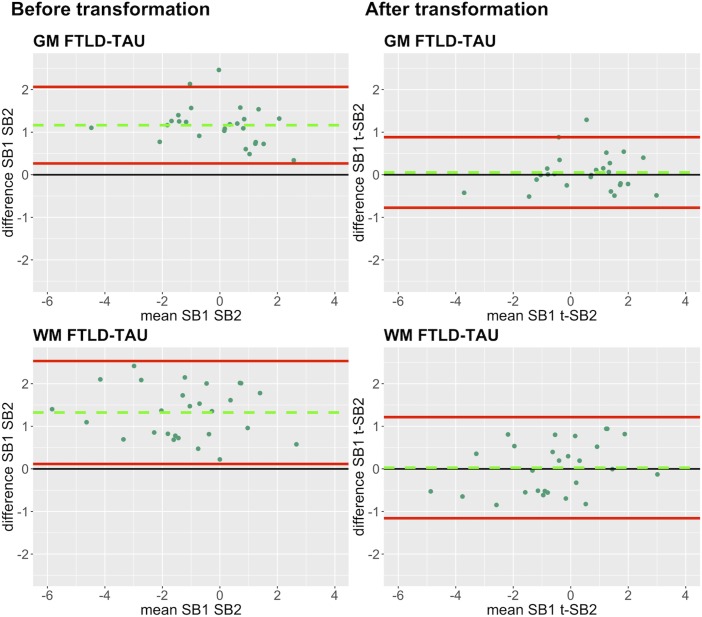
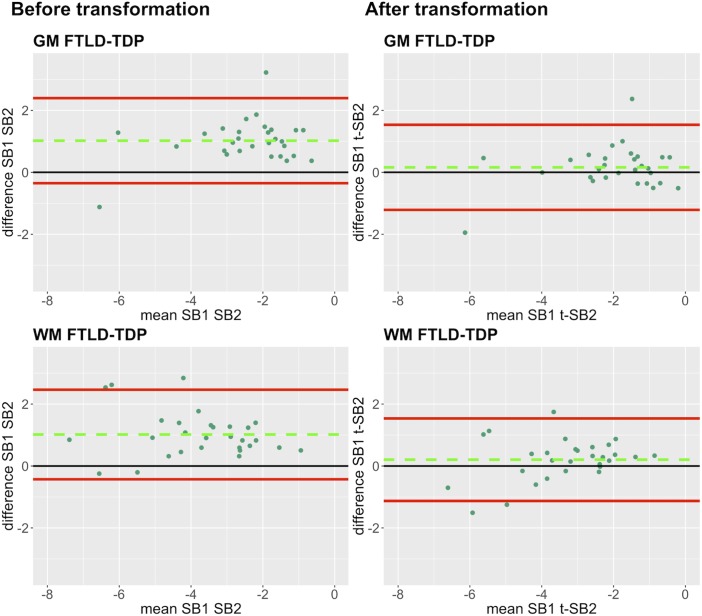
Digital pathology is increasingly prominent in neurodegenerative disease research, but variability in immunohistochemical staining intensity between staining batches prevents large-scale comparative studies. Here we provide a statistically rigorous method to account for staining batch effects in a large sample of brain tissue with frontotemporal lobar degeneration with tau inclusions (FTLD-Tau, = 39) or TDP-43 inclusions (FTLD-TDP, = 53). We analyzed the relationship between duplicate measurements of digital pathology, i.e., percent area occupied by pathology (%AO) for grey matter (GM) and white matter (WM), from two distinct staining batches. We found a significant difference in duplicate measurements from distinct staining batches in FTLD-Tau (mean difference: GM = 1.13 ± 0.44, WM = 1.28 ± 0.56; < 0.001) and FTLD-TDP (GM = 0.95 ± 0.66, WM = 0.90 ± 0.77; < 0.001), and these measurements were linearly related (R-squared [Rsq]: FTLD-Tau GM = 0.92, WM = 0.92; FTLD-TDP GM = 0.75, WM = 0.78; < 0.001 all). We therefore used linear regression to transform %AO from distinct staining batches into equivalent values. Using a train-test set design, we examined transformation prerequisites (i.e., Rsq) from linear-modeling in training sets, and we applied equivalence factors (i.e., beta, intercept) to independent testing sets to determine transformation outcomes (i.e., intraclass correlation coefficient [ICC]). First, random iterations (×100) of linear regression showed that smaller training sets ( = 12-24), feasible for prospective use, have acceptable transformation prerequisites (mean Rsq: FTLD-Tau ≥0.9; FTLD-TDP ≥0.7). When cross-validated on independent complementary testing sets, in FTLD-Tau, = 12 training sets resulted in 100% of GM and WM transformations with optimal transformation outcomes (ICC ≥ 0.8), while in FTLD-TDP = 24 training sets resulted in optimal ICC in testing sets (GM = 72%, WM = 98%). We therefore propose training sets of = 12 in FTLD-Tau and = 24 in FTLD-TDP for prospective transformations. Finally, the transformation enabled us to significantly reduce batch-related difference in duplicate measurements in FTLD-Tau (GM/WM: < 0.001 both) and FTLD-TDP (GM/WM: < 0.001 both), and to decrease the necessary sample size estimated in a power analysis in FTLD-Tau (GM:-40%; WM: -34%) and FTLD-TDP (GM: -20%; WM: -30%). Finally, we tested generalizability of our approach using a second, open-source, image analysis platform and found similar results. We concluded that a small sample of tissue stained in duplicate can be used to account for pre-analytical variability such as staining batch effects, thereby improving methods for future studies.
数字病理学在神经退行性疾病研究中日益突出,但染色批次之间免疫组织化学染色强度的变异性阻碍了大规模的比较研究。在此,我们提供了一种统计严格的方法,以考虑在大量伴有tau包涵体的额颞叶痴呆(FTLD-Tau,n = 39)或TDP-43包涵体(FTLD-TDP,n = 53)的脑组织样本中的染色批次效应。我们分析了来自两个不同染色批次的数字病理学重复测量值之间的关系,即灰质(GM)和白质(WM)中病理所占面积百分比(%AO)。我们发现在FTLD-Tau(平均差异:GM = 1.13±0.44,WM = 1.28±0.56;p < 0.001)和FTLD-TDP(GM = 0.95±0.66,WM = 0.90±0.77;p < 0.001)中,不同染色批次的重复测量值存在显著差异,并且这些测量值呈线性相关(决定系数[Rsq]:FTLD-Tau GM = 0.92,WM = 0.92;FTLD-TDP GM = 0.75,WM = 0.78;所有p < 0.001)。因此,我们使用线性回归将来自不同染色批次的%AO转换为等效值。采用训练集-测试集设计,我们在训练集中检查了线性建模的转换前提条件(即Rsq),并将等效因子(即β,截距)应用于独立测试集以确定转换结果(即组内相关系数[ICC])。首先,线性回归的随机迭代(×100)表明,较小的训练集(n = 12 - 24),适用于前瞻性使用,具有可接受的转换前提条件(平均Rsq:FTLD-Tau≥0.9;FTLD-TDP≥0.7)。当在独立的互补测试集上进行交叉验证时,在FTLD-Tau中,n = 12的训练集导致100%的GM和WM转换具有最佳转换结果(ICC≥0.8),而在FTLD-TDP中,n = 24的训练集导致测试集中的最佳ICC(GM = 72%,WM = 98%)。因此,我们建议在FTLD-Tau中使用n = 12的训练集,在FTLD-TDP中使用n = 24的训练集进行前瞻性转换。最后,这种转换使我们能够显著降低FTLD-Tau(GM/WM:两者p < 0.001)和FTLD-TDP(GM/WM:两者p < 0.001)中重复测量值与批次相关的差异,并减少FTLD-Tau(GM:-40%;WM:-34%)和FTLD-TDP(GM:-20%;WM:-30%)功效分析中估计所需的样本量。最后,我们使用第二个开源图像分析平台测试了我们方法的可推广性,并得到了类似的结果。我们得出结论,一小份重复染色的组织样本可用于考虑诸如染色批次效应等分析前的变异性,从而改进未来研究的方法。