Huntsman Richard J, Tang-Wai Richard, Alcorn Jane, Vuong Stephanie, Acton Bryan, Corley Scott, Laprairie Robert, Lyon Andrew W, Meier Simona, Mousseau Darrell D, Newmeyer Doris, Prosser-Loose Erin, Seifert Blair, Tellez-Zenteno Jose, Huh Linda, Leung Edward, Major Philippe
Cannabinoid Research Initiative of Saskatchewan, University of Saskatchewan, Saskatoon, SK, Canada.
Department of Pediatrics, Royal University Hospital, University of Saskatchewan, Saskatoon, SK, Canada.
Front Neurol. 2019 Jul 3;10:716. doi: 10.3389/fneur.2019.00716. eCollection 2019.
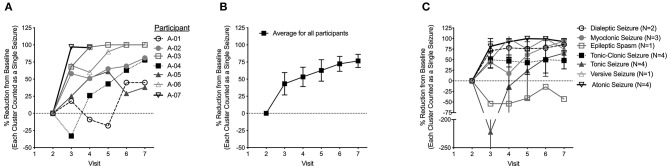
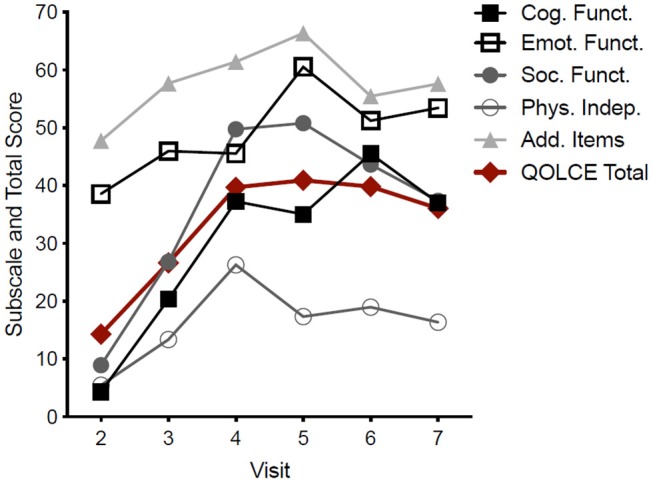
There is uncertainty regarding the appropriate dose of Cannabidiol (CBD) for childhood epilepsy. We present the preliminary data of seven participants from the Cannabidiol in Children with Refractory Epileptic Encephalopathy (CARE-E) study. The study is an open-label, prospective, dose-escalation trial. Participants received escalating doses of a Herbal Extract (CHE) preparation of 1:20 Δ-tetrahydrocannabinol (THC): CBD up to 10-12 mg CBD/kg/day. Seizure frequency was monitored in daily logs, participants underwent regular electroencephalograms, and parents filled out modified Quality of Life in Childhood Epilepsy (QOLCE) and Side Effect rating scale questionnaires. Steady-state trough levels (C) of selected cannabinoids were quantified. All seven participants tolerated the CHE up to 10-12 mg CBD/kg/day and had improvements in seizure frequency and QOLCE scores. C plasma levels for CBD, THC, and cannabichromene (CBC) showed dose-independent pharmacokinetics in all but one participant. C CBD levels associated with a >50% reduction in seizures and seizure freedom were lower than those reported previously with purified CBD. In most patients, C levels of THC remained lower than what would be expected to cause intoxication. The preliminary data suggest an initial CBD target dose of 5-6 mg/kg/day when a 1:20 THC:CBD CHE is used. Possible non-linear pharmacokinetics of CBD and CBC needs investigation. The reduction in seizure frequency seen suggests improved seizure control when a whole plant CHE is used. Plasma THC levels suggest a low risk of THC intoxication when a 1:20 THC:CBD CHE is used in doses up to 12 mg/kg CBD/kg/day.
关于儿童癫痫中大麻二酚(CBD)的合适剂量存在不确定性。我们展示了难治性癫痫性脑病患儿大麻二酚(CARE-E)研究中7名参与者的初步数据。该研究是一项开放标签、前瞻性、剂量递增试验。参与者接受递增剂量的1:20 Δ-四氢大麻酚(THC):CBD草药提取物(CHE)制剂,最高剂量达10 - 12毫克CBD/千克/天。通过每日日志监测癫痫发作频率,参与者接受定期脑电图检查,家长填写改良的儿童癫痫生活质量(QOLCE)和副作用评分量表问卷。对选定大麻素的稳态谷浓度(C)进行了定量分析。所有7名参与者都耐受了高达10 - 12毫克CBD/千克/天的CHE,癫痫发作频率和QOLCE评分均有改善。除一名参与者外,CBD、THC和大麻色烯(CBC)的C血浆水平显示出剂量非依赖性药代动力学。与癫痫发作减少>50%和无癫痫发作相关的C CBD水平低于先前报道的纯化CBD水平。在大多数患者中,THC的C水平仍低于预期会导致中毒的水平。初步数据表明,当使用1:20 THC:CBD CHE时,CBD的初始目标剂量为5 - 6毫克/千克/天。CBD和CBC可能的非线性药代动力学需要进一步研究。癫痫发作频率的降低表明,使用全植物CHE时癫痫控制得到改善。血浆THC水平表明,当以高达12毫克/千克CBD/千克/天的剂量使用1:20 THC:CBD CHE时,THC中毒风险较低。