Lee Eun-Young, Carson Valerie, Jeon Justin Y, Spence John C, Tremblay Mark S
School of Kinesiology and Health Studies, Queen's University, Kingston ON K7L 2N9, Canada.
Faculty of Kinesiology, Sport, and Recreation, University of Alberta, Edmonton AB T6G 2H9, Canada.
J Sport Health Sci. 2019 Jul;8(4):376-385. doi: 10.1016/j.jshs.2018.11.007. Epub 2018 Dec 1.
This study aimed to examine the levels and correlates of 24-h movement behaviors (i.e., physical activity, sedentary time, and sleep), and different patterns of these behaviors in a nationally representative sample of South Koreans aged 12 years and older. This study also aimed to examine the sociodemographic correlates of 24-h movement behaviors stratified by age groups.
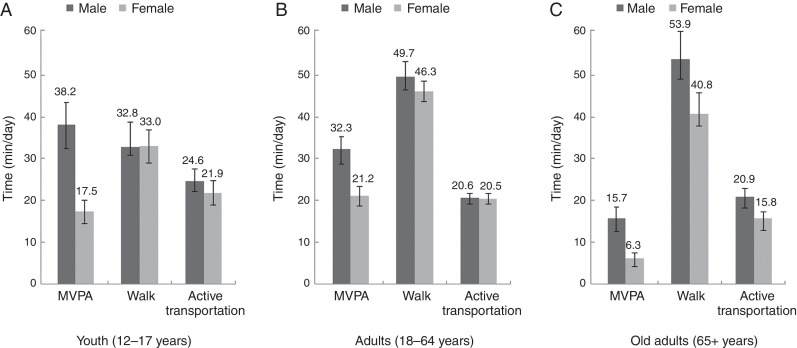
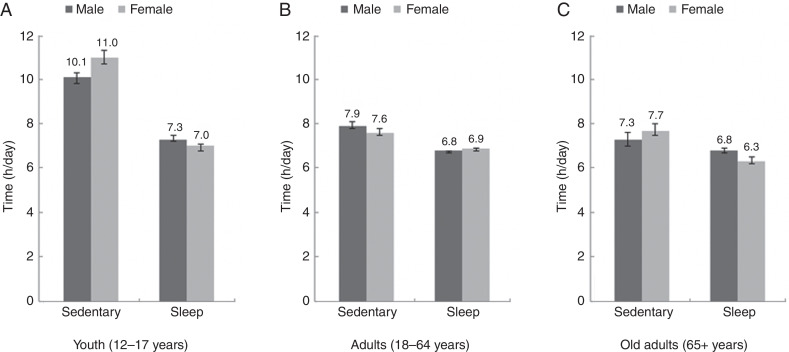
Self-reported, repeated cross-sectional data from 10,708 participants in the 2014 and 2015 Korea National Health and Nutrition Examination surveys were used. Key variables included moderate-to-vigorous intensity physical activity, muscular strengthening exercises, walking, active transportation, sedentary time, and sleep. Sociodemographic variables included age, sex, household income, area of residence, and education level. Descriptive statistics by sex and age as well as general linear models by age group were performed.
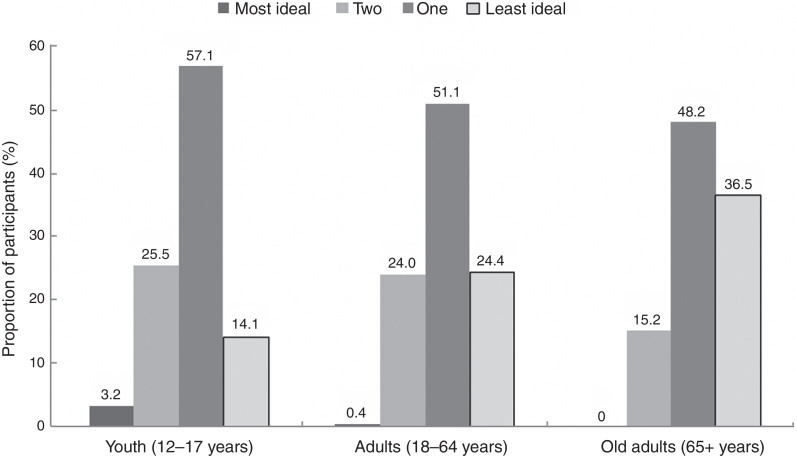
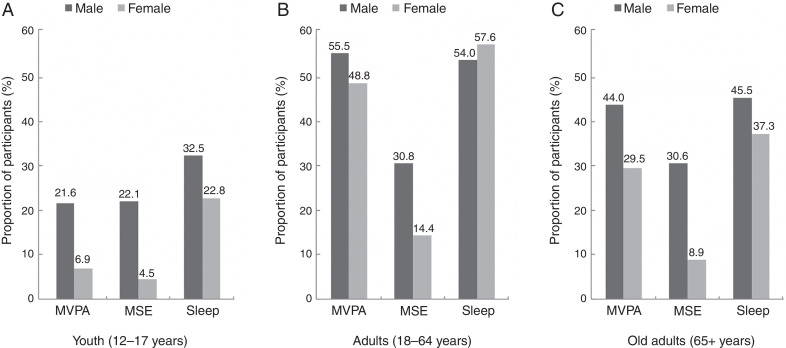
The proportions of individuals meeting the moderate-to-vigorous intensity physical activity, muscular strengthening exercises, and sleep guidelines were, respectively, 21.6%, 22.1%, and 32.5% in male youth; 6.9%, 4.5%, and 22.8% in female youth; 55.5%, 30.8%, and 54.0% in male adults; 48.8%, 14.4%, and 57.6% in female adults; 44.0%, 30.6%, and 45.5% in male older adults; and 29.5%, 8.9%, and 37.3% in female older adults. The proportions of individuals showing the most ideal combinations of 24-h movement behaviors were only 3.2% in youth, 0.4% in adults, and 0 in older adults. Universally, older age, female sex, or living in metro Seoul were associated with unfavorable patterns of 24-h movement behaviors across different age groups. However, the associations of income and education with movement behaviors were mixed across age groups.
Overall, the proportion of South Koreans with a healthy 24-h movement behavior pattern is low. The sociodemographic correlates of different types of 24-h movement behaviors should be considered when designing targeted interventions for the promotion of healthy active living for South Koreans.
本研究旨在调查12岁及以上韩国全国代表性样本中24小时运动行为(即身体活动、久坐时间和睡眠)的水平及其相关因素,以及这些行为的不同模式。本研究还旨在调查按年龄组分层的24小时运动行为的社会人口学相关因素。
使用了2014年和2015年韩国国家健康与营养检查调查中10708名参与者的自我报告重复横断面数据。关键变量包括中度至剧烈强度的身体活动、肌肉强化运动、步行、主动出行、久坐时间和睡眠。社会人口学变量包括年龄、性别、家庭收入、居住地区和教育水平。进行了按性别和年龄的描述性统计以及按年龄组的一般线性模型分析。
符合中度至剧烈强度身体活动、肌肉强化运动和睡眠指南的男性青年比例分别为21.6%、22.1%和32.5%;女性青年分别为6.9%、4.5%和22.8%;男性成年人分别为55.5%、30.8%和54.0%;女性成年人分别为48.8%、14.4%和57.6%;男性老年人分别为44.0%、30.6%和45.5%;女性老年人分别为29.5%、8.9%和37.3%。24小时运动行为呈现最理想组合的个体比例在青年中仅为3.2%,在成年人中为0.4%,在老年人中为0。普遍而言,年龄较大、女性或居住在首尔市与不同年龄组的24小时运动行为不良模式相关。然而,收入和教育与运动行为的关联在不同年龄组中各不相同。
总体而言,具有健康24小时运动行为模式的韩国人比例较低。在为促进韩国人健康积极生活设计针对性干预措施时,应考虑不同类型24小时运动行为的社会人口学相关因素。