Bey G S, Jesdale B, Forrester S, Person S D, Kiefe C
Department of Epidemiology, Gillings School of Global Public Health, University of North Carolina at Chapel Hill, 135 Dauer Dr. Chapel Hill, NC, 27599, USA.
Department of Population and Quantitative Health Sciences, University of Massachusetts Medical School, 55 Lake Ave North, Worcester, MA, 01655, USA.
SSM Popul Health. 2019 Jul 4;8:100446. doi: 10.1016/j.ssmph.2019.100446. eCollection 2019 Aug.
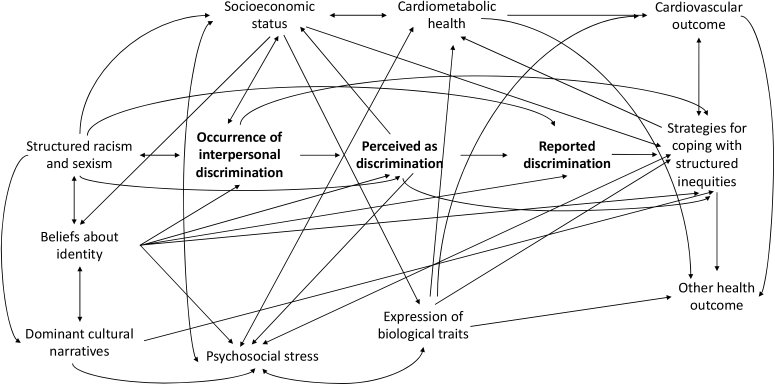
Testing hypotheses from the emerging Identity Pathology (IP) framework, we assessed race-gender differences in the effects of reporting experiences of racial and gender discrimination simultaneously compared with racial or gender discrimination alone, or no discrimination, on future cardiovascular health (CVH). Data were from a sample of 3758 black or white adults in CARDIA, a community-based cohort recruited in Birmingham, AL; Chicago, IL; Minneapolis, MN, and Oakland, CA in 1985-6 (year 0). Racial and gender discrimination were assessed using the Experiences of Discrimination scale. CVH was evaluated using a 12-point composite outcome modified from the Life's Simple 7, with higher scores indicating better health. Multivariable linear regressions were used to evaluate the associations between different perceptions of discrimination and CVH scores two decades later by race and gender simultaneously. Reporting racial and gender discrimination in ≥2 settings were 48% of black women, 42% of black men, 10% of white women, and 5% of white men. Year 30 CVH scores (mean, SD) were 7.9(1.4), 8.1(1.6), 8.8(1.6), and 8.7(1.3), respectively. Compared with those of their race-gender groups reporting no discrimination, white women reporting only gender-based discrimination saw an adjusted score difference of +0.3 (95% CI: 0.0,0.6), whereas white men reporting only racial discrimination had on average a 0.4 (95% CI: 0.1,0.8) higher score, and scores among white men reporting both racial and gender discrimination were on average 0.6 (95% CI: 1.1,-0.1) lower than those of their group reporting no discrimination. Consistent with predictions of the IP model, the associations of reported racial and gender discrimination with future CVH were different for different racially-defined gender groups. More research is needed to understand why reported racial and gender discrimination might better predict deterioration in CVH for whites than blacks, and what additional factors associated with gender and race contribute variability to CVH among these groups.
为了验证新兴的身份认同病理学(IP)框架中的假设,我们评估了同时报告种族和性别歧视经历与仅报告种族或性别歧视经历或未报告歧视经历相比,对未来心血管健康(CVH)的影响在种族 - 性别上的差异。数据来自社区队列研究CARDIA中的3758名黑人和白人成年人样本,该队列于1985 - 1986年(第0年)在阿拉巴马州伯明翰、伊利诺伊州芝加哥、明尼苏达州明尼阿波利斯和加利福尼亚州奥克兰招募。使用歧视经历量表评估种族和性别歧视。CVH使用从“生命简单七要素”修改而来的12分综合结果进行评估,分数越高表明健康状况越好。多变量线性回归用于同时按种族和性别评估二十年后不同歧视认知与CVH分数之间的关联。在≥2种情况下报告种族和性别歧视的比例分别为:48%的黑人女性、42%的黑人男性、10%的白人女性和5%的白人男性。第30年的CVH分数(均值,标准差)分别为7.9(1.4)、8.1(1.6)、8.8(1.6)和8.7(1.3)。与各自种族 - 性别组中未报告歧视的人相比,仅报告基于性别的歧视的白人女性调整后分数差异为 +0.3(95%置信区间:0.0,0.6),而仅报告种族歧视的白人男性平均分数高0.4(95%置信区间:0.1,0.8),报告种族和性别歧视的白人男性分数平均比其组中未报告歧视的人低0.6(95%置信区间:1.1, -0.1)。与IP模型的预测一致,对于不同种族定义的性别组,报告的种族和性别歧视与未来CVH之间的关联有所不同。需要更多研究来理解为什么报告的种族和性别歧视对白人未来CVH恶化的预测可能比对黑人更好,以及与性别和种族相关的哪些其他因素导致这些组之间CVH存在差异。