Chou Ping-Song, Chen Sharon Chia-Ju, Hsu Chung-Yao, Liou Li-Min, Wu Meng-Ni, Liu Ching-Kuan, Lai Chiou-Lian
Department of Neurology, Kaohsiung Medical University Hospital, Kaohsiung Medical University, Kaohsiung 807, Taiwan.
Department of Neurology, Faculty of Medicine, College of Medicine, Kaohsiung Medical University, Kaohsiung 807, Taiwan.
J Clin Med. 2019 Jul 22;8(7):1077. doi: 10.3390/jcm8071077.
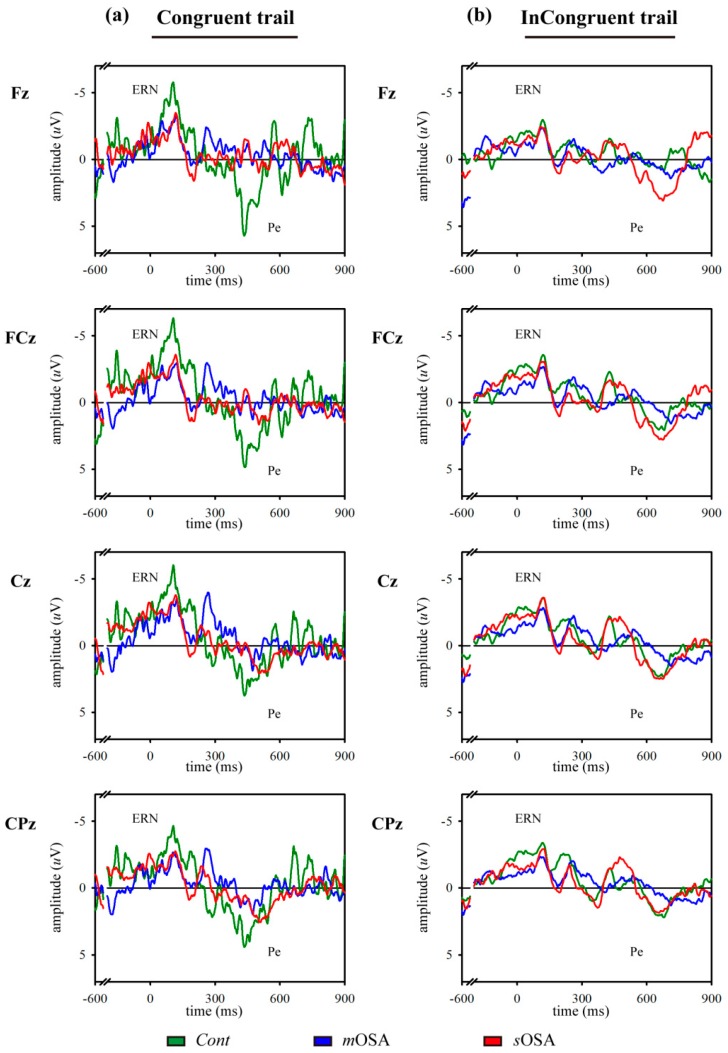
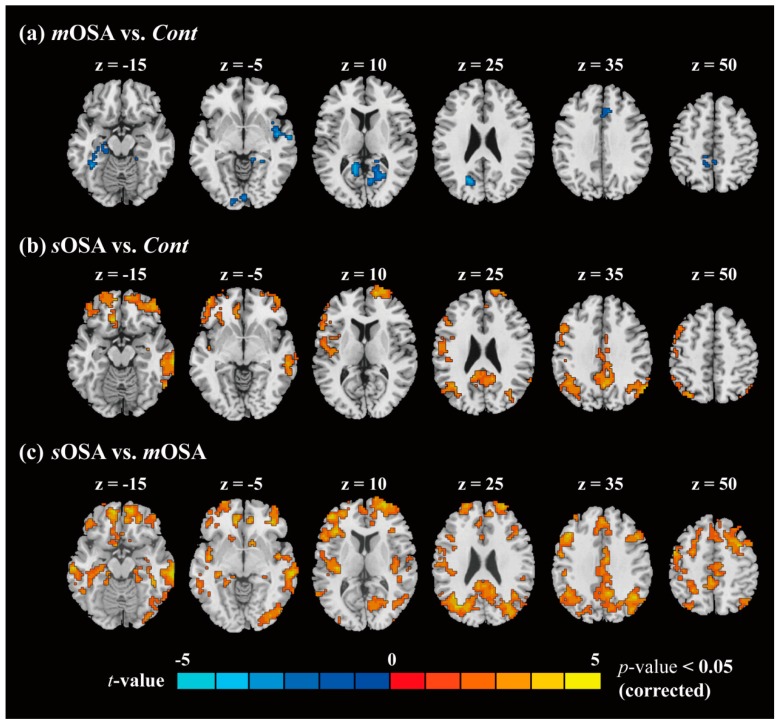
(1) Background: Although it is known that obstructive sleep apnea (OSA) impairs action-monitoring function, there is only limited information regarding the associated cerebral substrate underlying this phenomenon. (2) Methods: The modified Flanker task, error-related event-related potentials (ERPs), namely, error-related negativity (ERN) and error positivity (Pe), and functional magnetic resonance imaging (fMRI) were used to evaluate neural activities and the functional connectivity underlying action-monitoring dysfunction in patients with different severities of OSA. (3) Results: A total of 14 control () subjects, 17 patients with moderate OSA (OSA), and 10 patients with severe OSA (OSA) were enrolled. A significant decline in posterror correction rate was observed in the modified Flanker task when patients with OSA were compared with subjects. Comparison between patients with OSA and OSA did not reveal any significant difference. In the analysis of ERPs, ERN and Pe exhibited declined amplitudes in patients with OSA compared with subjects, which were found to increase in patients with OSA. Results of fMRI revealed a decreased correlation in multiple anterior cingulate cortex functional-connected areas in patients with OSA compared with subjects. However, these areas appeared to be reconnected in patients with OSA. (4) Conclusions: The behavioral, neurophysiological, and functional image findings obtained in this study suggest that OSA leads to action-monitoring dysfunction; however, compensatory neural recruitment might have contributed to the maintenance of the action-monitoring function in patients with OSA.
(1) 背景:尽管已知阻塞性睡眠呼吸暂停(OSA)会损害动作监测功能,但关于这一现象背后相关脑基质的信息有限。(2) 方法:采用改良的侧翼任务、错误相关事件相关电位(ERP),即错误相关负波(ERN)和错误正波(Pe),以及功能磁共振成像(fMRI)来评估不同严重程度OSA患者动作监测功能障碍背后的神经活动和功能连接。(3) 结果:共纳入14名对照()受试者、17名中度OSA患者(OSA)和10名重度OSA患者(OSA)。与对照受试者相比,OSA患者在改良的侧翼任务中错误后校正率显著下降。OSA患者与重度OSA患者之间的比较未发现任何显著差异。在ERP分析中,与对照受试者相比,OSA患者的ERN和Pe振幅下降,而重度OSA患者的ERN和Pe振幅增加。fMRI结果显示,与对照受试者相比,OSA患者多个前扣带回皮质功能连接区域的相关性降低。然而,这些区域在重度OSA患者中似乎重新连接。(4) 结论:本研究获得的行为、神经生理学和功能影像学结果表明,OSA导致动作监测功能障碍;然而,代偿性神经募集可能有助于维持OSA患者的动作监测功能。