Department of Food Science and Human Nutrition, Michigan State University, East Lansing, MI 48824, USA.
Department of Psychiatry, Michigan State University, East Lansing, MI 48824, USA.
Nutrients. 2019 Jul 12;11(7):1570. doi: 10.3390/nu11071570.
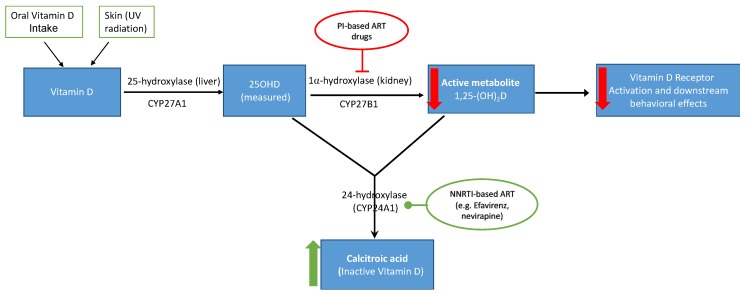
An impact of vitamin D in neurocognitive function has been theorized but it remains unknown whether vitamin-D insufficiency (VDI) is associated with worse socio-emotional adjustment (SEA) in vulnerable early school-aged children. This study examines the thesis that deficits in SEA are related to VDI using longitudinal data from 254 children that are perinatally HIV-infected (PHIV), exposed-uninfected (HEU), or unexposed-uninfected (HUU). In utero/peripartum antiretroviral (IPA) exposure was established per medical record documentation of biological mother's ART regimen in pregnancy. Four caregiver-reported age- and sex-standardized measures of SEA were obtained at months 0, 6, and 12 for dependent children aged 6-10 years: externalizing problems (EPC), internalizing problems (IPC), behavioral symptoms index (BSI), and adaptive skills index (ASI). VDI was highly prevalent (74%, = 188), and its association with change in SEA measures over 12 months varied by HIV-status (VDIHIV, all -values < 0.03). There was further variation in relationship of vitamin-D to SEA by IPA among PHIV (for ASI, BSI, and EPC, vitamin-DIPA, -value ≤ 0.01) and HEU (for BSI and EPC, vitamin-D*IPA, -value ≤ 0.04). Among HUU, BSI (β = -0.32, 95% CI: -0.50, -0.13), IPC (β = -0.28, 95% CI: -0.47, -0.09), and EPC (β = -0.20, 95% CI: -0.37, -0.02) all declined moderately per quartile increment in VD. Among PHIV, on the one hand higher vitamin D predicted ASI gains (moderate vs. low VD, β = 0.52, = 0.002), but this protective association was absent for BSI, EPC, and IPC (β = 0.36-0.77, < 0.05). In absence of IPA-exposure, increasing vitamin-D predicted declines in BSI and EPC (moderate vs. low Vitamin D, β = -0.56 to -0.71, ≤ 0.02) among HEU. However, given IPA exposure among HEU, higher VDI predicted moderate elevation in BSI (β = 0.39, 95% CI: 0.00, 0.78) and IPC (β = 0.48, 95% CI: 0.05, 0.92). Interaction between VD and IPA exposure for SEA outcomes among HEU and PHIV children warrants further investigation. The vitamin-D associated SEA improvement among HUU and HEU without IPA exposure suggests vitamin-D supplementation may remediate behavioral and adaptive deficits in this groups.
已有理论认为维生素 D 会对神经认知功能产生影响,但目前尚不清楚维生素 D 缺乏症(VDI)是否与脆弱的学龄前期儿童较差的社会情感适应(SEA)有关。本研究使用来自 254 名围产期感染艾滋病毒(PHIV)、暴露但未感染(HEU)或未暴露但未感染(HUU)的儿童的纵向数据,检验了 SEA 缺陷与 VDI 相关的假设。宫内/围产期抗逆转录病毒(IPA)暴露是根据生物母亲怀孕期间抗逆转录病毒治疗方案的医疗记录文件确定的。对于 6-10 岁的依赖儿童,获得了四个 caregiver 报告的年龄和性别标准化的 SEA 测量值:外化问题(EPC)、内化问题(IPC)、行为症状指数(BSI)和适应技能指数(ASI)。VDI 患病率很高(74%,n=188),其与 12 个月内 SEA 测量值变化的相关性因 HIV 状态而异(VDIHIV,所有 - 值<0.03)。在 PHIV(对于 ASI、BSI 和 EPC,维生素-DIPA,- 值≤0.01)和 HEU(对于 BSI 和 EPC,维生素-D*IPA,- 值≤0.04)中,IPA 对维生素-D 与 SEA 的关系存在进一步的差异。在 HUU 中,BSI(β=-0.32,95%CI:-0.50,-0.13)、IPC(β=-0.28,95%CI:-0.47,-0.09)和 EPC(β=-0.20,95%CI:-0.37,-0.02)每增加一个四分位距的 VD,均呈中度下降。在 PHIV 中,一方面较高的维生素 D 预示着 ASI 增加(中度与低 VD,β=0.52, =0.002),但这种保护关联在 BSI、EPC 和 IPC 中不存在(β=0.36-0.77,<0.05)。在没有 IPA 暴露的情况下,较高的维生素-D 预示着 HEU 中 BSI 和 EPC 下降(中度与低维生素 D,β=-0.56 至-0.71,≤0.02)。然而,鉴于 HEU 中存在 IPA 暴露,较高的 VDI 预示着 BSI(β=0.39,95%CI:0.00,0.78)和 IPC(β=0.48,95%CI:0.05,0.92)中度升高。需要进一步研究 IPA 暴露和维生素 D 对 HEU 和 PHIV 儿童 SEA 结果的相互作用。在没有 IPA 暴露的 HUU 和 HEU 中,维生素 D 相关的 SEA 改善表明,维生素 D 补充可能会纠正这些群体的行为和适应缺陷。