Zong Lu, Chu Ping, Huang Pu, Guo Yulin, Lv Ye
Department of Gynaecology and Obstetrics, The First Affiliated Hospital of Xi'an Jiaotong University, Xi'an, Shaanxi 710061, P.R. China.
Department of Gynaecology and Obstetrics, Yantai Affiliated Hospital of Binzhou Medical University, Yantai, Shandong 264100, P.R. China.
Exp Ther Med. 2017 Jul;14(1):581-586. doi: 10.3892/etm.2017.4523. Epub 2017 May 30.
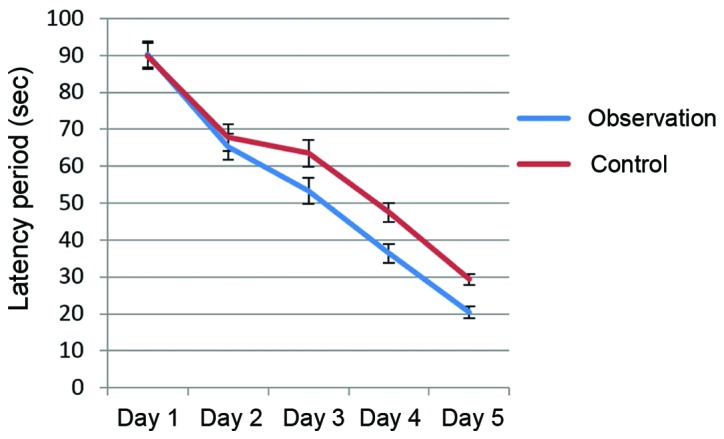
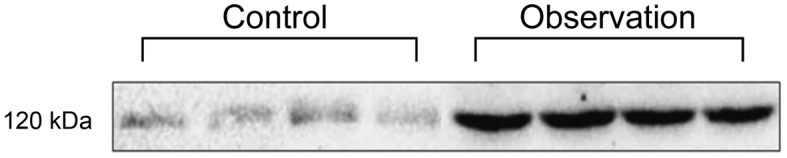
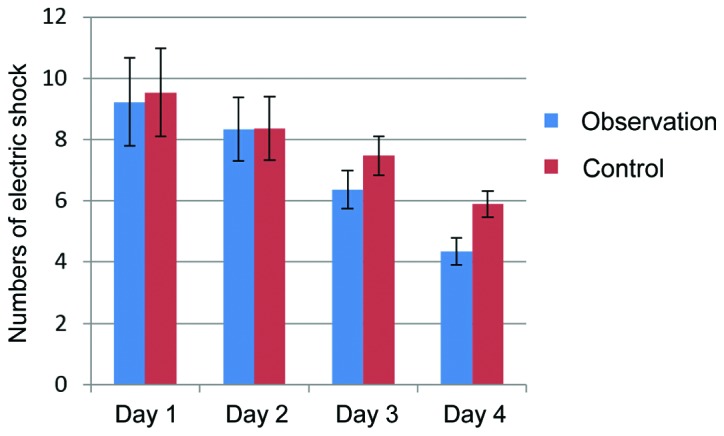
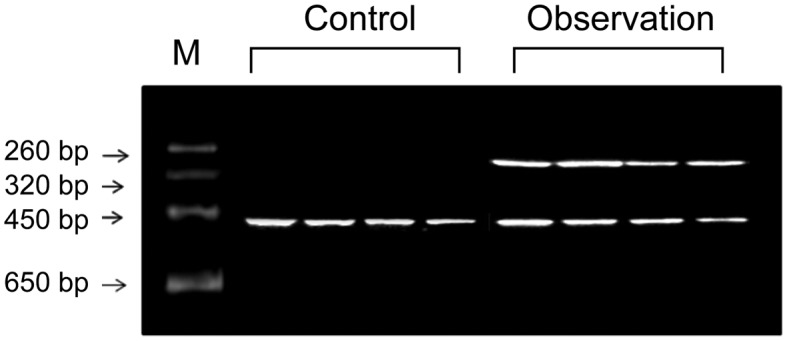
The aim of this study is to investigate the effect of vitamin D (VD) on the learning and memory ability of fetal growth restriction (FGR) rat and the expression of NMDA receptor in hippocampus. The FGR models of rat were established through passive smoking, and divided into two groups randomly, i.e. the control group and the observation group. Rats were fed regular diet with the addition of VD in the observation group. The serum level of 25(OH)-D was assayed in both groups of the rats at different time points using ELISA, and the learning and memory ability of rat aged 30 days were evaluated using Morris water maze and passive avoidance test. In addition, we also compared the brain weight of rats at different age and detected the mRNA expression of NRI subunit of NMDA receptor of hippocampus of rats aged 30 days using quantitative RT-PCR. After 7 days, the serum level of 25(OH)D in rats of the observation group was significantly higher than that of the control group (P<0.05); during the Morris water maze, we found no significant difference in comparison of the latency between the two groups in the first 2 days (P>0.05), but from the 3rd day, the latency of the observation group was shorter than that in the control group (P<0.05); in the passive avoidance test, no significant difference was identified when comparing the electric shock times between the two groups in the first 2 days, but from the 3rd day, the electric shock times in the observation group were significantly lower than those in the control group (P<0.05); the brain weight of rats in the observation group on the 1st, 7th and 14th day were all lower than those in the control group (P<0.05), but the comparison of brain weight at 21st and 30th day showed no significant difference (P>0.05) between the two groups. We also found that the mRNA and protein expression of NRI subunit of NMDA receptor in hippocampus was significantly higher in the observation group than in the control group (P<0.05). VD can increase the learning and memory ability of FGR rats, significantly ameliorating the cognitive dysfunction of FGR rat and improving the learning and memory ability of rats, which may be related to the upregulation of NRI subunit of NMDA receptor.
本研究旨在探讨维生素D(VD)对胎儿生长受限(FGR)大鼠学习记忆能力及海马区N-甲基-D-天冬氨酸(NMDA)受体表达的影响。通过被动吸烟建立大鼠FGR模型,并随机分为两组,即对照组和观察组。观察组大鼠在常规饮食基础上添加VD。采用酶联免疫吸附测定法(ELISA)检测两组大鼠不同时间点的血清25(OH)-D水平,并用Morris水迷宫和被动回避试验评估30日龄大鼠的学习记忆能力。此外,我们还比较了不同年龄大鼠的脑重量,并采用定量逆转录聚合酶链反应(RT-PCR)检测30日龄大鼠海马区NMDA受体NR1亚基的mRNA表达。7天后,观察组大鼠血清25(OH)D水平显著高于对照组(P<0.05);在Morris水迷宫实验中,前2天两组大鼠潜伏期比较差异无统计学意义(P>0.05),但从第3天起,观察组大鼠潜伏期短于对照组(P<0.05);在被动回避试验中,前2天两组大鼠电击次数比较差异无统计学意义,但从第3天起,观察组大鼠电击次数显著低于对照组(P<0.05);观察组大鼠第1、7、14天的脑重量均低于对照组(P<0.05),但两组大鼠第21天和30天脑重量比较差异无统计学意义(P>0.05)。我们还发现,观察组大鼠海马区NMDA受体NR1亚基的mRNA和蛋白表达均显著高于对照组(P<0.05)。VD可提高FGR大鼠的学习记忆能力,显著改善FGR大鼠的认知功能障碍,提高大鼠的学习记忆能力,这可能与上调NMDA受体NR1亚基有关。