Department of Pharmacology and Therapeutics, McGill University, Montreal, QC H3G 1Y6, Canada.
Departments of Obstetrics and Gynecology, McGill University, Montreal, QC H4A 3J1, Canada.
Genes (Basel). 2019 Jul 12;10(7):525. doi: 10.3390/genes10070525.
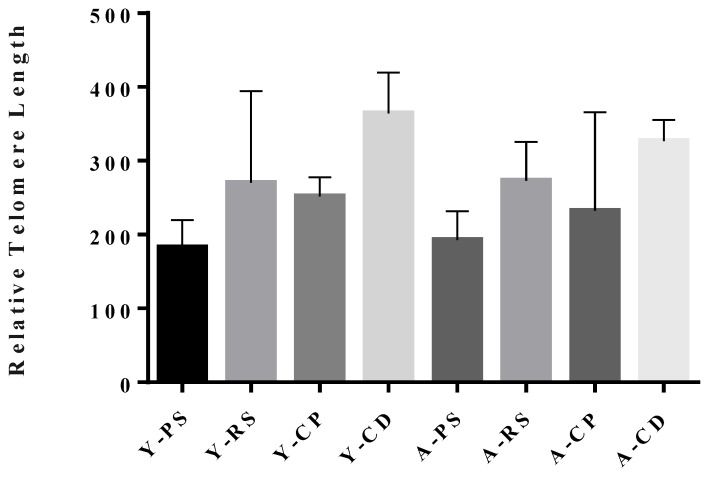
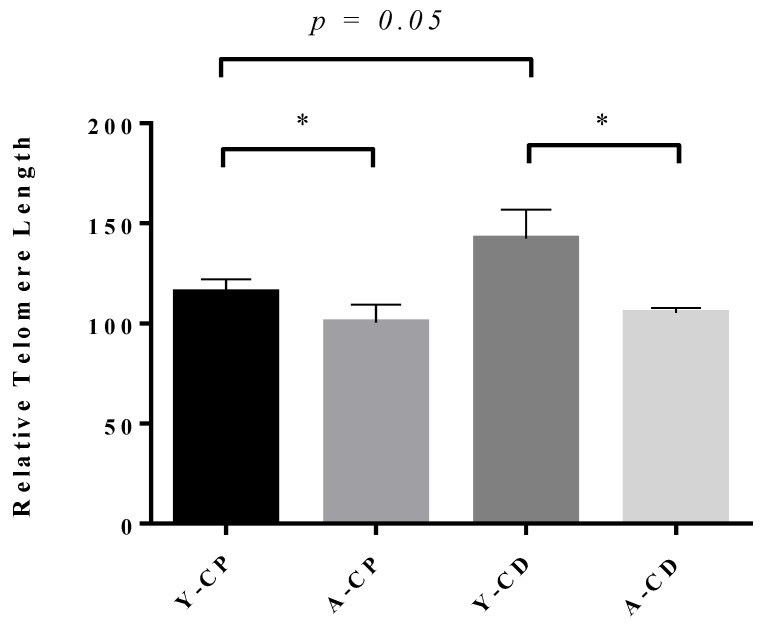
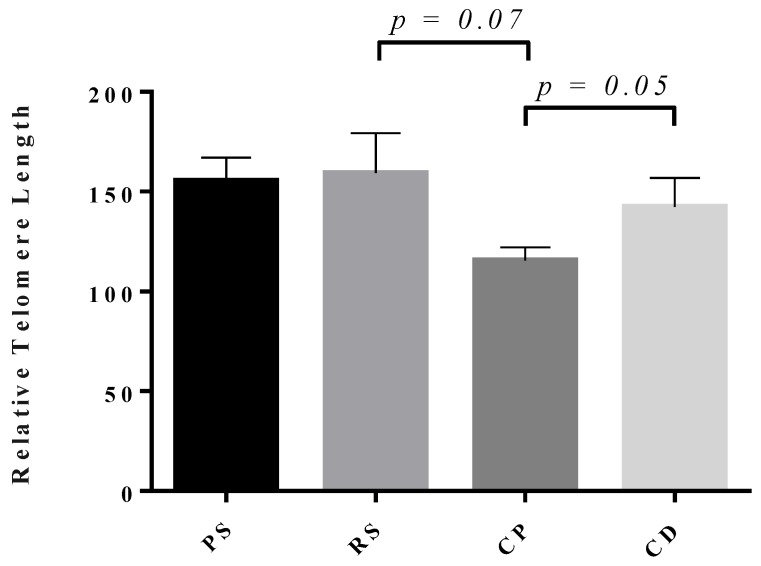
Telomeres are repeat regions of DNA that cap either end of each chromosome, thereby providing stability and protection from the degradation of gene-rich regions. Each cell replication causes the loss of telomeric repeats due to incomplete DNA replication, though it is well-established that progressive telomere shortening is evaded in male germ cells by the maintenance of active telomerase. However, germ cell telomeres are still susceptible to disruption or insult by oxidative stress, toxicant exposure, and aging. Our aim was to examine the relative telomere length (rTL) in an outbred Sprague Dawley (SD) and an inbred Brown Norway (BN) rat model for paternal aging. No significant differences were found when comparing pachytene spermatocytes (PS), round spermatids (RS), and sperm obtained from the caput and cauda of the epididymis of young and aged SD rats; this is likely due to the high variance observed among individuals. A significant age-dependent decrease in rTL was observed from 115.6 (±6.5) to 93.3 (±6.3) in caput sperm and from 142.4 (±14.6) to 105.3 (±2.5) in cauda sperm from BN rats. Additionally, an increase in rTL during epididymal maturation was observed in both strains, most strikingly from 115.6 (±6.5) to 142 (±14.6) in young BN rats. These results confirm the decrease in rTL in rodents, but only when an inbred strain is used, and represent the first demonstration that rTL changes as sperm transit through the epididymis.
端粒是 DNA 的重复区域,位于每条染色体的两端,从而提供稳定性并防止富含基因的区域降解。每次细胞复制都会导致端粒重复序列丢失,这是由于 DNA 复制不完全所致,但已确立的是,通过维持活跃的端粒酶,雄性生殖细胞可以避免端粒逐渐缩短。然而,生殖细胞端粒仍然容易受到氧化应激、毒物暴露和衰老的破坏或损伤。我们的目的是检查外群 Sprague Dawley(SD)和内群 Brown Norway(BN)大鼠模型中父系衰老的相对端粒长度(rTL)。比较年轻和衰老的 SD 大鼠附睪头和尾精子中的精母细胞减数分裂前期(PS)、圆形精子和精子时,未发现显著差异;这可能是由于个体之间的高变异性所致。BN 大鼠附睪头精子的 rTL 从 115.6(±6.5)显著下降到 93.3(±6.3),附睪尾精子的 rTL 从 142.4(±14.6)显著下降到 105.3(±2.5),这与年龄有关。此外,两种品系的 rTL 在附睾成熟过程中均增加,BN 幼鼠最为明显,从 115.6(±6.5)增加到 142(±14.6)。这些结果证实了啮齿动物 rTL 的减少,但只有在使用近交系时才会出现,这是首次证明 rTL 在精子通过附睪时会发生变化。