Institute for Diabetes and Obesity, Helmholtz Diabetes Center, Helmholtz Zentrum München, German Research Center for Environmental Health (GmbH), 85764 Neuherberg, Germany.
Center for Research in Molecular Medicine and Chronic Diseases (CIMUS), University of Santiago de Compostela-Instituto de Investigación Sanitaria, 15782 Santiago de Compostela, Spain.
Int J Mol Sci. 2019 Jul 13;20(14):3445. doi: 10.3390/ijms20143445.
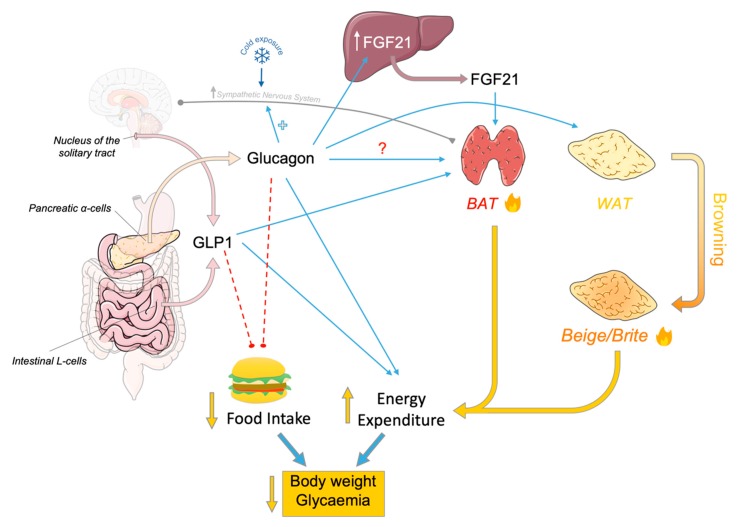
Brown adipose tissue (BAT) thermogenesis is a conserved mechanism to maintain body temperature in mammals. However, since BAT contribution to energy expenditure can represent a relevant modulator of metabolic homeostasis, many studies have focused on the nervous system and endocrine factors that control the activity of this tissue. There is long-established evidence that the counter-regulatory hormone glucagon negatively influences energy balance, enhances satiety, and increases energy expenditure. Despite compelling evidence showing that glucagon has direct action on BAT thermogenesis, recent findings are questioning this conventional attribute of glucagon action. Glucagon like peptide-1 (GLP-1) is an incretin secreted by the intestinal tract which strongly decreases feeding, and, furthermore, improves metabolic parameters associated with obesity and diabetes. Therefore, GLP-1 receptors (GLP-1-R) have emerged as a promising target in the treatment of metabolic disorders. In this short review, we will summarize the latest evidence in this regard, as well as the current therapeutic glucagon- and GLP-1-based approaches to treating obesity.
棕色脂肪组织(BAT)的产热是哺乳动物维持体温的一种保守机制。然而,由于 BAT 对能量消耗的贡献可以作为代谢稳态的一个相关调节剂,许多研究都集中在控制该组织活性的神经系统和内分泌因素上。有长期确立的证据表明,抗调节激素胰高血糖素会对能量平衡产生负面影响,增强饱腹感,并增加能量消耗。尽管有确凿的证据表明胰高血糖素对 BAT 产热有直接作用,但最近的发现质疑了胰高血糖素作用的这一传统属性。胰高血糖素样肽-1(GLP-1)是一种由肠道分泌的肠促胰岛素,它能强烈地抑制进食,而且还能改善与肥胖和糖尿病相关的代谢参数。因此,GLP-1 受体(GLP-1-R)已成为治疗代谢紊乱的有前途的靶点。在这篇简短的综述中,我们将总结这方面的最新证据,以及目前基于胰高血糖素和 GLP-1 的治疗肥胖的方法。