Center for Mass Spectrometry and Optical Spectroscopy (CeMOS), Mannheim University of Applied Sciences, Paul-Wittsack-Str. 10, 68163, Mannheim, Germany.
Institute of Medical Technology, Heidelberg University and Mannheim University of Applied Sciences, Paul-Wittsack-Str. 10, 68163, Mannheim, Germany.
Sci Rep. 2019 Jul 23;9(1):10698. doi: 10.1038/s41598-019-47089-5.
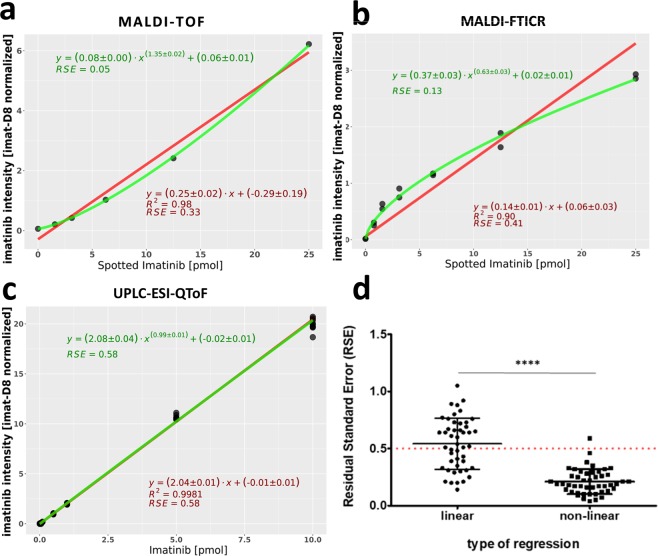
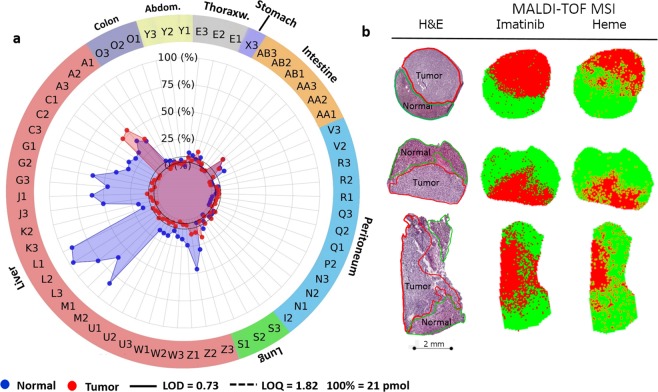
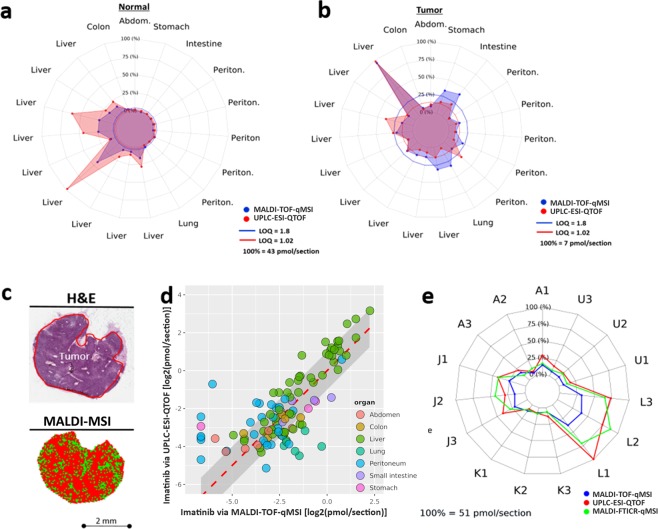
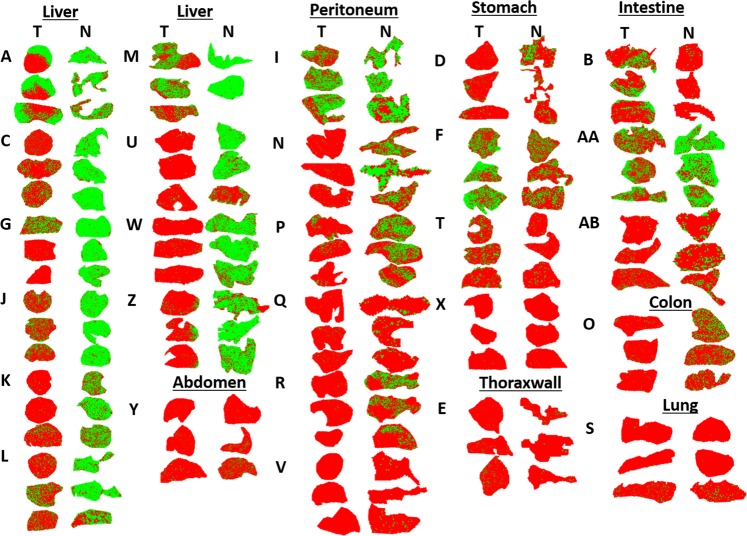
Mass spectrometry imaging (MSI) is an enabling technology for label-free drug disposition studies at high spatial resolution in life science- and pharmaceutical research. We present the first extensive clinical matrix-assisted laser desorption/ionization (MALDI) quantitative mass spectrometry imaging (qMSI) study of drug uptake and distribution in clinical specimen, analyzing 56 specimens of tumor and corresponding non-tumor tissues from 27 imatinib-treated patients with the biopsy-proven rare disease gastrointestinal stromal tumors (GIST). For validation, we compared MALDI-TOF-qMSI with conventional UPLC-ESI-QTOF-MS-based quantification from tissue extracts and with ultra-high resolution MALDI-FTICR-qMSI. We introduced a novel generalized nonlinear calibration model of drug quantities based on computational evaluation of drug-containing areas that enabled better data fitting and assessment of the inherent method nonlinearities. Imatinib tissue spatial maps revealed striking inefficiency in drug penetration into GIST liver metastases even though the corresponding healthy liver tissues in the vicinity showed abundant imatinib levels beyond the limit of quantification (LOQ), thus providing evidence for secondary drug resistance independent of mutation status. Taken together, these findings underscore the important application of MALDI-qMSI in studying the spatial distribution of molecularly targeted therapeutics in oncology, namely to serve as orthogonal post-surgical approach to evaluate the contribution of anticancer drug disposition to resistance against treatment.
质谱成像(MSI)是生命科学和制药研究中无标记药物处置研究的一项重要技术,可实现高空间分辨率。我们首次进行了广泛的临床基质辅助激光解吸/电离(MALDI)定量质谱成像(qMSI)研究,分析了 27 名接受伊马替尼治疗的胃肠道间质瘤(GIST)患者的 56 份肿瘤和相应非肿瘤组织的临床标本,以研究药物摄取和分布。为了验证,我们将 MALDI-TOF-qMSI 与组织提取物的常规 UPLC-ESI-QTOF-MS 定量进行了比较,并与超高分辨率 MALDI-FTICR-qMSI 进行了比较。我们引入了一种新的基于计算药物含量区域的药物定量广义非线性校准模型,该模型能够更好地拟合数据并评估内在方法的非线性。伊马替尼组织空间图谱显示,即使附近的健康肝组织中药物水平超过定量限(LOQ),GIST 肝转移中药物渗透效率也非常低,这为突变状态以外的继发性药物耐药提供了证据。总之,这些发现强调了 MALDI-qMSI 在研究肿瘤中分子靶向治疗剂的空间分布方面的重要应用,即作为一种正交的术后方法,用于评估抗癌药物处置对治疗耐药性的贡献。