Zhou Qunjie, Zhang Lu, Feng Jianfeng, Lo Chun-Yi Zac
Shanghai Center for Mathematical Sciences, Fudan University, Shanghai, China.
Institute of Science and Technology for Brain Inspired Intelligence, Fudan University, Shanghai, China.
Front Neurosci. 2019 Jul 9;13:685. doi: 10.3389/fnins.2019.00685. eCollection 2019.
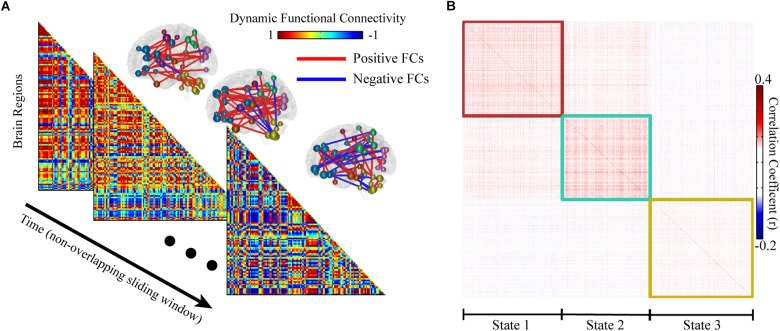
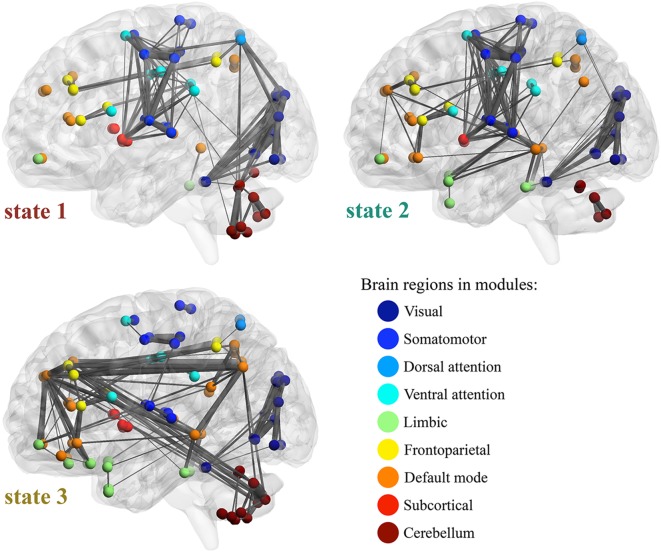
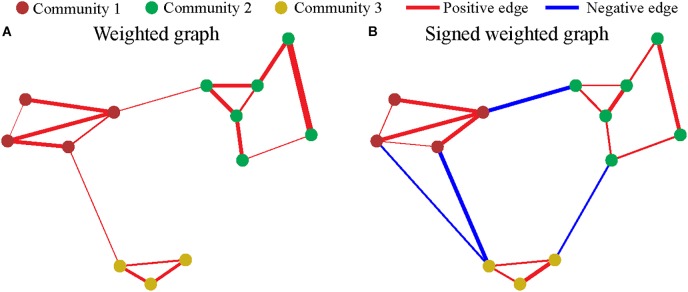
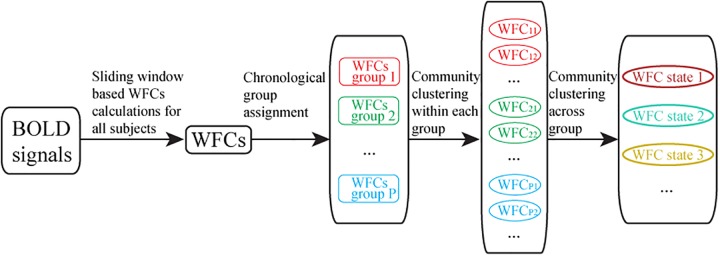
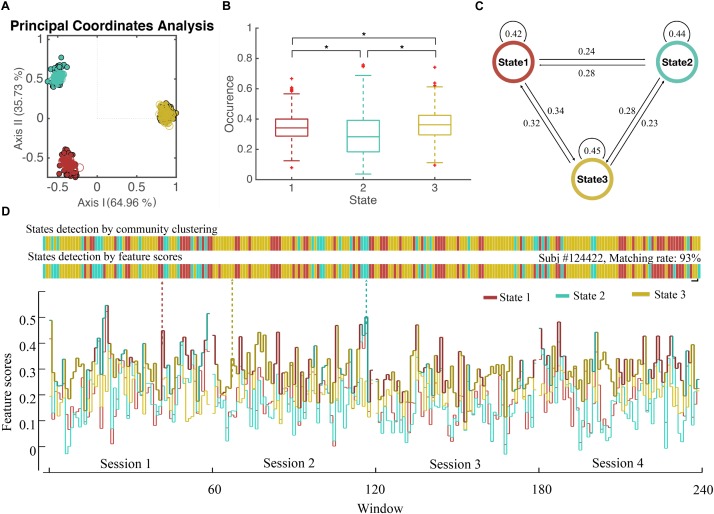
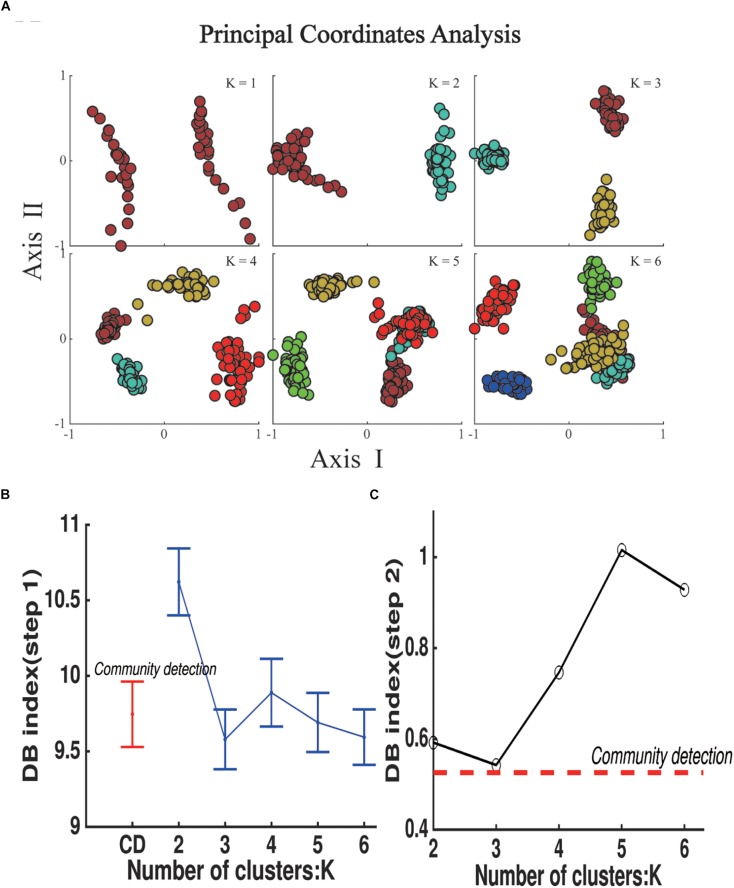
Dynamical changes have recently been tracked in functional connectivity (FC) calculated from resting-state functional magnetic resonance imaging (R-fMRI), when a person is conscious but not carrying out a directed task during scanning. Diverse dynamical FC states (dFC) are believed to represent different internal states of the brain, in terms of brain-regional interactions. In this paper, we propose a novel protocol, the signed community clustering with the optimized modularity by two-step procedures, to track dynamical whole brain functional connectivity (dWFC) states. This protocol is assumption free without threshold for the number of clusters. By applying our method on sliding window based dWFC's with automated anatomical labeling 2 (AAL2), three main dWFC states were extracted from R-fMRI datasets in Human Connectome Project, that are independent on window size. Through extracting the FC features of these states, we found the functional links in state 1 (WFC-C) mainly involved visual, somatomotor, attention and cerebellar (posterior lobe) modules. State 2 (WFC-C) was similar to WFC-C, but more FC's linking limbic, default mode, and frontoparietal modules and less linking the cerebellum, sensory and attention modules. State 3 had more FC's linking default mode, limbic, and cerebellum, compared to WFC-C and WFC-C. With tests of robustness and stability, our work provides a solid, hypothesis-free tool to detect dWFC states for the possibility of tracking rapid dynamical change in FCs among large data sets.
最近,人们追踪了静息态功能磁共振成像(R-fMRI)计算得出的功能连接性(FC)的动态变化,即在扫描过程中,人处于清醒状态但未执行定向任务时的情况。就脑区相互作用而言,不同的动态FC状态(dFC)被认为代表了大脑的不同内部状态。在本文中,我们提出了一种新颖的方法,即通过两步程序进行具有优化模块度的符号社区聚类,以追踪动态全脑功能连接性(dWFC)状态。该方法无需假设,且对聚类数量没有阈值要求。通过将我们的方法应用于基于自动解剖标记2(AAL2)的滑动窗口dWFC,从人类连接组计划的R-fMRI数据集中提取了三种主要的dWFC状态,这些状态与窗口大小无关。通过提取这些状态的FC特征,我们发现状态1(WFC-C)中的功能连接主要涉及视觉、躯体运动、注意力和小脑(后叶)模块。状态2(WFC-C)与WFC-C相似,但更多的FC连接边缘系统、默认模式和额顶叶模块,而连接小脑、感觉和注意力模块的FC较少。与WFC-C和WFC-C相比,状态3有更多的FC连接默认模式、边缘系统和小脑。通过稳健性和稳定性测试,我们的工作提供了一个可靠的、无假设的工具,用于检测dWFC状态,以便在大数据集中追踪FC的快速动态变化。