1Groningen Research Institute of Pharmacy, Unit of Pharmaco-Therapy, - Epidemiology & - Economics (PTE2), University of Groningen, Antonius Deusinglaan 1, 9713 AV Groningen, the Netherlands.
2Department of Pharmacology and Clinical Pharmacy, Faculty of Pharmacy, Universitas Padjadjaran, Jawa Barat, Indonesia.
Antimicrob Resist Infect Control. 2019 Jul 12;8:115. doi: 10.1186/s13756-019-0561-z. eCollection 2019.
Since in low incidence TB countries population migration and complex treatment of drug-resistant tuberculosis (DR-TB) patients are major issues, we aimed to analyse patient risk factors associated with the incidence of poor outcome of TB treatment among DR-TB patients in the Netherlands.
This retrospective cohort study included adult patients with confirmed DR-TB treated from 2005 to 2015. We obtained data from a nationwide exhaustive registry of tuberculosis patients in the Netherlands. Predictors for unsuccessful TB treatment (defaulted and failed treatment) and TB-associated mortality were analysed using multivariate logistic regression.
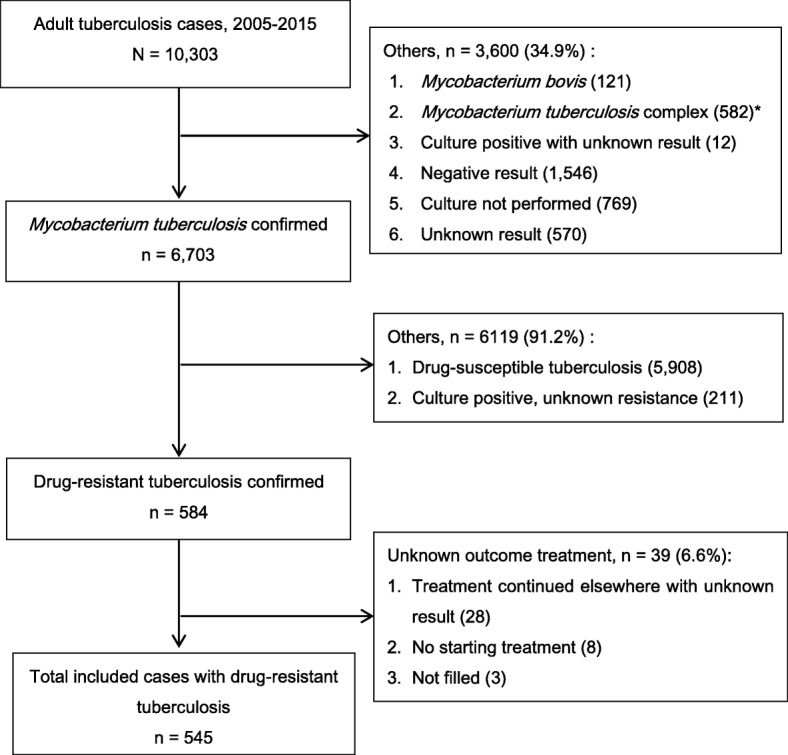
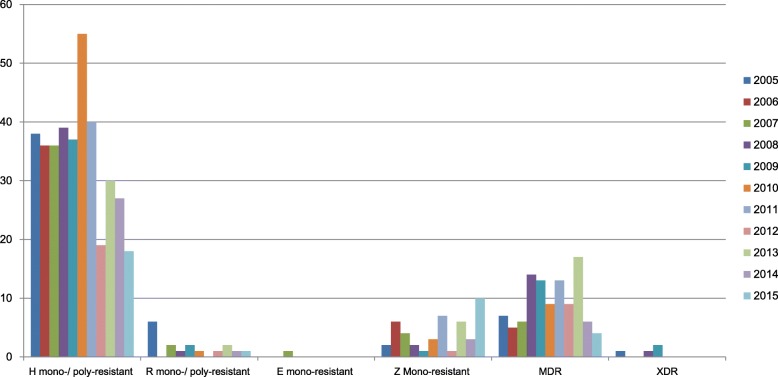
Among 10,303 registered TB patients, 545 patients with DR-TB were analysed. Six types of DR-TB were identified from the included patients, i.e. isoniazid mono- or poly-resistance (68%); rifampicin mono- or poly-resistance (3.1%); pyrazinamide mono-resistance (8.3%); ethambutol mono-resistance (0.1%); multidrug-resistance (18.9%); and extensively drug-resistance (0.7%). The majority of patients were foreign-born (86%) and newly diagnosed TB (89%) patients. The cumulative incidence of unsuccessful treatment and mortality were 5 and 1%, respectively. Among all DR-TB cases, patients with Multi Drug-Resistant Tuberculosis (MDR-TB) (OR 4.43; 95%CI 1.70-11.60) were more likely to have unsuccessful treatment, while miliary and central nervous system TB (OR 15.60; 95%CI 2.18-111.52) may also be predictors for TB mortality. Additionally, patients with substance abuse and homelessness tend to have unsuccessful treatment.
In recent years, we identified a low incidence of DR-TB as well as the poor outcome of DR-TB treatment. The majority of cases were primary drug-resistant and foreign-born. To further improve treatment outcome, special attention should be given to the high-risk DR-TB patients.
在低发病率结核病国家,人口迁移和耐药结核病(DR-TB)患者的复杂治疗是主要问题,因此我们旨在分析与荷兰 DR-TB 患者治疗结果不良相关的患者风险因素。
本回顾性队列研究纳入了 2005 年至 2015 年确诊的 DR-TB 成年患者。我们从荷兰结核病患者全国性全面登记处获取数据。使用多变量逻辑回归分析治疗失败(停药和治疗失败)和与结核病相关的死亡率的预测因子。
在登记的 10303 例结核病患者中,分析了 545 例 DR-TB 患者。从纳入的患者中确定了 6 种 DR-TB 类型,即异烟肼单药或多药耐药(68%);利福平单药或多药耐药(3.1%);吡嗪酰胺单药耐药(8.3%);乙胺丁醇单药耐药(0.1%);耐多药(18.9%);广泛耐药(0.7%)。大多数患者为外国出生(86%)和新诊断的结核病(89%)患者。治疗失败和死亡率的累积发生率分别为 5%和 1%。在所有 DR-TB 病例中,耐多药结核病(MDR-TB)患者(OR 4.43;95%CI 1.70-11.60)更有可能治疗失败,而血行播散性和中枢神经系统结核病(OR 15.60;95%CI 2.18-111.52)也可能是结核病死亡的预测因子。此外,有药物滥用和无家可归史的患者往往治疗失败。
近年来,我们发现 DR-TB 的发病率较低,且 DR-TB 治疗结果不佳。大多数病例为原发性耐药和外国出生。为了进一步提高治疗效果,应特别关注高危 DR-TB 患者。