Su Xiaoyu, Griffin Jason, Xu Jingwen, Ouyang Ping, Zhao Zhihui, Wang Weiqun
Department of Food Nutrition Dietetics & Health, Kansas State University, Manhattan, KS, 66506, USA.
Department of Horticulture & Natural Resources, Kansas State University, Manhattan, KS, 66506, USA.
Heliyon. 2019 Jun 29;5(6):e01964. doi: 10.1016/j.heliyon.2019.e01964. eCollection 2019 Jun.
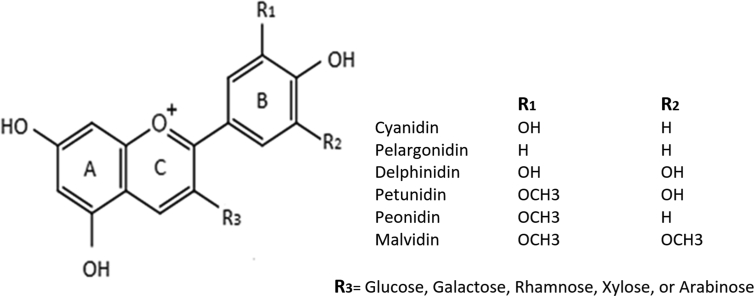
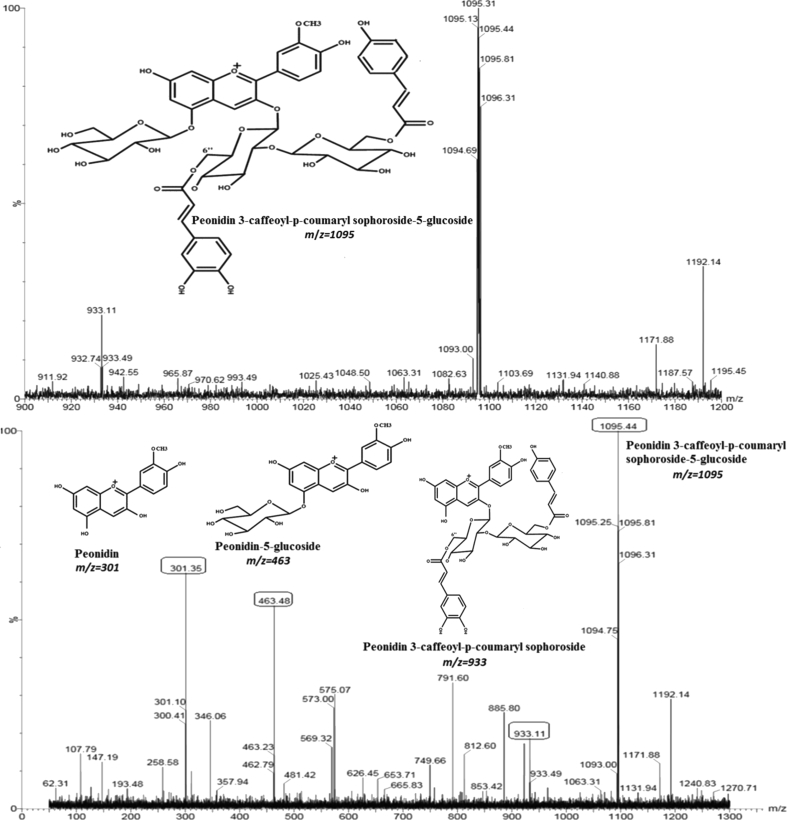
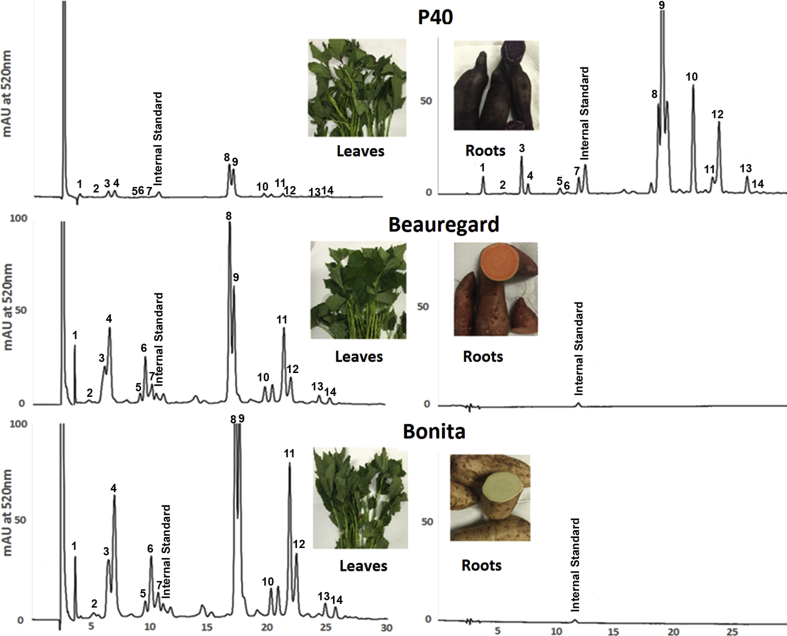
As phytochemical-enriched edible greens, sweet potato () leaves have become popular. However, the profile and content of phytochemicals in sweet potato leaves are mostly unknown. We previously bred a purple-fleshed sweet potato P40 that demonstrated cancer prevention due to high levels of anthocyanins in the tuberous roots. The objectives of this study were to identify and quantify anthocyanins in P40 leaves when compared with the white-fleshed Bonita and orange-fleshed Beauregard. The mature leaves of P40 at 6-week vine stage were collected and extracted for anthocyanin analysis by HPLC-MS/MS. Fourteen anthocyanins, including a novel anthocyanin (peonidin 3-caffeoyl-p-coumaryl sophoroside-5-glucoside), were identified and quantitated. The contents of anthocyanins in P40 leaves (32.7 ± 2.9 mg/kg DW) were much lower than that in the root (13,100 ± 70 mg/kg DW). Furthermore, anthocyanin contents in P40 leaves were even lesser than those of the orange-fleshed Beauregard (334 ± 60.9 mg/kg DW) and white-fleshed Bonita (563 ± 50.4 mg/kg DW). Total phenolic contents as measured by Folin-Ciocalteu were 36.8 ± 4.8 mg GAE/g DW in the leaves of P40, but 41.2 ± 5.0 mg GAE/g DW in Beauregard and 46.7 ± 2.1 mg GAE/g DW in Bonita. No anthocyanin was detectable in the stem of these three sweet potato varieties. Taken together, this study reports for the first time the profile and content of anthocyanins in the leaves of three sweet potato varieties with a new anthocyanin identified. The unexpected lower levels of anthocyanins in the purple-fleshed sweet potato leaves when compared with either the counterpart tuberous roots or the control white-fleshed and orange-fleshed sweet potato varieties advanced our existing knowledge and also validated a diverse phenotype of anthocyanin biosynthesis between sweet potato leaves and roots.
作为富含植物化学物质的可食用蔬菜,甘薯()叶已广受欢迎。然而,甘薯叶中植物化学物质的种类和含量大多未知。我们之前培育了一种紫肉甘薯P40,其块根中因含有高水平的花青素而具有防癌作用。本研究的目的是在将P40叶与白肉博尼塔和橙肉波瑞加德进行比较时,鉴定并定量其中的花青素。采集了处于6周藤蔓期的P40成熟叶,并通过高效液相色谱-串联质谱法(HPLC-MS/MS)提取用于花青素分析。鉴定并定量了14种花青素,包括一种新型花青素(芍药素3-咖啡酰-对香豆酰槐糖苷-5-葡萄糖苷)。P40叶中的花青素含量(32.7±2.9毫克/千克干重)远低于其根中的含量(13100±70毫克/千克干重)。此外,P40叶中的花青素含量甚至低于橙肉波瑞加德(334±60.9毫克/千克干重)和白肉博尼塔(563±50.4毫克/千克干重)。用福林-西奥尔特试剂法测得,P40叶中的总酚含量为36.8±4.8毫克没食子酸当量/克干重,而波瑞加德叶中的为41.2±5.0毫克没食子酸当量/克干重,博尼塔叶中的为46.7±2.1毫克没食子酸当量/克干重。在这三个甘薯品种的茎中均未检测到花青素。综上所述,本研究首次报告了三个甘薯品种叶中花青素的种类和含量,并鉴定出一种新的花青素。与相应的块根或对照白肉和橙肉甘薯品种相比,紫肉甘薯叶中花青素含量出人意料地较低,这拓展了我们现有的知识,也验证了甘薯叶和根之间花青素生物合成的不同表型。