Division of Pulmonary and Critical Care Medicine, Department of Medicine, Brigham and Women's Hospital, Harvard Medical School, Boston, Massachusetts.
Program On Regulation, Therapeutics, And Law, Division of Pharmacoepidemiology and Pharmacoeconomics, Department of Medicine, Brigham and Women's Hospital, Harvard Medical School, Boston, Massachusetts.
JAMA Netw Open. 2019 Jul 3;2(7):e197591. doi: 10.1001/jamanetworkopen.2019.7591.
The US Food and Drug Administration (FDA) created the exception from informed consent (EFIC) pathway in 1996 to allow some emergency trials to enroll patients without informed consent. To protect individual autonomy and preserve public trust, the FDA requires that EFIC trial investigators consult with community members before a trial may begin.
To analyze data from surveys conducted as part of community consultation ahead of EFIC trials and assess levels of public approval.
All trials granted an EFIC must submit documentation of compliance with EFIC regulations to a publicly available docket at the FDA. Submissions between November 1, 1996, and October 23, 2017, were reviewed.
Trials with survey data were included.
Data were extracted between January 2018 and June 2018 and were analyzed between June 2018 and August 2018. The quality and validity of data were assessed according to Preferred Reporting Items for Systematic Reviews and Meta-analyses (PRISMA) guidelines. A random-effects metaregression was used to assess the association of demographic characteristics with EFIC approval.
The primary study outcome was EFIC approval.
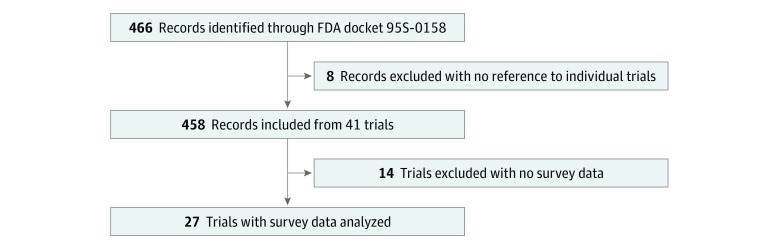
The FDA docket contained 15 958 pages of material with survey data for 42 448 individuals submitted by 27 trials. Public approval of EFIC varied by question type, with more people willing to approve initiation of EFIC trials in their community (86.5%) than personal enrollment (73.0%), enrollment of a family member (68.6%), or the principle of enrollment without consent (58.4%) (P < .001 for all comparisons). In the United States, African American individuals made up 29.3% of those enrolled in EFIC trials that reported data on race (5064 of 17 302) but only 16.7% of those surveyed as part of community consultation. In the United States and Canada, men made up 42.9% of the surveyed population but 65.6% of those eventually enrolled in EFIC trials (29 961 of 45 694). Groups surveyed with higher proportions of African American and male respondents had lower rates of EFIC approval.
Public approval of EFIC trials varied by question type and by the respondents' reported race and sex. The demographic characteristics of those surveyed did not match the demographic characteristics of EFIC enrollees. The FDA could strengthen community consultation by standardizing survey instruments and reporting, requiring broader inclusion of African American and male respondents, clarifying the function of surveys in the development and modification of trial protocols, and building more public consensus around the acceptable use of EFIC.
美国食品和药物管理局(FDA)于 1996 年创建了知情同意豁免(EFIC)途径,以允许某些紧急试验在没有知情同意的情况下招募患者。为了保护个人自主权并维护公众信任,FDA 要求 EFIC 试验的调查人员在试验开始前与社区成员进行咨询。
分析作为 EFIC 试验前社区咨询的一部分进行的调查数据,并评估公众支持率。
所有获得 EFIC 批准的试验都必须向 FDA 的公开文件提交合规文件。审查了 1996 年 11 月 1 日至 2017 年 10 月 23 日期间提交的文件。
包括有调查数据的试验。
数据于 2018 年 1 月至 6 月之间提取,并于 2018 年 6 月至 8 月之间进行分析。根据系统评价和荟萃分析的首选报告项目(PRISMA)指南评估数据的质量和有效性。使用随机效应荟萃回归评估人口统计学特征与 EFIC 批准的关联。
主要研究结果是 EFIC 批准。
FDA 文件中包含 15958 页材料,其中包含 27 项试验提交的 42448 个人的调查数据。EFIC 的公众认可度因问题类型而异,与个人参加 EFIC 试验的认可度(73.0%)相比,更多的人愿意批准在其社区中启动 EFIC 试验(86.5%),参加 EFIC 试验(68.6%)或没有同意的原则参加试验(58.4%)(所有比较的 P 值均<.001)。在美国,非裔美国人占报告种族数据的 EFIC 试验参与者的 29.3%(17302 人中有 5064 人),但仅占社区咨询调查对象的 16.7%。在美国和加拿大,男性占调查人口的 42.9%,但最终参加 EFIC 试验的比例为 65.6%(45694 人中有 29961 人)。接受调查的群体中,非裔美国人和男性受访者的比例越高,EFIC 批准率越低。
EFIC 试验的公众认可度因问题类型以及受访者报告的种族和性别而异。接受调查的人群的人口统计学特征与 EFIC 参与者的人口统计学特征不匹配。FDA 可以通过标准化调查工具和报告、要求更广泛地纳入非裔美国人和男性受访者、阐明调查在试验方案制定和修改中的作用以及围绕 EFIC 的可接受用途建立更多的公众共识来加强社区咨询。
