Sacko Koita, Thangavel Karthik, Shoyele Sunday A
Department of Pharmaceutical Science, College of Pharmacy, Thomas Jefferson University, Philadelphia, PA 19107, USA.
Nanomaterials (Basel). 2019 Jul 23;9(7):1052. doi: 10.3390/nano9071052.
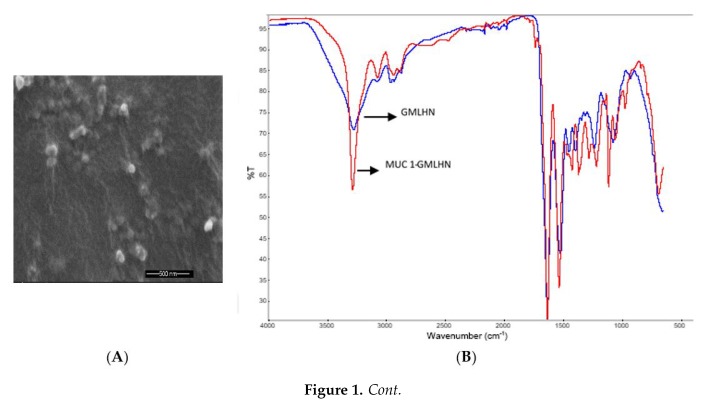
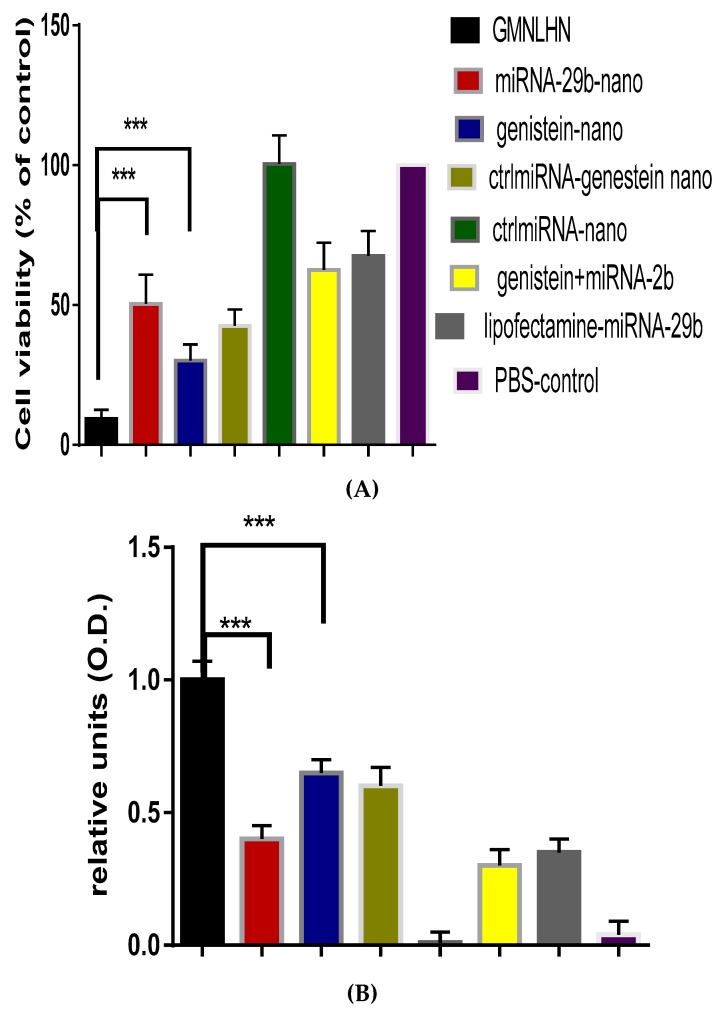
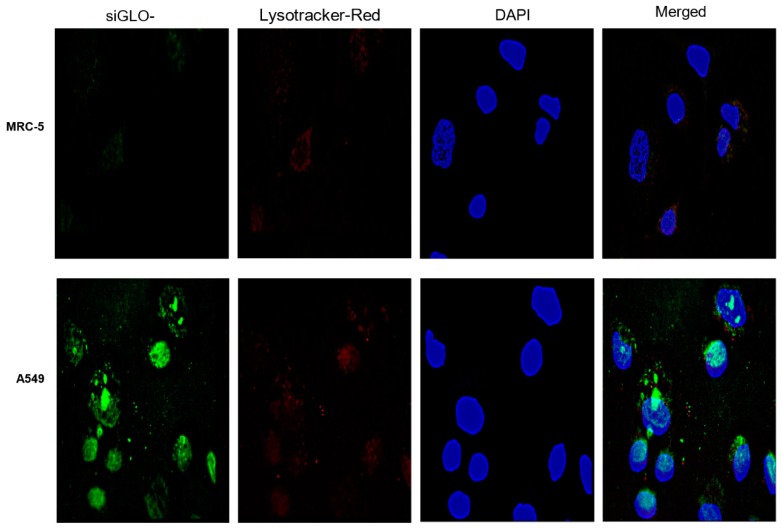
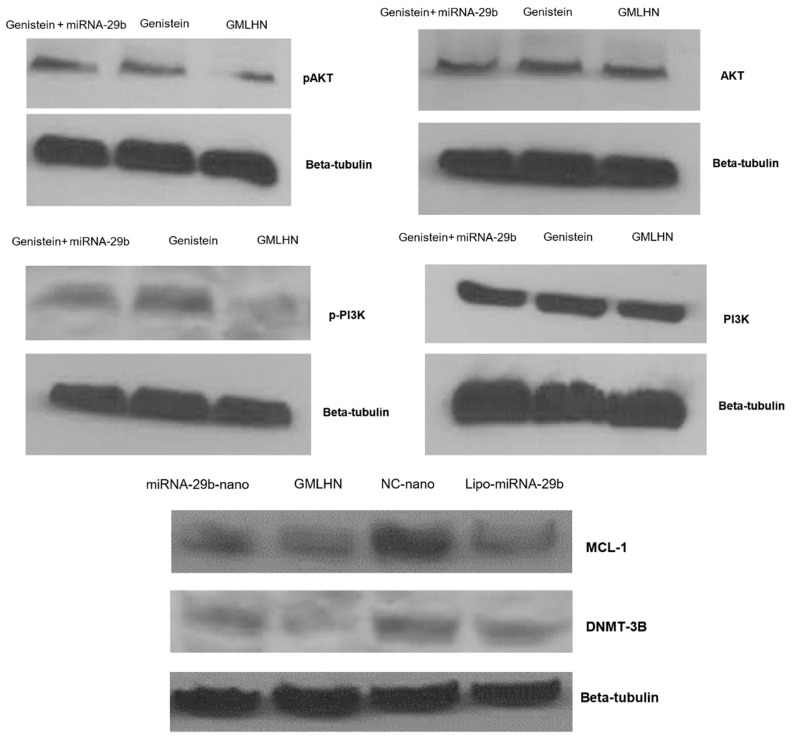
This study aimed to evaluate the anti-cancer effect of a combination therapy of miRNA-29b and genistein loaded in mucin-1 (MUC 1)-aptamer functionalized hybrid nanoparticles in non-small cell lung cancer (NSCLC) A549 cell line. Genistein-miRNA-29b-loaded hybrid nanoparticles (GMLHN) was prepared and characterized. Particle size and zeta potential were measured using photon correlation spectroscopy (PCS). Encapsulation efficiency and loading efficiency were determined using HPLC. Preferential internalization of MUC 1-aptamer functionalized GMLHN by A549 cells was evaluated and compared to normal MRC-5 cells. The ability of GMLHN to downregulate targeted oncoproteins Phosphorylated protein kinase, strain AK, Thymoma (Phosphorylated protein kinase B) (pAKT), Phosphorylated phosphoinositide 3-kinase (p-PI3K), DNA (cytosine-5-)-methyltransferase 3 beta (DNMT3B) and Myeloid Cell Leukemia Sequence 1 (MCL 1) was evaluated using western blot, while antiproliferative effect and ability to initiate apoptosis was also assessed in A549 cells. MUC 1-aptamer functionalized GMLHN nanoparticles were prepared. These nanoparticles were preferentially internalized by A549 cells but less so, in MRC-5 cells. pAKT, p-PI3K, DNMT3B and MCL 1 were efficiently downregulated by these nanoparticles without affecting the levels of AKT and PI3K in A549 cells. GMLHN demonstrated a superior antiproliferative effect compared to individual genistein and miRNA-29b-loaded nanoparticles. Results generated were able to demonstrate that genistein-miRNA-29b-loaded hybrid nanoparticles (GMLHN) could be a potential treatment modality for NSCLC because of the ability of the payloads to attack multiple targets.
本研究旨在评估载有微小RNA-29b和染料木黄酮的粘蛋白-1(MUC 1)适配体功能化杂化纳米颗粒联合疗法对非小细胞肺癌(NSCLC)A549细胞系的抗癌作用。制备并表征了载有染料木黄酮-微小RNA-29b的杂化纳米颗粒(GMLHN)。使用光子相关光谱法(PCS)测量粒径和zeta电位。使用高效液相色谱法(HPLC)测定包封率和负载率。评估了MUC 1适配体功能化GMLHN被A549细胞优先内化的情况,并与正常MRC-5细胞进行比较。使用蛋白质免疫印迹法评估GMLHN下调靶向癌蛋白磷酸化蛋白激酶、AK菌株、胸腺瘤(磷酸化蛋白激酶B)(pAKT)、磷酸化磷脂酰肌醇3激酶(p-PI3K)、DNA(胞嘧啶-5-)-甲基转移酶3β(DNMT3B)和髓样细胞白血病序列1(MCL 1)的能力,同时还评估了A549细胞中的抗增殖作用和引发凋亡的能力。制备了MUC 1适配体功能化GMLHN纳米颗粒。这些纳米颗粒被A549细胞优先内化,但在MRC-5细胞中的内化程度较低。这些纳米颗粒有效地下调了pAKT、p-PI-3K、DNMT3B和MCL 1,而不影响A549细胞中AKT和PI3K的水平。与单独载有染料木黄酮和微小RNA-29b的纳米颗粒相比,GMLHN表现出更强的抗增殖作用。所得结果能够证明,载有染料木黄酮-微小RNA-29b的杂化纳米颗粒(GMLHN)可能是一种治疗NSCLC的潜在方式,因为其有效载荷能够攻击多个靶点。