Faculty of Social Science and Law, University of Castilla-La Mancha, Talavera de la Reina, Spain.
Faculty of Health Science, University of Castilla-La Mancha, Talavera de la Reina, Spain.
Eur J Health Econ. 2019 Nov;20(8):1207-1236. doi: 10.1007/s10198-019-01087-6. Epub 2019 Jul 24.
The main objective of this study was to analyse how the inclusion (exclusion) of social costs can alter the results and conclusions of economic evaluations in the field of Alzheimer's disease interventions.
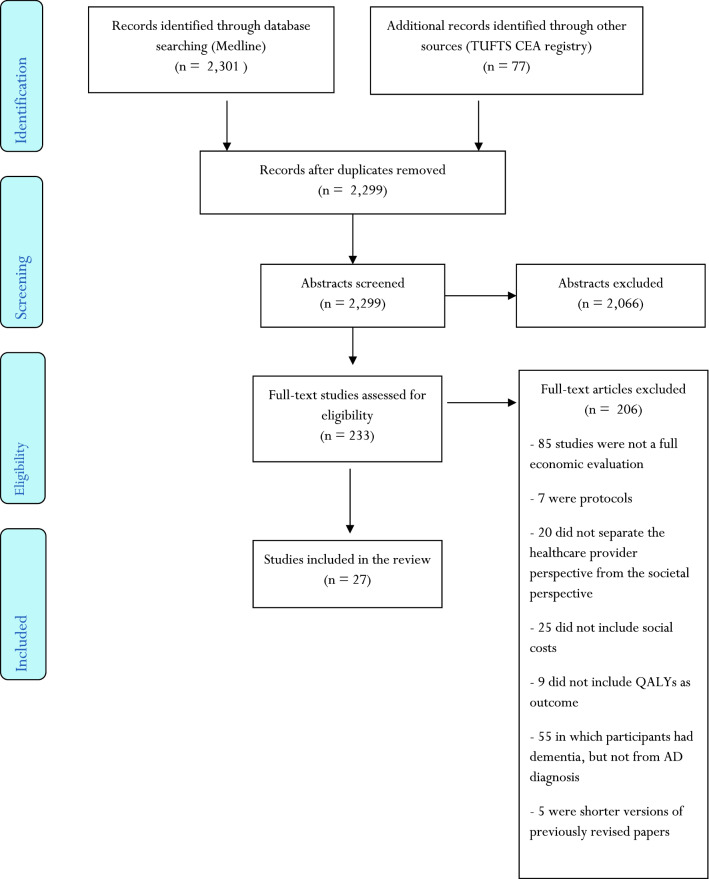
We designed a systematic review that included economic evaluations in Alzheimer's disease. The search strategy was launched in 2000 and ran until November 2018. The inclusion criteria were: being an original study published in a scientific journal, being an economic evaluation of any intervention related to Alzheimer's disease, including social costs (informal care costs and/or productivity losses), being written in English, using QALYs as an outcome for the incremental cost-utility analysis, and separating the results according to the perspective applied.
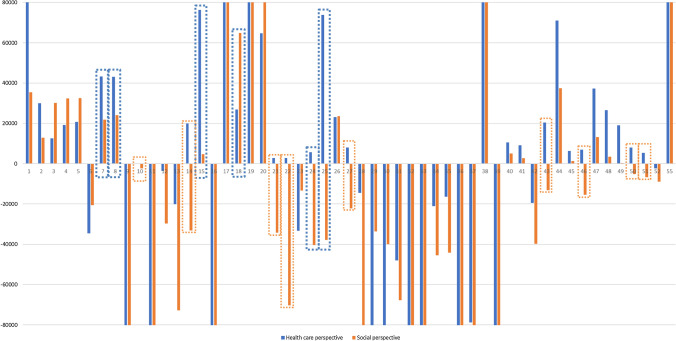
It was finally included 27 studies and 55 economic evaluations. Around 11% of economic evaluations changed their main conclusions. More precisely, three of them concluded that the new intervention became cost-effective when the societal perspective was considered, whereas when using just the health care payer perspective, the new intervention did not result in a cost-utility ratio below the threshold considered. Nevertheless, the inclusion of social cost can also influence the results, as 37% of the economic evaluations included became the dominant strategy after including social costs when they were already cost-effective in the health care perspective.
Social costs can substantially modify the results of the economic evaluations. Therefore, taking into account social costs in diseases such as Alzheimer's can be a key element in making decisions about public financing and pricing of health interventions.
本研究的主要目的是分析在阿尔茨海默病干预领域,纳入(排除)社会成本如何改变经济评估的结果和结论。
我们设计了一项系统评价,其中包括阿尔茨海默病的经济评估。搜索策略于 2000 年启动,一直持续到 2018 年 11 月。纳入标准为:作为科学期刊发表的原始研究,是任何与阿尔茨海默病相关的干预措施的经济评估,包括社会成本(非正式护理成本和/或生产力损失),用英文书写,使用 QALY 作为增量成本效用分析的结果,并根据应用的角度对结果进行分离。
最终纳入了 27 项研究和 55 项经济评估。约有 11%的经济评估改变了其主要结论。更确切地说,其中有三项研究在考虑社会角度时得出新干预措施具有成本效益的结论,而仅从医疗保健支付者的角度来看,新干预措施不会导致成本效益比低于所考虑的阈值。然而,纳入社会成本也会影响结果,因为在纳入社会成本后,37%的经济评估在从医疗保健角度来看已经具有成本效益的情况下成为主导策略。
社会成本可以极大地改变经济评估的结果。因此,在阿尔茨海默病等疾病中考虑社会成本可以成为公共融资和卫生干预定价决策的关键因素。