Søgaard Rikke, Sørensen Jan, Waldorff Frans B, Eckermann Ane, Buss Dorte V, Phung Kieu T T, Waldemar Gunhild
CAST-Centre for Applied Health Services Research, University of Southern Denmark, Odense, Denmark.
BMJ Open. 2014 Jan 15;4(1):e004105. doi: 10.1136/bmjopen-2013-004105.
To assess the cost utility of early psychosocial intervention for patients with Alzheimer's disease and their primary caregivers.
Cost utility evaluation alongside a multicentre, randomised controlled trial with 3 years of follow-up.
Primary care and memory clinics in five Danish districts.
330 community-dwelling patients and their primary caregivers.
Psychosocial counselling and support lasting 8-12 months after diagnosis and follow-up at 3, 6, 12 and 36 months in the intervention group or follow-up only in the control group.
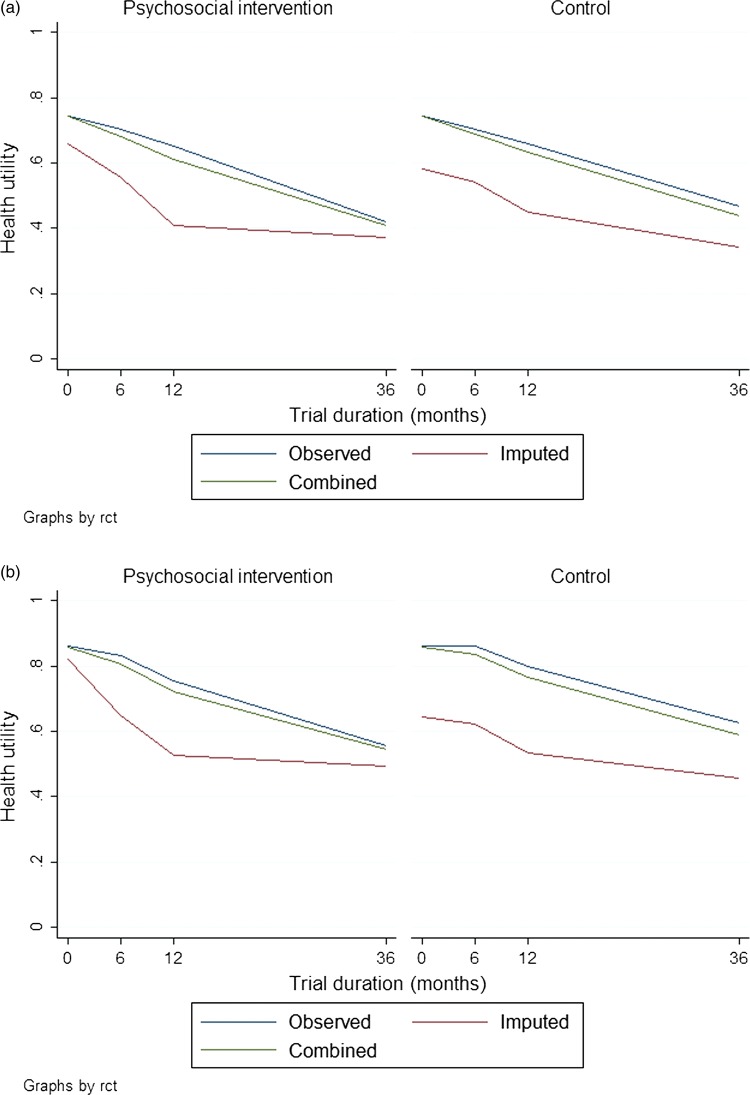
The primary outcome measure was the cost of additional quality-adjusted life years (QALYs). Costs were measured from a societal perspective, including the costs of healthcare, social care, informal care and production loss. QALYs were estimated separately for the patient and the caregiver before aggregation for the main analysis.
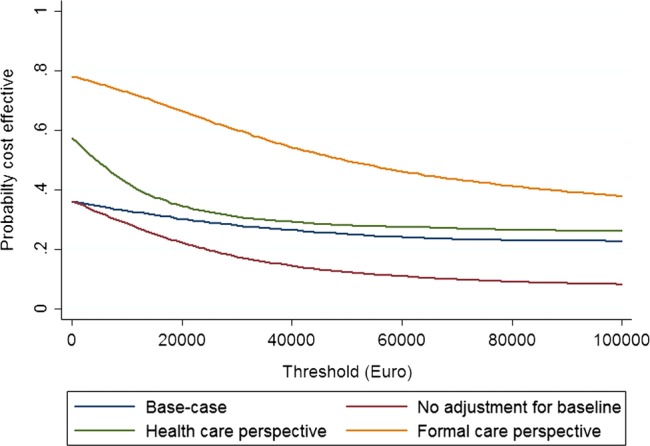
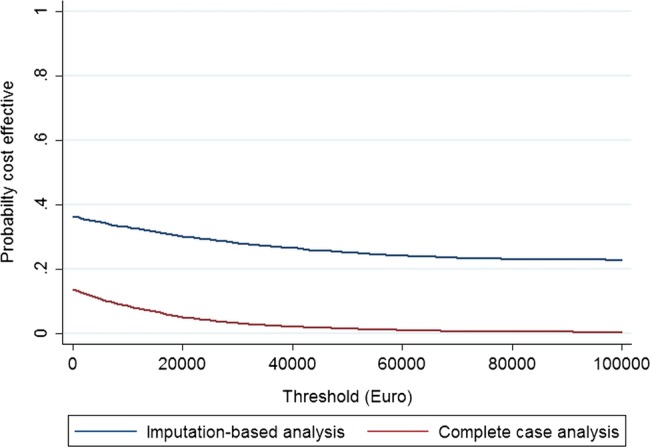
None of the observed cost and QALY measures were significantly different between the intervention and control groups, although a tendency was noted for psychosocial care leading to cost increases with informal care that was not outweighed by the tendency for cost savings with formal care. The probability of psychosocial intervention being cost-effective did not exceed 36% for any threshold value. The alternative scenario analysis showed that the probability of cost-effectiveness increased over the range of threshold values used if the cost perspective was restricted to formal healthcare.
A multifaceted, psychosocial intervention programme was found unlikely to be cost-effective from a societal perspective. The recommendation for practice in settings that are similar to the Danish setting is to provide follow-up with referral to available local support programmes when needed, and to restrict large multifaceted intervention programmes to patients and caregivers with special needs until further evidence for cost-effectiveness emerges.
The study was registered in the Clinical Trial Database as ISRCTN74848736.
评估针对阿尔茨海默病患者及其主要照料者的早期心理社会干预的成本效用。
在一项为期3年随访的多中心随机对照试验基础上进行成本效用评估。
丹麦五个地区的初级保健机构和记忆诊所。
330名居家患者及其主要照料者。
干预组在诊断后进行为期8 - 12个月的心理社会咨询与支持,并在3、6、12和36个月进行随访;对照组仅进行随访。
主要结局指标为额外的质量调整生命年(QALY)成本。成本从社会角度衡量,包括医疗保健、社会护理、非正式护理和生产损失的成本。在汇总进行主要分析之前,分别对患者和照料者的QALY进行估计。
干预组和对照组之间观察到的成本和QALY指标均无显著差异,尽管注意到心理社会护理导致非正式护理成本增加的趋势,但正式护理节省成本的趋势并未超过该趋势。对于任何阈值,心理社会干预具有成本效益的概率均未超过36%。替代情景分析表明,如果成本视角仅限于正式医疗保健,则在所用阈值范围内成本效益的概率会增加。
从社会角度来看,一项多方面的心理社会干预计划不太可能具有成本效益。对于与丹麦情况类似的环境中的实践建议是,在需要时提供随访并转介至可用的当地支持计划,并且在有进一步的成本效益证据出现之前,将大型多方面干预计划限制于有特殊需求的患者和照料者。
该研究在临床试验数据库中注册为ISRCTN74848736。