Centers for Disease Control and Prevention, Dengue Branch, San Juan, Puerto Rico, United States of America.
United States Public Health Service, Silver Springs, Maryland, United States of America.
PLoS Negl Trop Dis. 2019 Jul 25;13(7):e0007538. doi: 10.1371/journal.pntd.0007538. eCollection 2019 Jul.
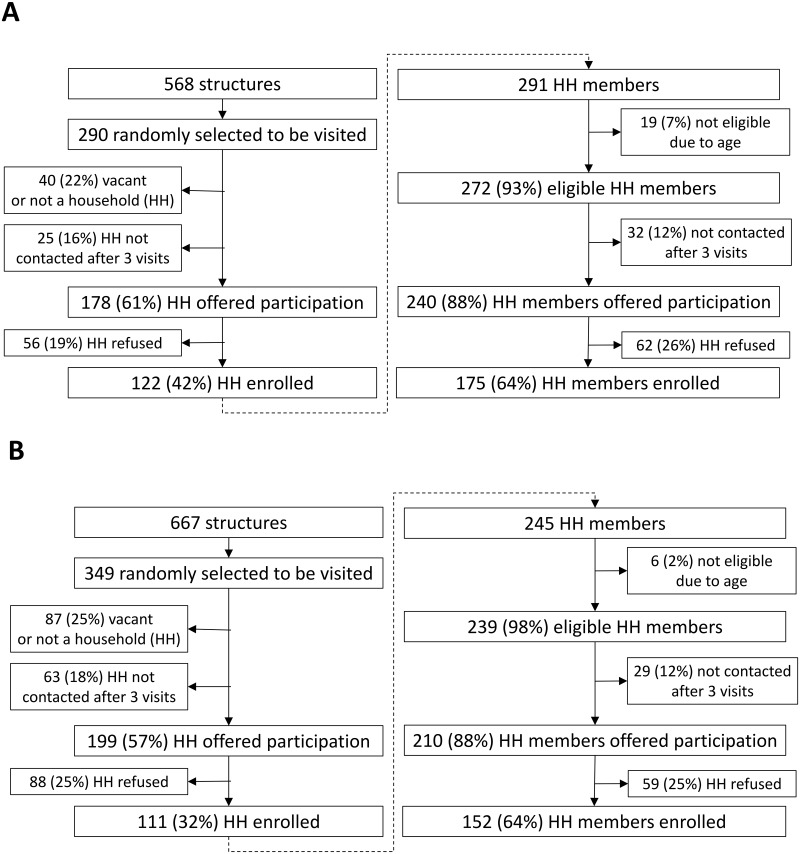
Public health responses to outbreaks of dengue, chikungunya, and Zika virus have been stymied by the inability to control the primary vector, Aedes aegypti mosquitos. Consequently, the need for novel approaches to Aedes vector control is urgent. Placement of three autocidal gravid ovitraps (AGO traps) in ~85% of homes in a community was previously shown to sustainably reduce the density of female Ae. aegypti by >80%. Following the introduction of chikungunya virus (CHIKV) to Puerto Rico, we conducted a seroprevalence survey to estimate the prevalence of CHIKV infection in communities with and without AGO traps and evaluate their effect on reducing CHIKV transmission.
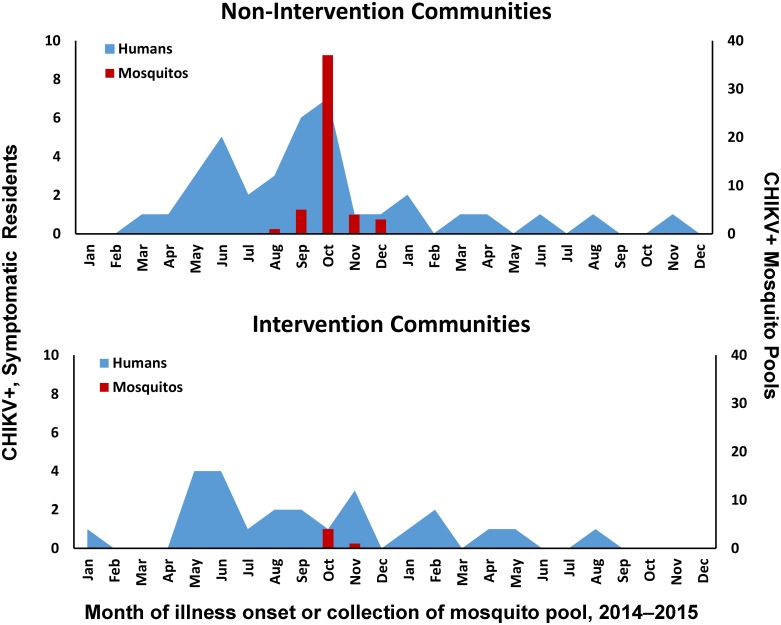
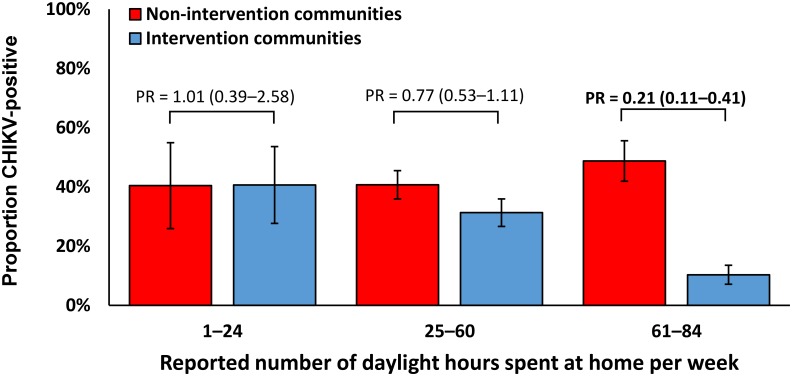
Multivariate models that calculated adjusted prevalence ratios (aPR) showed that among 175 and 152 residents of communities with and without AGO traps, respectively, an estimated 26.1% and 43.8% had been infected with CHIKV (aPR = 0.50, 95% CI: 0.37-0.91). After stratification by time spent in their community, protection from CHIKV infection was strongest among residents who reported spending many or all weekly daytime hours in their community:10.3% seropositive in communities with AGO traps vs. 48.7% in communities without (PR = 0.21, 95% CI: 0.11-0.41). The age-adjusted rate of fever with arthralgia attributable to CHIKV infection was 58% (95% CI: 46-66%). The monthly number of CHIKV-infected mosquitos and symptomatic residents were diminished in communities with AGO traps compared to those without.
These findings indicate that AGO traps are an effective tool that protects humans from infection with a virus transmitted by Ae. aegypti mosquitos. Future studies should evaluate their protective effectiveness in large, urban communities.
登革热、基孔肯雅热和寨卡病毒疫情的公共卫生应对措施受到无法控制主要传播媒介埃及伊蚊的阻碍。因此,迫切需要寻找新的方法来控制埃及伊蚊。先前的研究表明,在社区中约 85%的家庭中放置三个自灭性带卵诱蚊器(AGO 诱蚊器)可将雌性埃及伊蚊的密度持续降低 80%以上。在寨卡病毒(CHIKV)传入波多黎各后,我们进行了血清流行率调查,以估计有和没有 AGO 诱蚊器的社区中 CHIKV 感染的流行率,并评估它们对降低 CHIKV 传播的影响。
多变量模型计算出的调整后患病率比值(aPR)表明,在分别有和没有 AGO 诱蚊器的社区中,估计有 175 名和 152 名居民感染了 CHIKV(aPR=0.50,95%CI:0.37-0.91)。按在社区中度过的时间进行分层后,在报告每周白天大部分或全部时间都在社区中度过的居民中,对 CHIKV 感染的保护最强:有 AGO 诱蚊器的社区中 10.3%血清阳性,而没有 AGO 诱蚊器的社区中 48.7%血清阳性(PR=0.21,95%CI:0.11-0.41)。归因于 CHIKV 感染的发热伴关节炎的年龄调整发病率为 58%(95%CI:46-66%)。与没有 AGO 诱蚊器的社区相比,有 AGO 诱蚊器的社区中每月感染 CHIKV 的蚊子和出现症状的居民数量减少。
这些发现表明,AGO 诱蚊器是一种有效的工具,可以保护人类免受埃及伊蚊传播的病毒感染。未来的研究应评估它们在大型城市社区中的保护效果。