Department of Biochemistry/Biotechnology, University of Turku, Turku, Finland.
Faculty of Medicine and Health Technology, Tampere University and Department of Oncology, Tampere University Hospital, Tampere, Finland.
PLoS One. 2019 Jul 25;14(7):e0219480. doi: 10.1371/journal.pone.0219480. eCollection 2019.
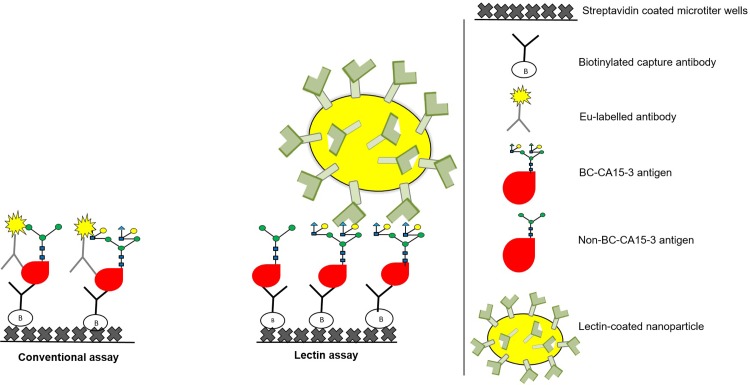
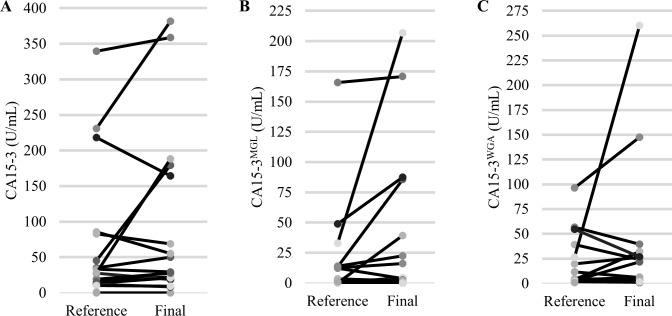
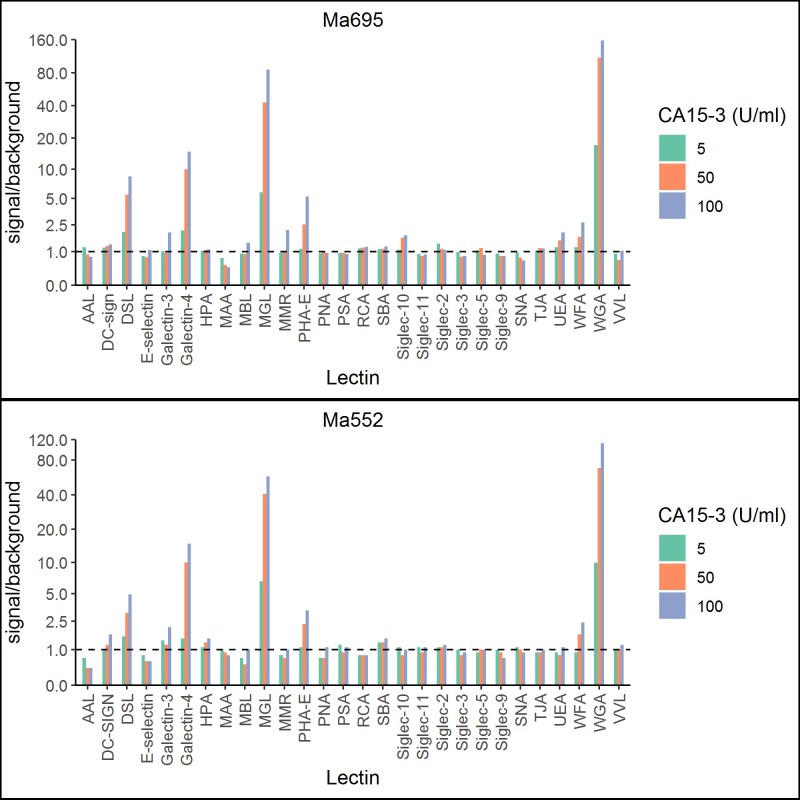
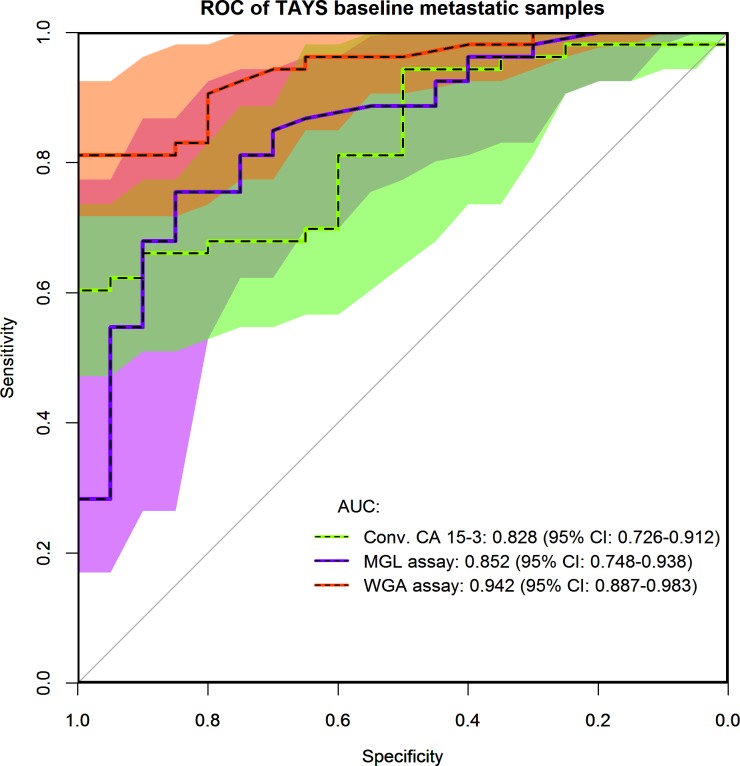
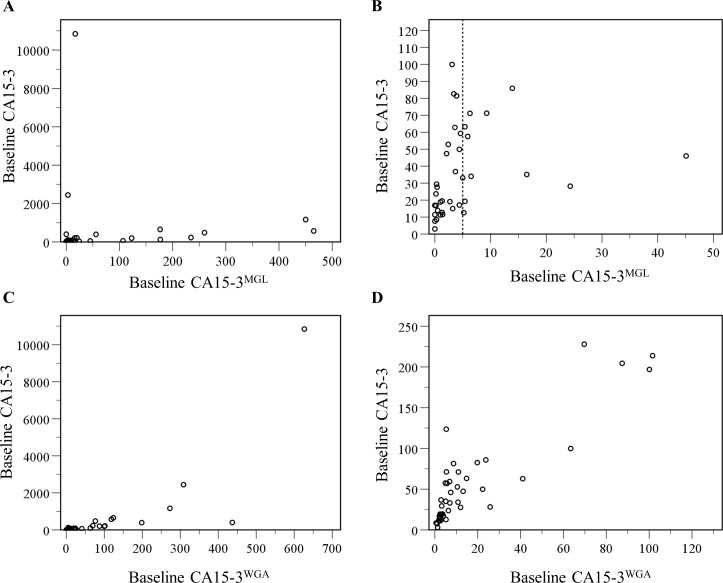
Cancer antigen 15-3 (CA15-3) is widely utilized for monitoring metastatic breast cancer (BC). However, its utility for early detection of breast cancer is severely limited due to poor clinical sensitivity and specificity. The glycosylation of CA15-3 is known to be affected by BC, and therefore it might offer a way to construct CA15-3 glycovariant assays with improved cancer specificity. To this end, we performed lectin-based glycoprofiling of BC-associated CA15-3. CA15-3 expressed by a BC cell line was immobilized on microtitration wells using an anti-CA15-3 antibody. The glycosylation of the immobilized CA15-3 was then detected by using lectins coated onto europium (III)-doped nanoparticles (Eu+3-NPs) and measuring the time-resolved fluorescence of Eu. Out of multiple lectin-Eu+3-NP preparations, wheat germ agglutinin (WGA) and macrophage galactose-type lectin (MGL) -Eu3+-NPs bound to the BC cell line-dericed CA15-3 glycovariants (CA15-3Lectin). To evaluate the clinical performance of these two lectin-based assays, plasma samples from metastatic BC patients (n = 53) and healthy age-matched women (n = 20).Plasma CA15-3Lectin measurements better distinguished metastatic BC patients from healthy controls than the conventional CA15-3 immunoassay. At 90% specificity, the clinical sensitivity of the assays was 66.0, 67.9 and 81.1% for the conventional CA15-3, CA15-3MGL and CA15-3WGA assays, respectively. Baseline CA15-3MGL and CA15-3WGA were correlated to conventional baseline CA15-3 levels (r = 0.68, p<0.001, r = 0.90, p>0.001, respectively). However, very low baseline CA15-3MGL levels ≤ 5 U/mL were common in this metastatic breast cancer patient population.In conclusion, the new CA15-3Lectin concept could considerably improve the clinical sensitivity of BC detection compared to the conventional CA15-3 immunoassays and should be validated further on a larger series of subjects with different cancer subtypes and stages.
癌抗原 15-3(CA15-3)广泛用于监测转移性乳腺癌(BC)。然而,由于其临床敏感性和特异性较差,其用于早期检测乳腺癌的用途受到严重限制。已知 CA15-3 的糖基化受 BC 影响,因此它可能提供了一种构建具有改善癌症特异性的 CA15-3 糖变异体测定的方法。为此,我们对与 BC 相关的 CA15-3 进行了基于凝集素的糖蛋白组学研究。使用抗 CA15-3 抗体将 BC 细胞系表达的 CA15-3 固定在微量滴定孔中。然后,通过使用涂覆在铕(III)掺杂纳米颗粒(Eu+3-NP)上的凝集素检测固定化 CA15-3 的糖基化,并测量 Eu 的时间分辨荧光。在多种凝集素-Eu+3-NP 制剂中,麦胚凝集素(WGA)和巨噬细胞半乳糖型凝集素(MGL)-Eu3+-NP 与 BC 细胞系衍生的 CA15-3 糖变异体(CA15-3Lectin)结合。为了评估这两种基于凝集素的测定方法的临床性能,对 53 例转移性 BC 患者(n=53)和 20 例健康年龄匹配的女性(n=20)的血浆样本进行了检测。与传统的 CA15-3 免疫测定相比,这些基于凝集素的测定方法可以更好地区分转移性 BC 患者和健康对照者。在 90%特异性的情况下,常规 CA15-3、CA15-3MGL 和 CA15-3WGA 测定的临床灵敏度分别为 66.0%、67.9%和 81.1%。在基线时,CA15-3MGL 和 CA15-3WGA 与常规基线 CA15-3 水平相关(r=0.68,p<0.001,r=0.90,p>0.001)。然而,在该转移性乳腺癌患者人群中,非常低的基线 CA15-3MGL 水平≤5 U/mL 很常见。结论,与传统的 CA15-3 免疫测定相比,新的 CA15-3Lectin 概念可以显著提高 BC 检测的临床灵敏度,应在具有不同癌症亚型和阶段的更大系列受试者中进一步验证。