Department of Sport Sciences, Sports Research Centre, Miguel Hernandez University of Elche, Elche, Spain.
Postdoctoral fellow from Seneca Foundation, Murcia, Spain.
PLoS One. 2019 Jul 25;14(7):e0220065. doi: 10.1371/journal.pone.0220065. eCollection 2019.
The purpose of this study was to analyse the relationship between several parameters of neuromuscular performance with dynamic postural control using a Bayesian Network Classifiers (BN) based analysis.
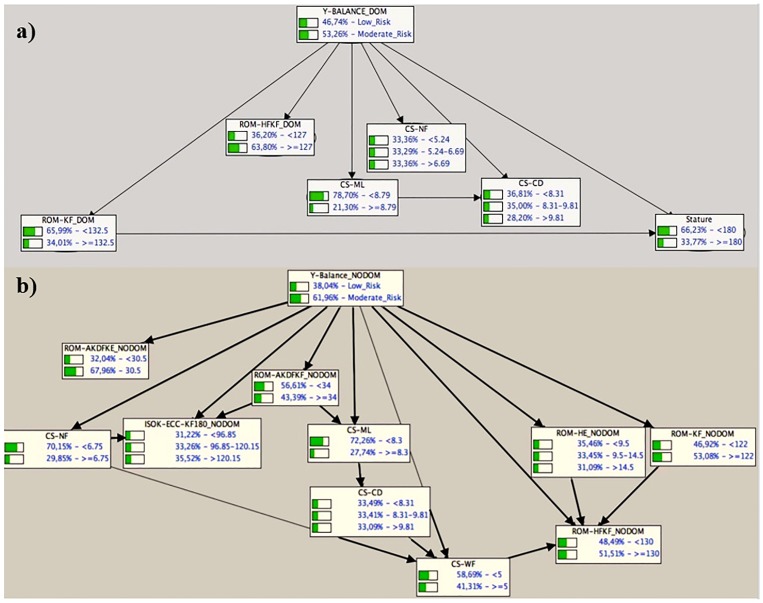
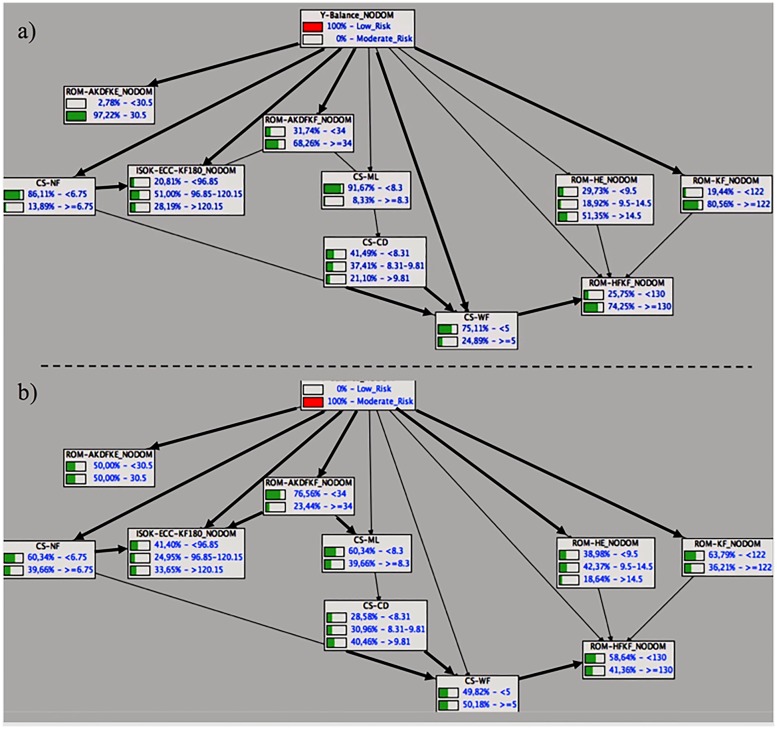
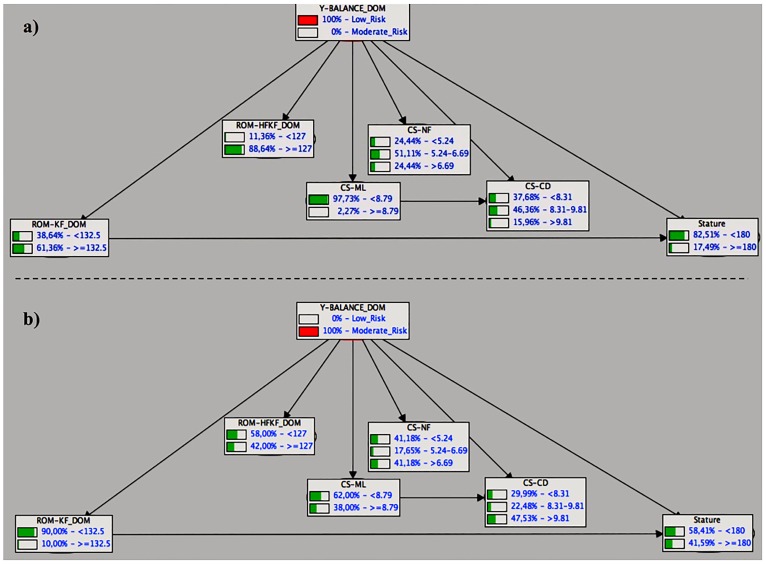
The y-balance test (measure of dynamic postural control), isokinetic (concentric and eccentric) knee flexion and extension strength, isometric hip abduction and adduction strength, lower extremity joint range of motion (ROM) and core stability were assessed in 44 elite male futsal players. A feature selection process was carried out before building a BN (using the Tabu search algorithm) for each leg. The BN models built were used to make belief updating processes to study the individual and concurrent contributions of the selected parameters of neuromuscular performance on dynamic postural control.
The BNs generated using the selected features by the algorithms correlation attribute evaluator and chi squared reported the highest evaluation criteria (area under the receiver operating characteristic curve [AUC]) for the dominant (AUC = 0.899) and non-dominant (AUC = 0.879) legs, respectively.
The BNs demonstrated that performance achieved in the y-balance test appears to be widely influenced by hip and knee flexion and ankle dorsiflexion ROM measures in the sagittal plane, as well as by measures of static but mainly dynamic core stability in the frontal plane. Therefore, training interventions aimed at improving or maintaining dynamic postural control in elite male futsal players should include, among other things, exercises that produce ROM scores equal or higher than 127° of hip flexion, 132.5° of knee flexion as well as 34° and 30.5° of ankle dorsiflexion with the knee flexed and extended, respectively. Likewise, these training interventions should also include exercises to maintain or improve both the static and dynamic (medial-lateral plane) core stability so that futsal players can achieve medial radial error values lower than 6.69 and 8.79 mm, respectively.
本研究旨在分析基于贝叶斯网络分类器(BN)的分析中神经肌肉性能的几个参数与动态姿势控制之间的关系。
在 44 名精英男性五人制足球运动员中评估了 Y 平衡测试(动态姿势控制的测量)、等速(向心和离心)膝关节屈伸力量、等长髋关节外展和内收力量、下肢关节活动度(ROM)和核心稳定性。在为每条腿构建 BN 之前,进行了特征选择过程(使用禁忌搜索算法)。构建的 BN 模型用于进行置信度更新过程,以研究所选神经肌肉性能参数对动态姿势控制的个体和并发贡献。
使用算法相关属性评估器和卡方选择的特征生成的 BNs 为优势(AUC = 0.899)和非优势(AUC = 0.879)腿分别报告了最高的评估标准(接收者操作特征曲线下的面积[AUC])。
BN 表明,在 Y 平衡测试中取得的成绩似乎受到矢状面中髋关节和膝关节屈伸以及踝关节背屈 ROM 测量以及额状面中静态但主要是动态核心稳定性测量的广泛影响。因此,旨在改善或维持精英男性五人制足球运动员动态姿势控制的训练干预措施除其他外,还应包括产生 ROM 评分等于或高于 127°髋关节屈曲、132.5°膝关节屈曲以及分别在膝关节屈伸时 34°和 30.5°踝关节背屈的运动,同样,这些训练干预措施还应包括保持或改善静态和动态(内外平面)核心稳定性的运动,以便五人制足球运动员能够实现低于 6.69 和 8.79 毫米的内侧放射状误差值。