Lai Wilson C, Wang Dean, Chen James B, Vail Jeremy, Rugg Caitlin M, Hame Sharon L
Department of Orthopaedic Surgery, David Geffen School of Medicine, University of California at Los Angeles, Los Angeles, California, USA.
Department of Athletics, University of California at Los Angeles, Los Angeles, California, USA.
Orthop J Sports Med. 2017 Aug 8;5(8):2325967117723666. doi: 10.1177/2325967117723666. eCollection 2017 Aug.
Functional movement tests that are predictive of injury risk in National Collegiate Athletic Association (NCAA) athletes are useful tools for sports medicine professionals. The Lower Quarter Y-Balance Test (YBT-LQ) measures single-leg balance and reach distances in 3 directions.
To assess whether the YBT-LQ predicts the laterality and risk of sports-related lower extremity (LE) injury in NCAA athletes.
Case-control study; Level of evidence, 3.
The YBT-LQ was administered to 294 NCAA Division I athletes from 21 sports during preparticipation physical examinations at a single institution. Athletes were followed prospectively over the course of the corresponding season. Correlation analysis was performed between the laterality of reach asymmetry and composite scores (CS) versus the laterality of injury. Receiver operating characteristic (ROC) analysis was used to determine the optimal asymmetry cutoff score for YBT-LQ. A multivariate regression analysis adjusting for sex, sport type, body mass index, and history of prior LE surgery was performed to assess predictors of earlier and higher rates of injury.
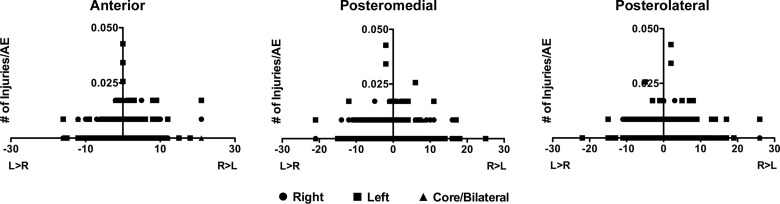
Neither the laterality of reach asymmetry nor the CS correlated with the laterality of injury. ROC analysis found optimal cutoff scores of 2, 9, and 3 cm for anterior, posteromedial, and posterolateral reach, respectively. All of these potential cutoff scores, along with a cutoff score of 4 cm used in the majority of prior studies, were associated with poor sensitivity and specificity. Furthermore, none of the asymmetric cutoff scores were associated with earlier or increased rate of injury in the multivariate analyses.
YBT-LQ scores alone do not predict LE injury in this collegiate athlete population. Sports medicine professionals should be cautioned against using the YBT-LQ alone to screen for injury risk in collegiate athletes.
对于美国国家大学体育协会(NCAA)运动员而言,能够预测损伤风险的功能动作测试是运动医学专业人员的有用工具。下肢Y平衡测试(YBT-LQ)可测量单腿在3个方向上的平衡和伸展距离。
评估YBT-LQ是否能预测NCAA运动员与运动相关的下肢(LE)损伤的侧别和风险。
病例对照研究;证据等级,3级。
在一所机构的赛前体检中,对来自21个运动项目的294名NCAA一级运动员进行了YBT-LQ测试。在相应赛季中对运动员进行前瞻性随访。对伸展不对称的侧别和综合评分(CS)与损伤侧别之间进行相关性分析。采用受试者工作特征(ROC)分析来确定YBT-LQ的最佳不对称临界值。进行多因素回归分析,对性别、运动类型、体重指数和既往LE手术史进行校正,以评估损伤早期发生率和高发生率的预测因素。
伸展不对称的侧别和CS均与损伤侧别无关。ROC分析发现,前向、后内侧和后外侧伸展的最佳临界值分别为2 cm、9 cm和3 cm。所有这些潜在的临界值,以及大多数先前研究中使用的4 cm临界值,均与较低的敏感性和特异性相关。此外,在多因素分析中,没有一个不对称临界值与损伤的早期或发生率增加相关。
仅YBT-LQ评分不能预测该大学生运动员群体中的LE损伤。应提醒运动医学专业人员不要仅使用YBT-LQ来筛查大学生运动员的损伤风险。