Holm Laurits J, Buschard Karsten
The Bartholin Institute, Department of Pathology, Rigshospitalet, Copenhagen N, Denmark.
APMIS. 2019 Oct;127(10):655-659. doi: 10.1111/apm.12987. Epub 2019 Sep 2.
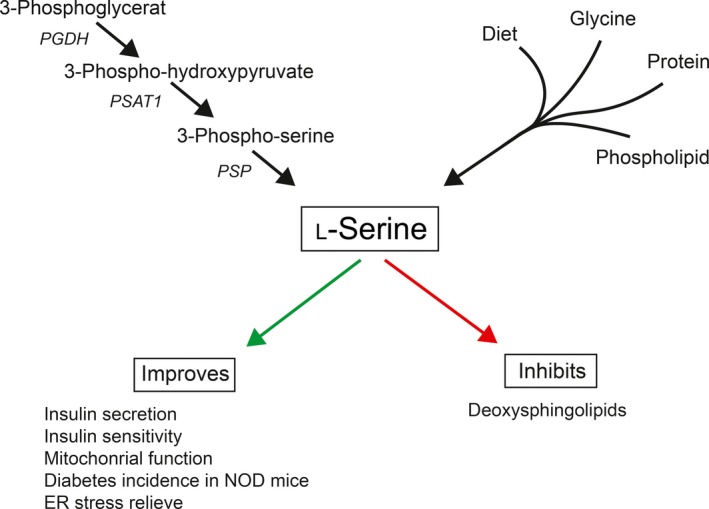
L-serine is classified as a non-essential amino acid; however, L-serine is indispensable having a central role in a broad range of cellular processes. Growing evidence suggests a role for L-serine in the development of diabetes mellitus and its related complications, with L-serine being positively correlated to insulin secretion and sensitivity. L-serine metabolism is altered in type 1, type 2, and gestational diabetes, and L-serine supplementations improve glucose homeostasis and mitochondrial function, and reduce neuronal death. Additionally, L-serine lowers the incidence of autoimmune diabetes in NOD mice. Dietary supplementations of L-serine are generally regarded as safe (GRAS) by the FDA. Therefore, we believe that L-serine should be considered as an emerging therapeutic option in diabetes, although work remains in order to fully understand the role of L-serine in diabetes.
L-丝氨酸被归类为非必需氨基酸;然而,L-丝氨酸在广泛的细胞过程中发挥着核心作用,不可或缺。越来越多的证据表明L-丝氨酸在糖尿病及其相关并发症的发生发展中起作用,L-丝氨酸与胰岛素分泌和敏感性呈正相关。1型、2型和妊娠期糖尿病患者的L-丝氨酸代谢发生改变,补充L-丝氨酸可改善葡萄糖稳态和线粒体功能,并减少神经元死亡。此外,L-丝氨酸可降低非肥胖糖尿病(NOD)小鼠自身免疫性糖尿病的发病率。L-丝氨酸的膳食补充剂通常被美国食品药品监督管理局(FDA)视为一般公认安全(GRAS)物质。因此,我们认为L-丝氨酸应被视为糖尿病治疗的一种新兴选择,尽管仍需开展研究以全面了解L-丝氨酸在糖尿病中的作用。