Alencar Mayke Bezerra, Girard Richard Marcel Bruno Moreira, Crispim Marcell, Baptista Carlos Gustavo, Biran Marc, Bringaud Frederic, Silber Ariel Mariano
Laboratory of Biochemistry of Trypanosomatids-LaBTryps, Department of Parasitology, Institute of Biomedical Science II-ICB II, University of São Paulo-USP, São Paulo, São Paulo, Brazil.
Microbiologie Fondamentale et Pathogénicité (MFP), UMR 5234, Univ. Bordeaux, CNRS, Bordeaux, France.
mSphere. 2025 Mar 25;10(3):e0098324. doi: 10.1128/msphere.00983-24. Epub 2025 Mar 5.
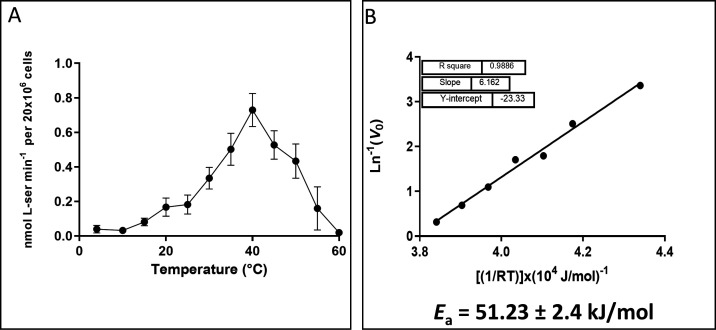
l-Serine and l-threonine have versatile roles in metabolism. In addition to their use in protein synthesis, these amino acids participate in the biosynthesis pathways of other amino acids and even phospholipids. Furthermore, l-serine and l-threonine can be substrates for a serine/threonine dehydratase (Ser/ThrDH), resulting in pyruvate and 2-oxobutyrate, respectively, thus being amino acids with anaplerotic potential. , the etiological agent of Chagas disease, uses amino acids in several biological processes: metacyclogenesis, infection, resistance to nutritional and oxidative stress, osmotic control, etc. This study investigated the import and metabolism of l-serine, l-threonine, and glycine in . Our results demonstrate that these amino acids are transported from the extracellular environment into cells through a saturable transport system that fits the Michaelis-Menten model. Our results show that l-serine and l-threonine can sustain epimastigote cell viability under nutritional stress conditions and stimulate oxygen consumption, maintaining intracellular ATP levels. Additionally, our findings indicate that serine plays a role in establishing the mitochondrial membrane potential in . Serine is also involved in energy metabolism via the serine-pyruvate pathway, which stimulates the production and subsequent excretion of acetate and alanine. Our results demonstrate the importance of l-serine and l-threonine in the energy metabolism of and provide new insights into the metabolic adaptations of this parasite during its life cycle.IMPORTANCE, the parasite responsible for Chagas disease, impacts 5-6 million individuals in the Americas and is rapidly spreading globally due to significant human migration. This parasitic organism undergoes a complex life cycle involving triatomine insects and mammalian hosts, thriving in diverse environments, such as various regions within the insect's digestive tract and mammalian cell cytoplasm. Crucially, its transmission hinges on its adaptive capabilities to varying environments. One of the most challenging environments is the insect's digestive tract, marked by nutrient scarcity between blood meals, redox imbalance, and osmotic stresses induced by the triatomine's metabolism. To endure these conditions, has developed a remarkably versatile metabolic network enabling it to metabolize sugars, lipids, and amino acids efficiently. However, the full extent of metabolites this parasite can thrive on remains incompletely understood. This study reveals that, beyond conventional carbon and energy sources (glucose, palmitic acids, proline, histidine, glutamine, and alanine), three additional metabolites (serine, threonine, and glycine) play vital roles in the parasite's survival during starvation. Remarkably, serine and threonine directly contribute to ATP production through a serine/threonine dehydratase enzyme not previously described in . The significance of this metabolic pathway for the parasite's survival sheds light on how metabolic networks aid in its endurance under extreme conditions and its ability to thrive in diverse metabolic settings.
L-丝氨酸和L-苏氨酸在新陈代谢中具有多种作用。除了用于蛋白质合成外,这些氨基酸还参与其他氨基酸甚至磷脂的生物合成途径。此外,L-丝氨酸和L-苏氨酸可以作为丝氨酸/苏氨酸脱水酶(Ser/ThrDH)的底物,分别生成丙酮酸和2-氧代丁酸,因此是具有回补潜力的氨基酸。克氏锥虫是恰加斯病的病原体,在多个生物过程中利用氨基酸:如后循环发育、感染、对营养和氧化应激的抗性、渗透调节等。本研究调查了克氏锥虫中L-丝氨酸、L-苏氨酸和甘氨酸的摄取与代谢。我们的结果表明,这些氨基酸通过符合米氏模型的可饱和转运系统从细胞外环境转运到克氏锥虫细胞中。我们的结果表明,在营养应激条件下,L-丝氨酸和L-苏氨酸可以维持无鞭毛体细胞的活力并刺激氧气消耗,维持细胞内ATP水平。此外,我们的研究结果表明,丝氨酸在克氏锥虫线粒体膜电位的建立中发挥作用。丝氨酸还通过丝氨酸-丙酮酸途径参与能量代谢,该途径刺激乙酸盐和丙氨酸的产生及随后的排泄。我们的结果证明了L-丝氨酸和L-苏氨酸在克氏锥虫能量代谢中的重要性,并为该寄生虫在其生命周期中的代谢适应性提供了新的见解。重要性:克氏锥虫是导致恰加斯病的寄生虫,影响着美洲500万至600万人,并且由于大量人口迁移而在全球迅速传播。这种寄生生物经历一个复杂的生命周期,涉及锥蝽昆虫和哺乳动物宿主,在多种环境中生存,如昆虫消化道的不同区域和哺乳动物细胞质。至关重要的是,其传播取决于其对不同环境的适应能力。最具挑战性的环境之一是昆虫的消化道,其特征是两次吸血之间营养物质稀缺、氧化还原失衡以及锥蝽代谢引起的渗透应激。为了在这些条件下生存,克氏锥虫已经发展出一个非常通用的代谢网络,使其能够有效地代谢糖、脂质和氨基酸。然而,这种寄生虫能够赖以生存的代谢物的全貌仍未完全了解。这项研究表明,除了传统的碳源和能源(葡萄糖、棕榈酸、脯氨酸、组氨酸、谷氨酰胺和丙氨酸)之外,另外三种代谢物(丝氨酸、苏氨酸和甘氨酸)在寄生虫饥饿期间的存活中起着至关重要的作用。值得注意的是,丝氨酸和苏氨酸通过一种以前在克氏锥虫中未被描述的丝氨酸/苏氨酸脱水酶直接促进ATP的产生。这种代谢途径对寄生虫生存的重要性揭示了代谢网络如何帮助其在极端条件下生存以及在不同代谢环境中茁壮成长的能力。