Department of Microbiology and Ecosystem Science, University of Vienna, Vienna, Austria.
Department of Ecology and Evolution, Université de Lausanne, Lausanne, Switzerland.
Glob Chang Biol. 2020 Feb;26(2):669-681. doi: 10.1111/gcb.14777. Epub 2019 Aug 28.
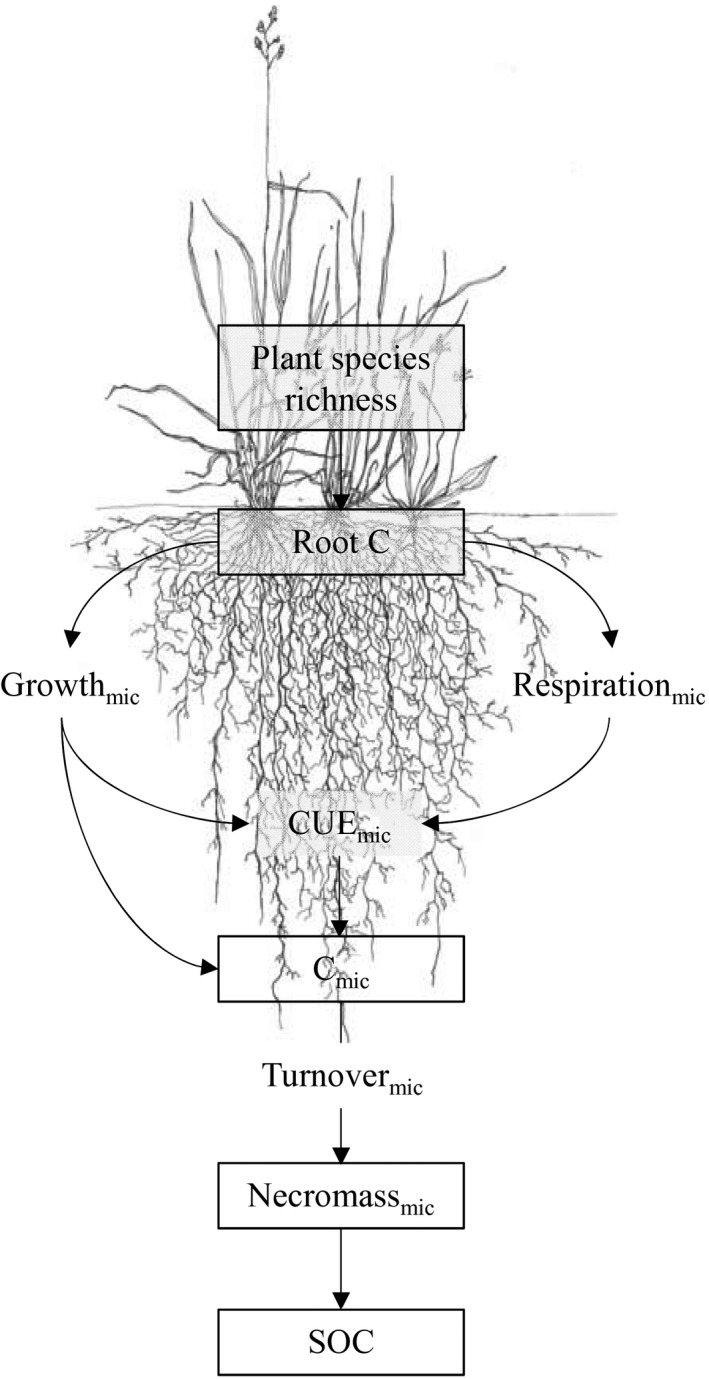
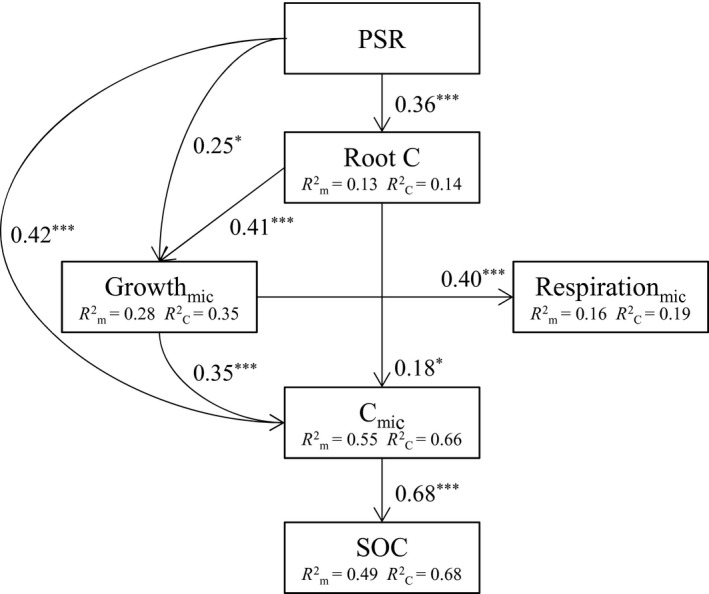
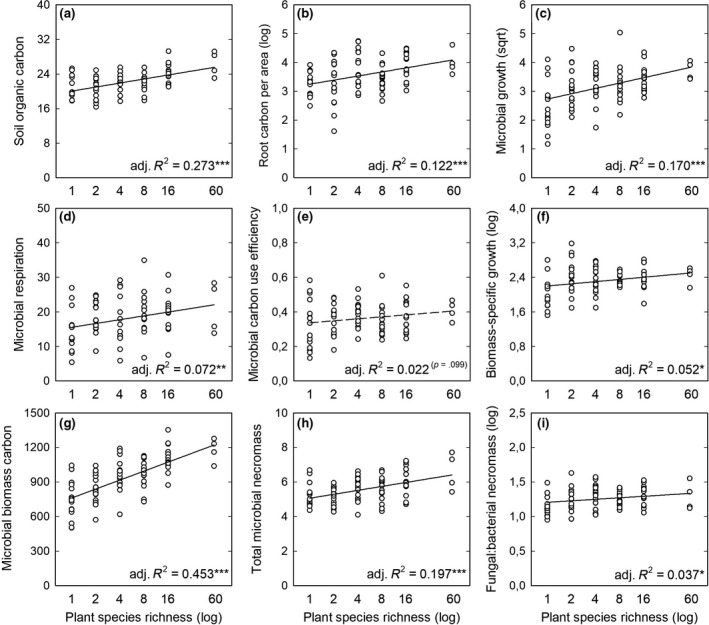
Species-rich plant communities have been shown to be more productive and to exhibit increased long-term soil organic carbon (SOC) storage. Soil microorganisms are central to the conversion of plant organic matter into SOC, yet the relationship between plant diversity, soil microbial growth, turnover as well as carbon use efficiency (CUE) and SOC accumulation is unknown. As heterotrophic soil microbes are primarily carbon limited, it is important to understand how they respond to increased plant-derived carbon inputs at higher plant species richness (PSR). We used the long-term grassland biodiversity experiment in Jena, Germany, to examine how microbial physiology responds to changes in plant diversity and how this affects SOC content. The Jena Experiment considers different numbers of species (1-60), functional groups (1-4) as well as functional identity (small herbs, tall herbs, grasses, and legumes). We found that PSR accelerated microbial growth and turnover and increased microbial biomass and necromass. PSR also accelerated microbial respiration, but this effect was less strong than for microbial growth. In contrast, PSR did not affect microbial CUE or biomass-specific respiration. Structural equation models revealed that PSR had direct positive effects on root biomass, and thereby on microbial growth and microbial biomass carbon. Finally, PSR increased SOC content via its positive influence on microbial biomass carbon. We suggest that PSR favors faster rates of microbial growth and turnover, likely due to greater plant productivity, resulting in higher amounts of microbial biomass and necromass that translate into the observed increase in SOC. We thus identify the microbial mechanism linking species-rich plant communities to a carbon cycle process of importance to Earth's climate system.
物种丰富的植物群落被证明具有更高的生产力,并表现出增加的长期土壤有机碳(SOC)储存。土壤微生物是将植物有机质转化为 SOC 的核心,但植物多样性、土壤微生物生长、周转以及碳利用效率(CUE)和 SOC 积累之间的关系尚不清楚。由于异养土壤微生物主要受到碳的限制,因此了解它们如何响应更高植物物种丰富度(PSR)下增加的植物源性碳输入非常重要。我们使用德国耶拿的长期草地生物多样性实验来研究微生物生理学如何响应植物多样性的变化,以及这如何影响 SOC 含量。该实验考虑了不同数量的物种(1-60)、功能组(1-4)以及功能身份(小草本植物、高大草本植物、禾本科植物和豆科植物)。我们发现,PSR 加速了微生物的生长和周转,增加了微生物生物量和腐殖质。PSR 还加速了微生物呼吸,但这种影响不如微生物生长强烈。相比之下,PSR 并没有影响微生物的 CUE 或生物量特异性呼吸。结构方程模型表明,PSR 对根生物量有直接的积极影响,从而对微生物的生长和微生物生物量碳产生影响。最后,PSR 通过对微生物生物量碳的积极影响,增加了 SOC 含量。我们认为,PSR 有利于更快的微生物生长和周转速度,这可能是由于更高的植物生产力,导致微生物生物量和腐殖质的增加,从而导致 SOC 的增加。因此,我们确定了将物种丰富的植物群落与对地球气候系统重要的碳循环过程联系起来的微生物机制。