Walker Tom W N, Kaiser Christina, Strasser Florian, Herbold Craig W, Leblans Niki I W, Woebken Dagmar, Janssens Ivan A, Sigurdsson Bjarni D, Richter Andreas
Department of Microbiology & Ecosystem Science, Division of Terrestrial Ecosystem Research, University of Vienna, 1090 Vienna, Austria.
Department of Ecology & Evolution, Université de Lausanne, CH-1015, Switzerland.
Nat Clim Chang. 2018 Oct;8(10):885-889. doi: 10.1038/s41558-018-0259-x. Epub 2018 Sep 17.
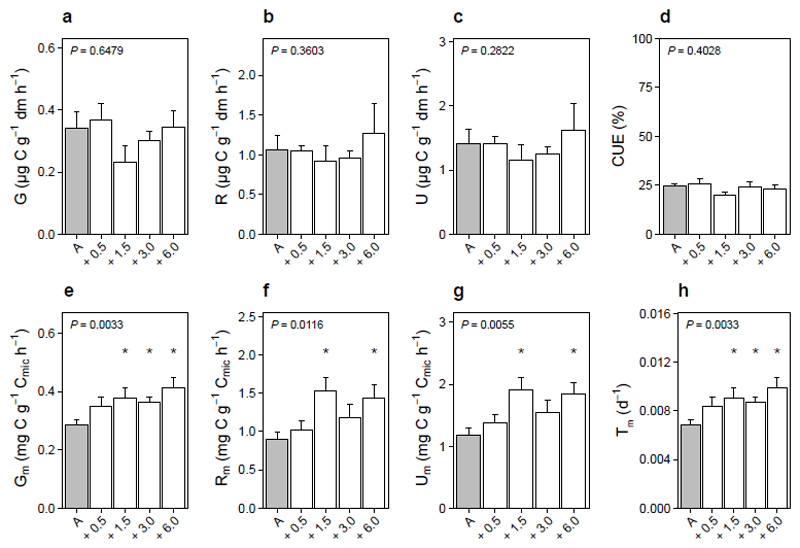
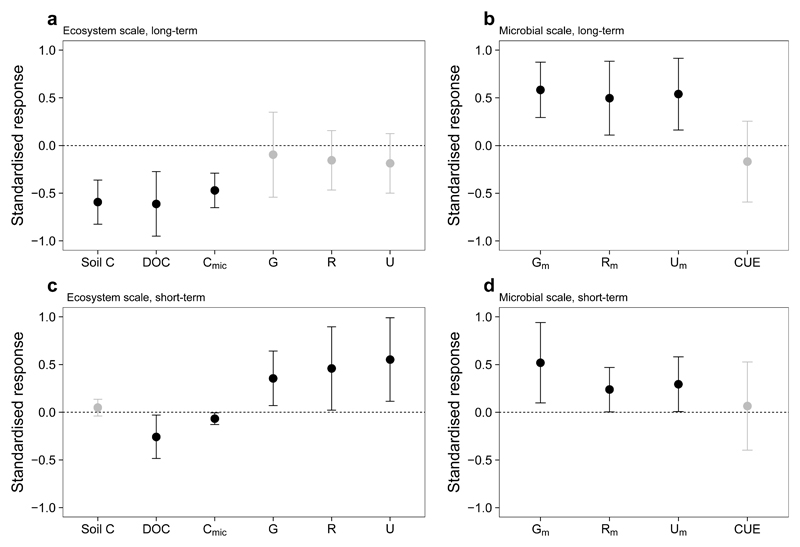
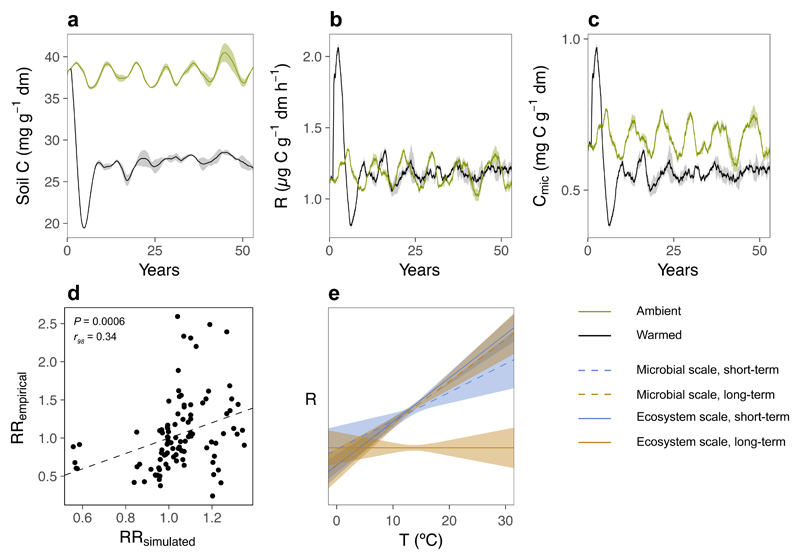
Soil microorganisms control carbon losses from soils to the atmosphere1-3, yet their responses to climate warming are often short-lived and unpredictable4-7. Two mechanisms, microbial acclimation and substrate depletion, have been proposed to explain temporary warming effects on soil microbial activity8-10. However, empirical support for either mechanism is unconvincing. Here we used geothermal temperature gradients (> 50 years of field warming)11 and a short-term experiment to show that microbial activity (gross rates of growth, turnover, respiration and carbon uptake) is intrinsically temperature sensitive and does not acclimate to warming (+ 6 ºC) over weeks or decades. Permanently accelerated microbial activity caused carbon loss from soil. However, soil carbon loss was temporary because substrate depletion reduced microbial biomass and constrained the influence of microbes over the ecosystem. A microbial biogeochemical model12-14 showed that these observations are reproducible through a modest, but permanent, acceleration in microbial physiology. These findings reveal a mechanism by which intrinsic microbial temperature sensitivity and substrate depletion together dictate warming effects on soil carbon loss their control over microbial biomass. We thus provide a framework for interpreting the links between temperature, microbial activity and soil carbon loss on timescales relevant to Earth's climate system.
土壤微生物控制着土壤向大气的碳流失1-3,然而它们对气候变暖的响应往往是短暂且不可预测的4-7。已经提出了两种机制,即微生物适应和底物耗尽,来解释气候变暖对土壤微生物活动的短期影响8-10。然而,对于这两种机制的实证支持都不令人信服。在这里,我们利用地热温度梯度(>50年的田间变暖)11和一项短期实验表明,微生物活动(生长、周转、呼吸和碳吸收的总速率)本质上对温度敏感,在数周或数十年内不会适应变暖(+6℃)。微生物活动的持续加速导致了土壤碳流失。然而,土壤碳流失是暂时的,因为底物耗尽减少了微生物生物量,并限制了微生物对生态系统的影响。一个微生物生物地球化学模型12-14表明,这些观察结果可以通过微生物生理学适度但永久的加速来重现。这些发现揭示了一种机制,即微生物内在的温度敏感性和底物耗尽共同决定了气候变暖对土壤碳流失及其对微生物生物量控制的影响。因此,我们提供了一个框架,用于解释在与地球气候系统相关的时间尺度上温度、微生物活动和土壤碳流失之间的联系。