Department of Public Health and Clinical Medicine, Umeå University, 90187 Umeå, Sweden.
Department of Public Health and Clinical Medicine, Unit of Research, Education and Development-Östersund Hospital, Box 654, 83127, Östersund, Sweden.
BMC Med Educ. 2019 Jul 25;19(1):282. doi: 10.1186/s12909-019-1713-9.
Early identification of patients with reduced left ventricular ejection fraction (LVEF) could facilitate the care of patients with suspected heart failure (HF). We examined if (1) focused cardiac ultrasound (FCU) performed with a hand-held device (Vscan 1.2) could identify patients with LVEF < 50%, and (2) the distribution of HF types among patients with suspected HF seen at primary care clinics.
FCU performed by general practitioners (GPs)/GP registrars after a training programme comprising 20 supervised FCU examinations were compared with the corresponding results from conventional cardiac ultrasound by specialists. The agreement between groups of estimated LVEF < 50%, after visual assessment of global left ventricular function, was compared. Types of HF were determined according to the outcomes from the reference examinations and serum levels of natriuretic peptides (NT-proBNP).
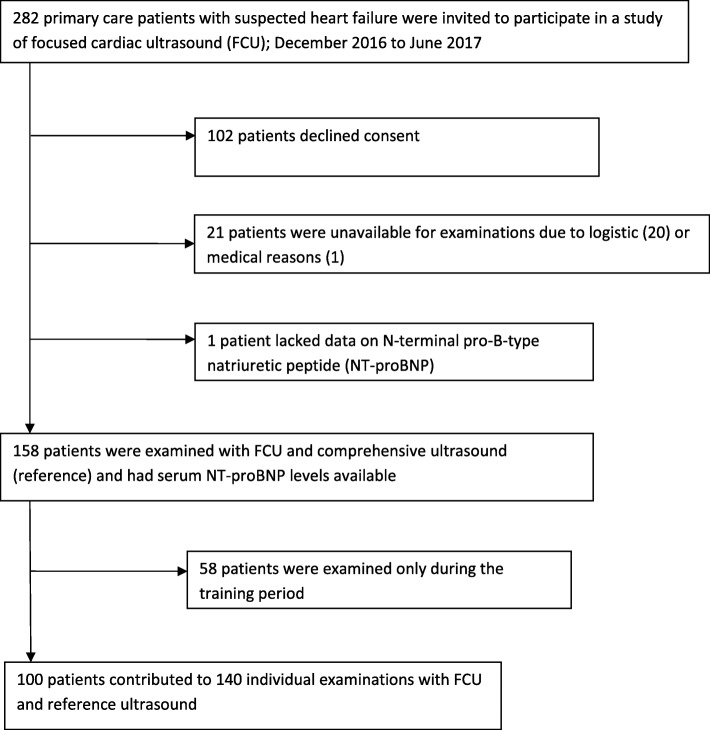
One hundred patients were examined by FCU that was performed by 1-4 independent examiners as well as by the reference method, contributing to 140 examinations (false positive rate, 19.0%; false negative rate, 52.6%; sensitivity, 47.4% [95% confidence interval [CI]: 27.3-68.3]; specificity, 81.0% [95% CI: 73.1-87.0]; Cohen's κ measure for agreement = 0.22 [95% CI: 0.03-0.40]). Among patients with false negative examinations, 1/7 had HF with LVEF < 40%, while the others had HF with LVEF 40-49% or did not meet the full criteria for HF. In patients with NT-proBNP > 125 ng/L and fulfilling the criteria for HF (68/94), HF with preserved LVEF (≥50%) predominated, followed by mid-range (40-49%) or reduced LVEF (< 40%) HF types (53.2, 11.7 and 7.4%, respectively).
There was poor agreement between expert examiners using standard ultrasound equipment and non-experts using a handheld ultrasound device to identify patients with reduced LVEF. Asides from possible shortcomings of the training programme, the poor performance of non-experts could be explained by their limited experience in identifying left ventricular dysfunction because of the low percentage of patients with HF and reduced ejection fraction seen in the primary care setting.
The study was registered at ClinicalTrials.gov (NCT02939157). Registered 19 October 2016.
早期识别左心室射血分数(LVEF)降低的患者可以方便疑似心力衰竭(HF)患者的护理。我们检查了(1)使用手持式设备(Vscan 1.2)进行的重点心脏超声(FCU)是否可以识别出 LVEF<50%的患者,以及(2)在初级保健诊所就诊的疑似 HF 患者中 HF 类型的分布。
经过包括 20 次监督 FCU 检查的培训计划后,由全科医生(GP)/GP 注册医师进行 FCU 检查,与专家进行的常规心脏超声检查结果进行比较。比较了通过视觉评估整体左心室功能后估计的 LVEF<50%的组之间的一致性。根据参考检查的结果和利钠肽(NT-proBNP)的血清水平确定 HF 类型。
100 名患者接受了 FCU 检查,由 1-4 名独立检查者以及参考方法进行检查,共进行了 140 次检查(假阳性率为 19.0%;假阴性率为 52.6%;敏感性为 47.4%[95%CI:27.3-68.3%];特异性为 81.0%[95%CI:73.1-87.0%];一致性的 Cohen's κ 测量值为 0.22[95%CI:0.03-0.40])。在假阴性检查中,有 1/7 例 HF 伴有 LVEF<40%,而其余患者 HF 伴有 LVEF 40-49%或不符合 HF 的全部标准。在 NT-proBNP>125ng/L 且符合 HF 标准(68/94)的患者中,HF 伴有保留的 LVEF(≥50%)占主导地位,其次是中范围(40-49%)或降低的 LVEF(<40%)HF 类型(分别为 53.2%、11.7%和 7.4%)。
使用标准超声设备的专家检查者与使用手持式超声设备的非专家检查者之间在识别 LVEF 降低的患者方面存在较差的一致性。除了培训计划可能存在的缺点外,非专家的表现不佳可能是由于初级保健环境中 HF 和射血分数降低的患者比例较低,导致他们在识别左心室功能障碍方面的经验有限所致。
该研究在 ClinicalTrials.gov 注册(NCT02939157)。于 2016 年 10 月 19 日注册。