Non-Communicable Disease Unit, World Health Organization Country Office for Bangladesh, Dhaka, Bangladesh.
Department of Epidemiology, University of North Carolina at Chapel Hill Gillings School of Global Public Health, Chapel Hill, North Carolina, USA.
BMJ Open. 2019 Jul 24;9(7):e029674. doi: 10.1136/bmjopen-2019-029674.
With the increasing burden of non-communicable diseases in low-income and middle-income countries, biological risk factors, such as hyperglycaemia, are a major public health concern in Bangladesh. Hyperglycaemia is an excess of glucose in the bloodstream and is often associated with type 2 diabetes mellitus. Nationally representative data of hyperglycaemia prevalence starting from age ≥18 years are currently unavailable for Bangladeshi adults. The objective of this study was to assess the prevalence and determinants of hyperglycaemia among adults in Bangladesh aged ≥18 years.
Cross-sectional, population-based study.
Data for this analysis were collected in November to December 2015, from a population-based nationally representative sample of 1843 adults, aged ≥18 years, from both urban and rural areas of Bangladesh. Demographic information, capillary blood glucose, blood pressure, height, weight, waist circumference and treatment history were recorded.
Hyperglycaemia was defined as a random capillary blood glucose level of ≥11.1 mmol/L (ie, in the diabetic range) or currently taking medication to control type 2 diabetes, based on self-report.
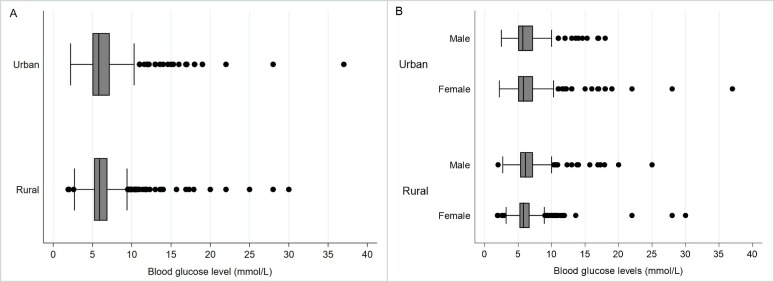
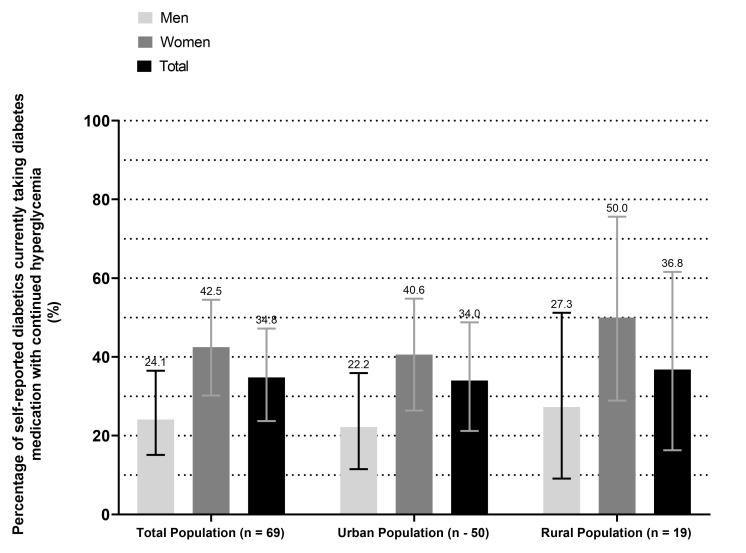
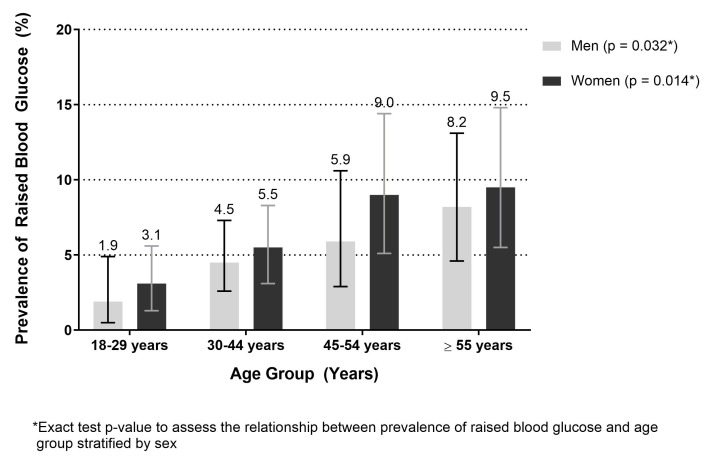
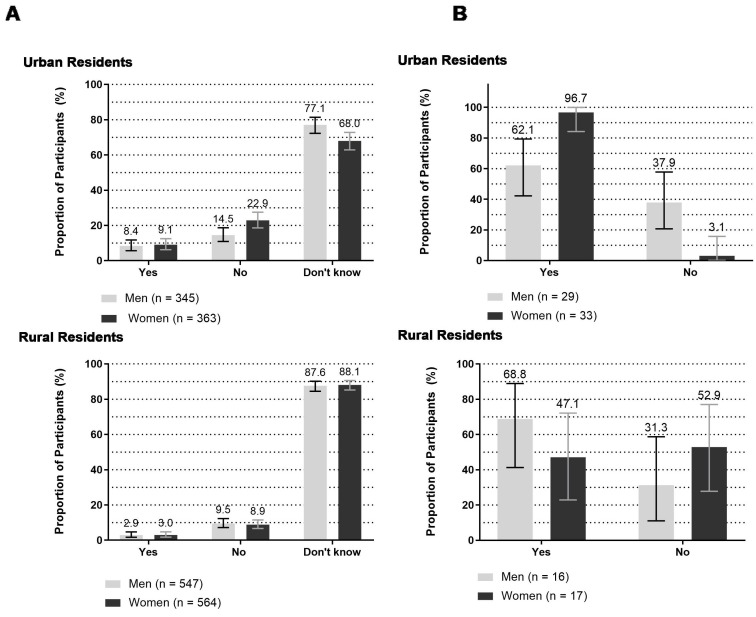
Overall, the prevalence of hyperglycaemia was 5.5% (95% CI 4.5% to 6.6%) and was significantly higher among urban (9.8%, 95% CI 7.7% to 12.2%) than rural residents (2.8%, 95% CI 1.9% to 3.9%). The age-standardised prevalence of hyperglycaemia was 5.6% (95% CI 4.6% to 6.8%). Among both urban and rural residents, the associated determinants of hyperglycaemia included hypertension and abdominal obesity. About 5% of the total population self-reported have been previously diagnosed with type 2 diabetes; among these adults, over 25% were not taking medications to control their diabetes.
Our study found that about 1 in 20 Bangladeshi adults aged ≥18 years have hyperglycaemia. To control and prevent the development of type 2 diabetes, data from this study can be used to inform public health programming and provide descriptive information on surveillance of progress towards controlling diabetes in Bangladesh.
随着低收入和中等收入国家非传染性疾病负担的增加,高血糖等生物危险因素成为孟加拉国的一个主要公共卫生关注点。高血糖是指血液中葡萄糖含量过高,通常与 2 型糖尿病有关。目前,孟加拉国成年人还没有年龄在 18 岁及以上的全国代表性高血糖患病率数据。本研究旨在评估孟加拉国年龄在 18 岁及以上成年人的高血糖患病率及其决定因素。
横断面、基于人群的研究。
本分析的数据于 2015 年 11 月至 12 月期间采集自孟加拉国城乡地区一个基于人群的全国代表性样本,该样本包括 1843 名年龄在 18 岁及以上的成年人。记录了人口统计学信息、毛细血管血糖、血压、身高、体重、腰围和治疗史。
高血糖定义为随机毛细血管血糖水平≥11.1mmol/L(即糖尿病范围)或根据自我报告目前正在服用药物控制 2 型糖尿病。
总体而言,高血糖的患病率为 5.5%(95%CI:4.5%至 6.6%),城市居民(9.8%,95%CI:7.7%至 12.2%)显著高于农村居民(2.8%,95%CI:1.9%至 3.9%)。高血糖的年龄标准化患病率为 5.6%(95%CI:4.6%至 6.8%)。在城市和农村居民中,高血压和腹型肥胖是高血糖的相关决定因素。大约 5%的总人口自我报告曾被诊断患有 2 型糖尿病;在这些成年人中,超过 25%的人没有服用药物来控制他们的糖尿病。
我们的研究发现,约 1/20 的孟加拉国年龄在 18 岁及以上的成年人患有高血糖。为了控制和预防 2 型糖尿病的发生,本研究的数据可用于为公共卫生规划提供信息,并提供孟加拉国控制糖尿病进展监测的描述性信息。