Department of Immunobiology, College of Life Science and Technology, Jinan University, Guangzhou, China.
School of Medicine, Sun Yat-Sen University, Shenzhen, China.
Cell Prolif. 2019 Sep;52(5):e12663. doi: 10.1111/cpr.12663. Epub 2019 Jul 26.
Induction of secondary necrosis/pyroptosis contributes to the toxicity of chemotherapeutic drugs, in which gasdermin E (GSDME) plays critical roles. This study aimed to explore whether GSDME is involved in mediating the cytotoxic effects of cisplatin and doxorubicin on mouse macrophages.
RAW 264.7 cells and bone marrow-derived macrophages (BMDMs) were treated with cisplatin or doxorubicin. Propidium iodide staining was used to assay necrosis, and immunoblotting was performed to detect protein expression. GSDME was knocked down by using small interfering RNA. Mice were injected intraperitoneally to evaluate toxicity to macrophages in vivo. Flow cytometry and immunofluorescence microscopy were adopted to analyse phenotypes of peritoneal cells. Cytokine levels were assayed by cytometric bead array.
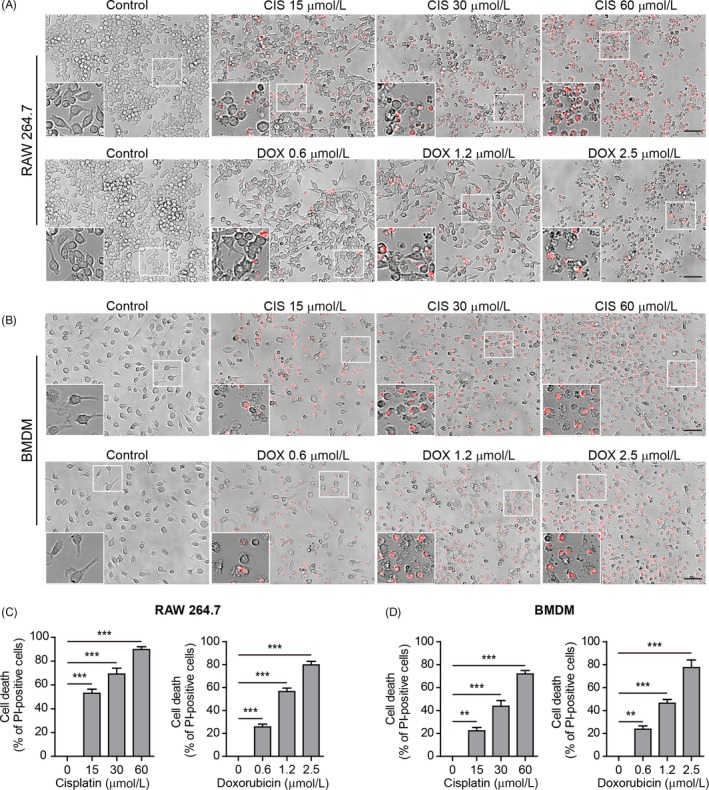
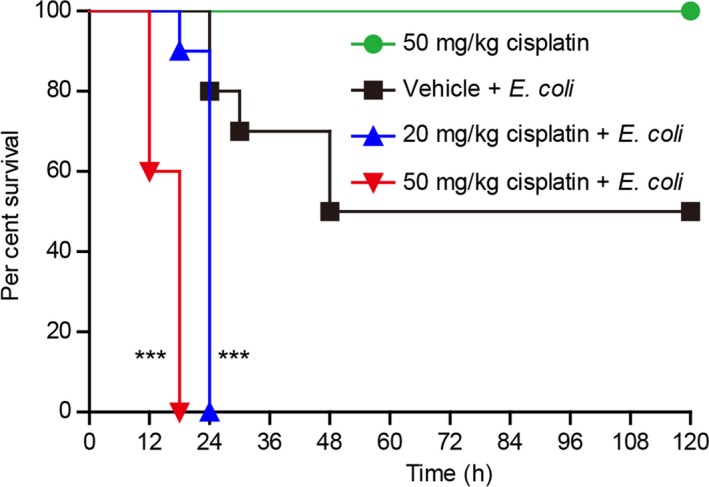
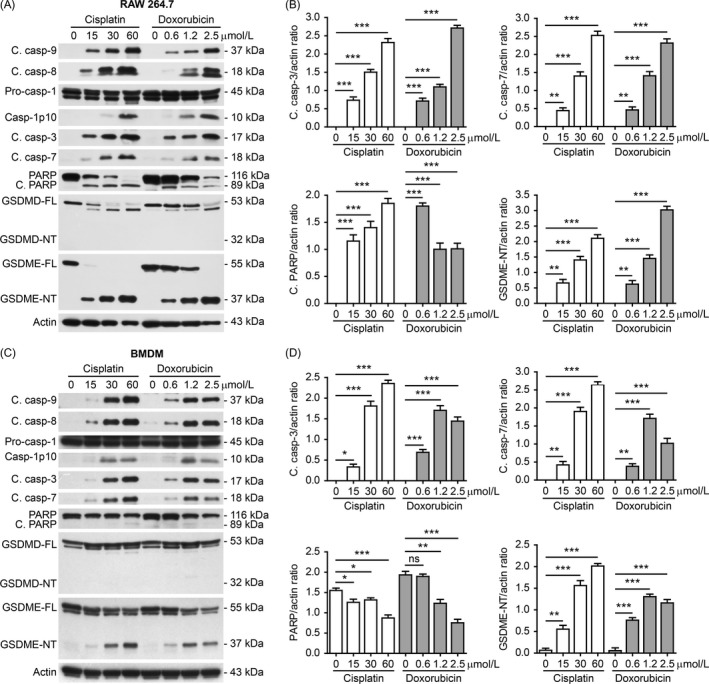
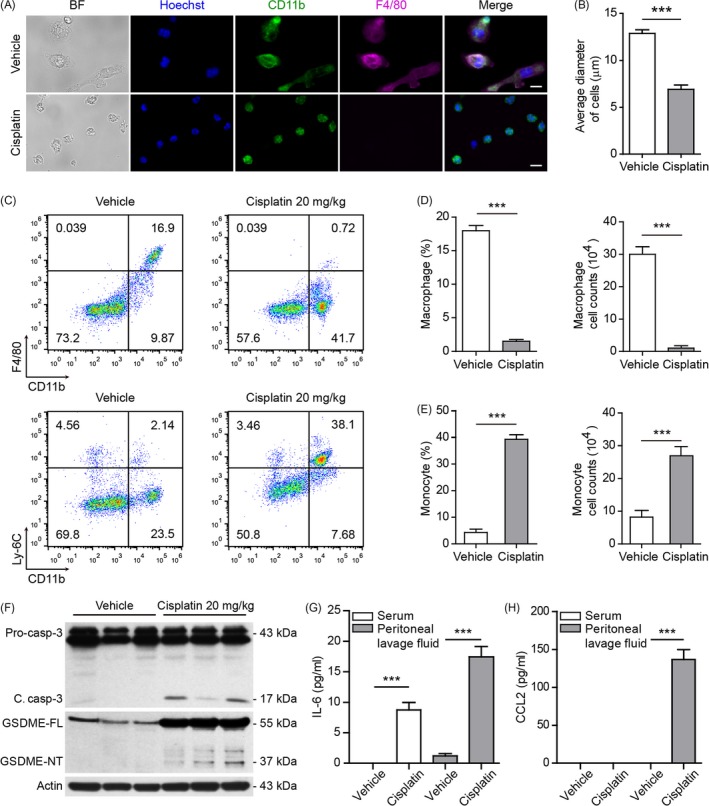
Both cisplatin and doxorubicin dose-dependently induced necrosis in mouse RAW 264.7 macrophages and BMDMs. Accompanying this, multiple caspases were activated, concomitant with the cleavage of poly (ADP-ribose) polymerase. Consistent with caspase-3 activation, GSDME was cleaved to generate its N-terminal fragment (GSDME-NT), thus leading to secondary necrosis/pyroptosis. Inhibition of caspase-3 significantly attenuated the generation of GSDME-NT concurrently with decreased necrosis in macrophages. GSDME knockdown also evidently decreased the necrosis in RAW 264.7 and BMDMs. Besides, cisplatin administration depleted peritoneal macrophages in mice, which was associated with caspase-3 activation and GSDME-NT generation. Consistent with the macrophage depletion, cisplatin administration significantly decreased survival of mice with bacterial infection.
Chemotherapeutic cisplatin and doxorubicin exerted their cytotoxicity on macrophages partly by inducing caspase-3/GSDME-mediated secondary necrosis.
继发坏死/细胞焦亡的诱导是化疗药物毒性的原因之一,其中 gasdermin E(GSDME)起着关键作用。本研究旨在探讨 GSDME 是否参与介导顺铂和阿霉素对小鼠巨噬细胞的细胞毒性作用。
用顺铂或阿霉素处理 RAW 264.7 细胞和骨髓来源的巨噬细胞(BMDMs)。碘化丙啶染色用于检测坏死,免疫印迹用于检测蛋白表达。用小干扰 RNA 敲低 GSDME。通过腹腔内注射小鼠来评估体内对巨噬细胞的毒性。采用流式细胞术和免疫荧光显微镜分析腹腔细胞表型。采用流式细胞术检测细胞因子水平。
顺铂和阿霉素均剂量依赖性地诱导小鼠 RAW 264.7 巨噬细胞和 BMDMs 发生坏死。与此同时,多种半胱天冬酶被激活,伴随着多聚(ADP-核糖)聚合酶的裂解。与 caspase-3 激活一致,GSDME 被切割产生其 N 端片段(GSDME-NT),从而导致继发坏死/细胞焦亡。Caspase-3 抑制剂显著抑制 GSDME-NT 的产生,同时减少巨噬细胞的坏死。GSDME 敲低也明显减少了 RAW 264.7 和 BMDMs 的坏死。此外,顺铂给药耗尽了小鼠腹腔巨噬细胞,这与 caspase-3 激活和 GSDME-NT 的产生有关。与巨噬细胞耗竭一致,顺铂给药显著降低了细菌感染小鼠的存活率。
化疗药物顺铂和阿霉素对巨噬细胞的细胞毒性作用部分是通过诱导 caspase-3/GSDME 介导的继发坏死实现的。