The Key Laboratory of Urinary Tract Tumors and Calculi, Department of Urology, The First Affiliated Hospital of Xiamen University, School of Medicine, Xiamen University, Xiamen, Fujian, 361003, P. R. China.
Department of Urology, The First Affiliated Hospital of Chongqing Medical University, Yuzhong, Chongqing, 400016, P. R. China.
Adv Sci (Weinh). 2024 Oct;11(38):e2404693. doi: 10.1002/advs.202404693. Epub 2024 Aug 9.
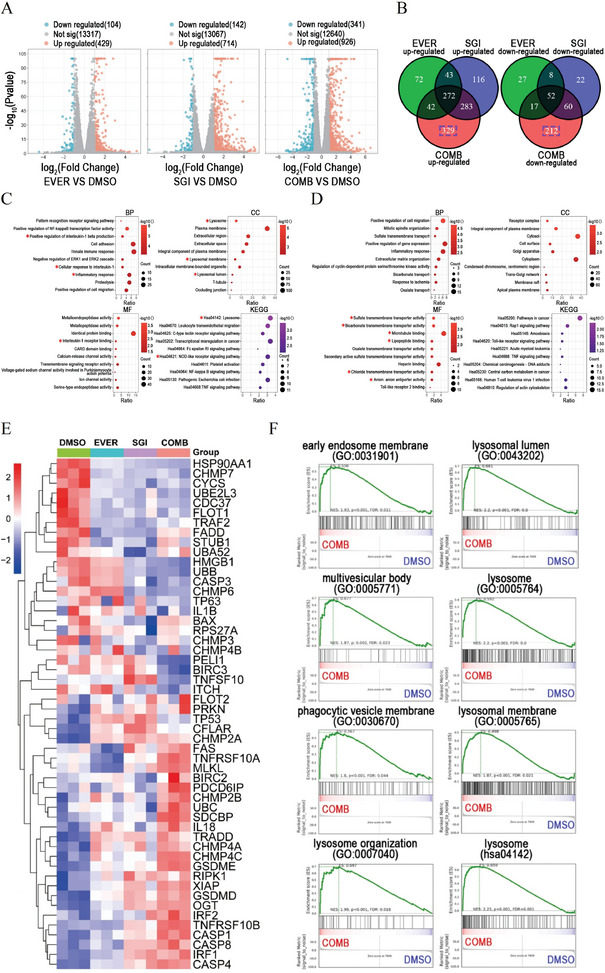
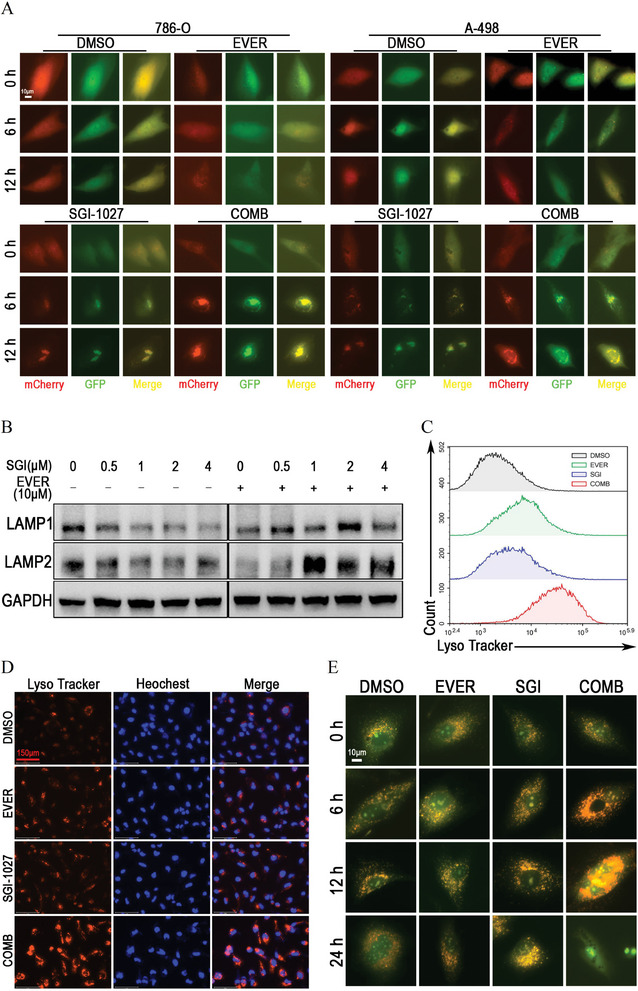
The mTOR inhibitor everolimus has been approved as a sequential or second-line therapy for renal cell carcinoma (RCC). However, the development of drug resistance limits its clinical applications. This study aims to address the challenge of everolimus resistance and provide new insights into the treatment of advanced RCC. Here, the cytotoxicity of the DNA methyltransferase 1 (DNMT1) inhibitor SGI-1027 in inducing cell vacuolation and methuosis is discovered and demonstrated for the first time. Additionally, SGI-1027 exerts synergistic effects with everolimus, as their combination suppresses the growth, migration, and invasion of renal cancer cells. Mechanistically, apoptosis and GSDME-dependent pyroptosis triggered by lysosomal membrane permeability (LMP) are observed. The upregulation of GSDME expression and increased lysosomal activity in renal cancer cells provide a therapeutic window for the combination of these two drugs to treat renal cancer. The combination treatment exhibits effective anti-tumor activity and is well tolerated in a subcutaneous tumor model. Overall, this study validates and reveals the specific cytotoxicity property of SGI-1027 and its potent synergistic effect with everolimus, offering new insights into advanced RCC therapy and everolimus-resistance overcoming.
mTOR 抑制剂依维莫司已被批准用于肾细胞癌(RCC)的序贯或二线治疗。然而,药物耐药性的发展限制了其临床应用。本研究旨在解决依维莫司耐药的挑战,并为晚期 RCC 的治疗提供新的见解。在这里,首次发现并证明了 DNA 甲基转移酶 1(DNMT1)抑制剂 SGI-1027 诱导细胞空泡化和 methuosis 的细胞毒性。此外,SGI-1027 与依维莫司具有协同作用,因为它们的组合抑制了肾癌细胞的生长、迁移和侵袭。在机制上,观察到溶酶体膜通透性(LMP)引发的细胞凋亡和 GSDME 依赖性焦亡。肾癌细胞中 GSDME 表达的上调和溶酶体活性的增加为这两种药物联合治疗肾提供了治疗窗口。联合治疗在皮下肿瘤模型中显示出有效的抗肿瘤活性和良好的耐受性。总的来说,这项研究验证并揭示了 SGI-1027 的特定细胞毒性及其与依维莫司的强大协同作用,为晚期 RCC 治疗和克服依维莫司耐药提供了新的见解。