Department of Internal Medicine 3 - Rheumatology and Immunology, Friedrich-Alexander-University Erlangen-Nurnberg (FAU) and Universitaetsklinikum Erlangen, Ulmenweg 18, 91054, Erlangen, Germany.
Department of Dermatology, Friedrich-Alexander University Erlangen-Nurnberg (FAU) and Universitaetsklinikum Erlangen, Erlangen, Germany.
Arthritis Res Ther. 2019 Jul 26;21(1):178. doi: 10.1186/s13075-019-1957-0.
A specific subset of psoriasis patients is characterized by subclinical inflammatory changes. These patients frequently present with arthralgia and have a higher risk to develop psoriatic arthritis (PsA). We hypothesized that IL-17A inhibition in this subset of patients can intercept the link between skin and joint disease and resolves pain and inflammatory changes.
Psoriasis, but no PsA, patients were included in the open prospective exploratory Interception in very early PsA (IVEPSA) study. Patients had to have nail or scalp involvement or a high psoriasis area severity index (PASI) (> 6) as well as inflammatory or erosive changes in MRI or CT. Patients received treatment with the anti-interleukin (IL)-17A antibody secukinumab over 24 weeks. Clinical assessments of skin and joint disease were done at baseline and after 12 and 24 weeks, MRI and CT at baseline and after 24 weeks.
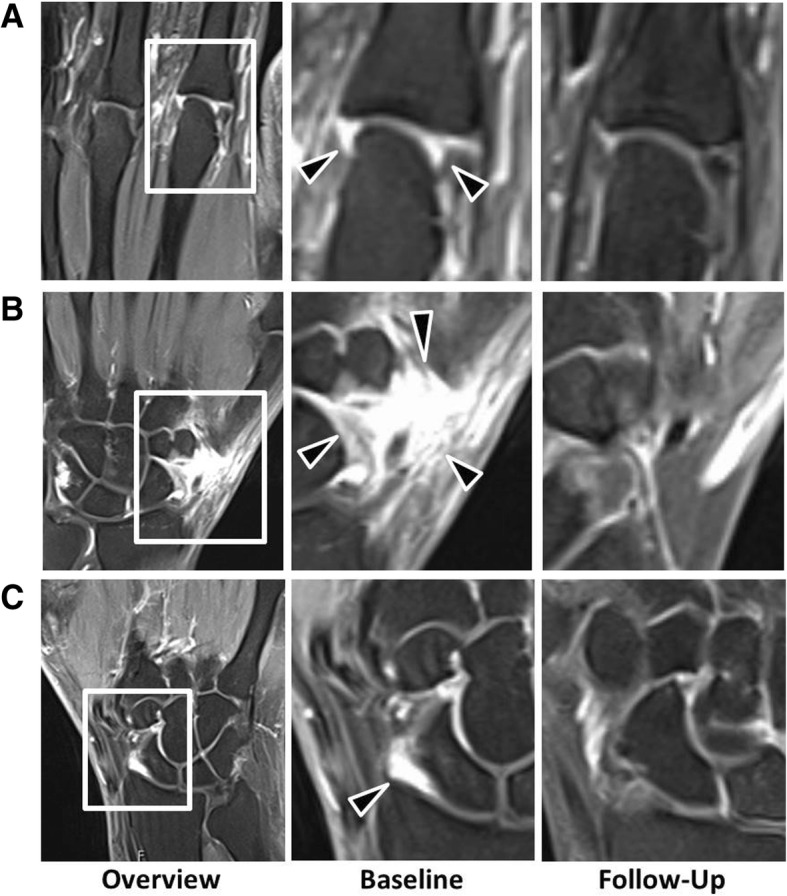
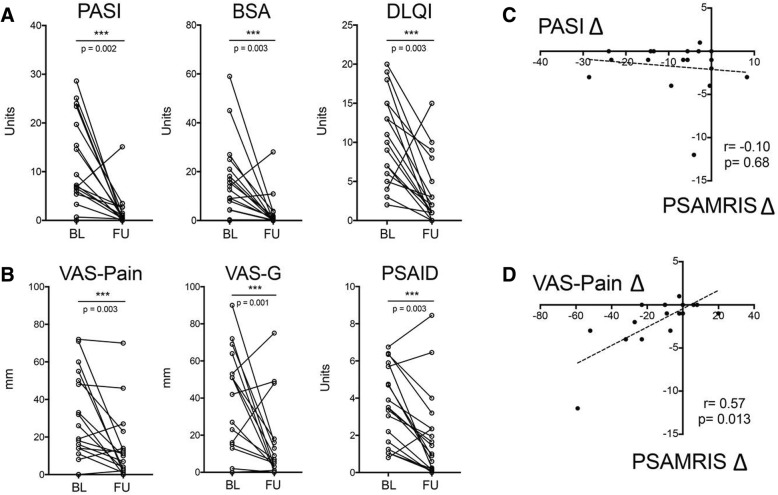
Twenty patients were included, 85% of them reporting arthralgia and 40% had tender joints at the examination. Eighty-three percent had at least one inflammatory lesion in the MRI, most of them synovitis/enthesitis. Skin disease (PASI: p < 0.002; BSA: p < 0.003) and arthralgia (VAS pain: p < 0.003) significantly improved after 24 weeks. Total PsAMRIS (p = 0.005) and synovitis subscore (p = 0.008) also significantly improved. Erosions and enthesiophytes did not progress, while bone mass in the distal radius significantly (p = 0.020) increased after 24 weeks.
These data suggest that very early disease interception in PsA is possible leading to a comprehensive decline in skin symptoms, pain, and subclinical inflammation. IVEPSA therefore provides rationale for future early interventions with the concept to prevent the onset of PsA in high-risk individuals.
Trial registry name PSARTROS; trial registry number: NCT02483234; June 26, 2015.
银屑病的一个特定亚组表现为亚临床炎症改变。这些患者常出现关节痛,发生银屑病关节炎(PsA)的风险更高。我们假设,在这组患者中抑制白细胞介素(IL)-17A 可以阻断皮肤和关节疾病之间的联系,并缓解疼痛和炎症改变。
本开放性前瞻性探索性早期银屑病关节炎(IVEPSA)研究纳入了仅患有银屑病但无银屑病关节炎的患者。患者必须有指甲或头皮受累或高银屑病面积严重指数(PASI)(>6),且 MRI 或 CT 显示有炎症或侵蚀性改变。患者接受抗白细胞介素(IL)-17A 抗体司库奇尤单抗治疗 24 周。在基线时和治疗 12 周和 24 周后评估皮肤和关节疾病,在基线时和治疗 24 周后评估 MRI 和 CT。
共纳入 20 例患者,85%的患者报告有关节痛,40%的患者在检查时有关节压痛。83%的患者至少有一个 MRI 炎症病灶,大多数为滑膜炎/肌腱炎。皮肤疾病(PASI:p<0.002;BSA:p<0.003)和关节痛(VAS 疼痛:p<0.003)在 24 周后显著改善。总 PsA-MRIS(p=0.005)和滑膜炎亚评分(p=0.008)也显著改善。侵蚀和附着点病没有进展,而桡骨远端骨量在 24 周后显著增加(p=0.020)。
这些数据表明,在银屑病关节炎的早期疾病干预是可能的,可导致皮肤症状、疼痛和亚临床炎症的全面下降。IVEPSA 因此为未来的早期干预提供了依据,其理念是预防高危人群发生银屑病关节炎。
试验注册名称 PSARTROS;试验注册号:NCT02483234;2015 年 6 月 26 日。