Department of Respiratory Medicine, Kamei Internal medicine and Respiratory Clinic, Takamatsu, Japan.
Department of Pulmonary Medicine, Sakaide City Hospital, Sakaide, Kagawa, Japan.
BMJ Open. 2019 Jul 26;9(7):e024114. doi: 10.1136/bmjopen-2018-024114.
Chronic obstructive pulmonary disease (COPD) is mainly treated pharmaceutically with bronchodilators. The purpose of this study was to evaluate the clinical benefits of two-times-per-day aclidinium bromide (Acli-BID) compared with once-a-day tiotropium bromide hydrate (Tio-QD) in patients with COPD.
This study was a multicentre, open-label, randomised study.
Fourcentres in Kagawa prefecture, Japan.
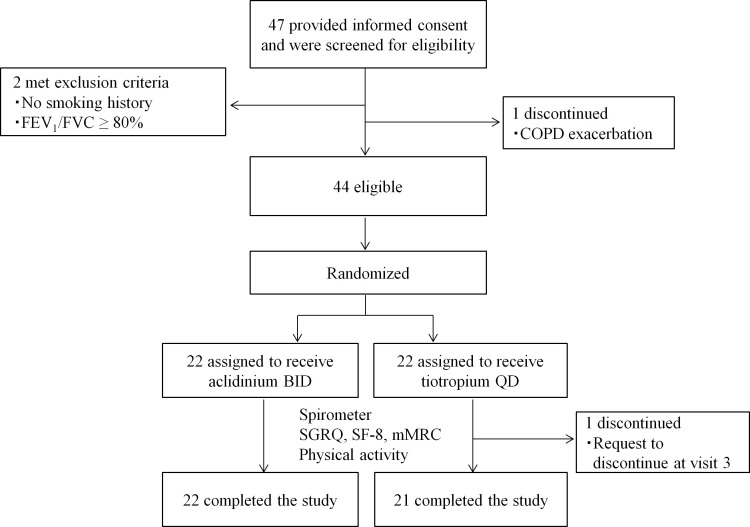
Patients who were diagnosed to have COPD Grade 2-3 according to the Global Initiative for Chronic Obstructive Lung Disease 2015 criteria were enrolled.
Patients were randomly assigned to receive Acli-BID or Tio-QD at a 1:1 ratio, and followed for 8 weeks. Acli-BID was administered in the morning and night, and Tio-QD was administered in the night.
Primary outcome was forced expiratory volume in one second area under the curve (FEVAUC), and secondary outcomes were pulmonary function, physical activity, St George's Respiratory Questionnaire (SGRQ), modified Medical Research Council (mMRC), the 8-item Short-Form Health Survey (SF-8) and COPD exacerbations. Adverse events were evaluated during the study.
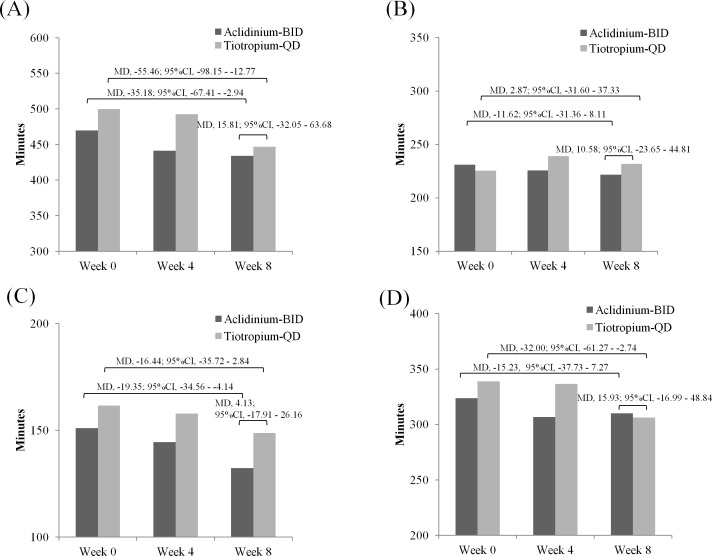
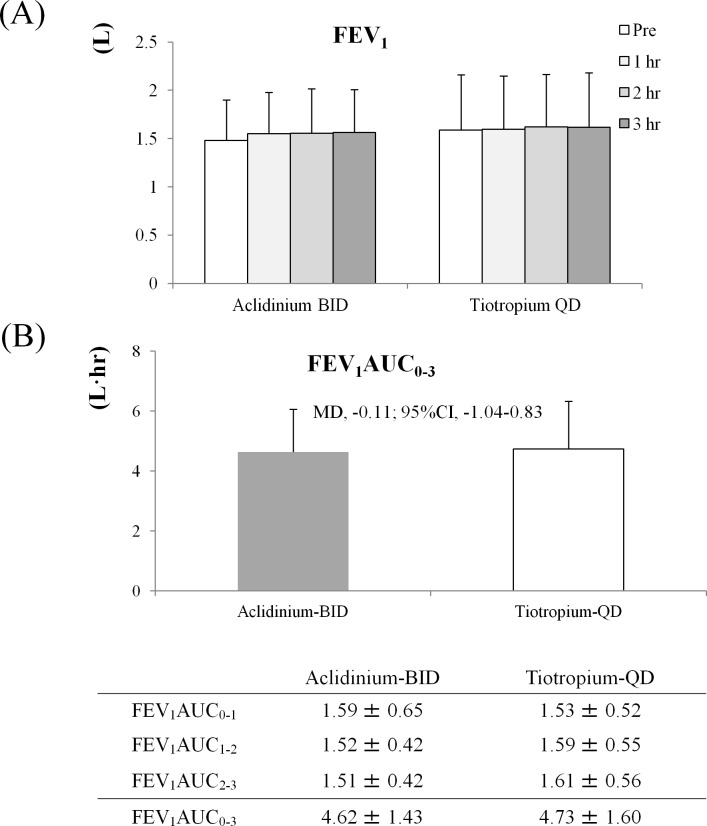
44 patients were included in this study. FEVAUC at week 8 was 4.62±1.43 L·hour in Acli-BID and 4.73±1.60 L·hour in Tio-QD (mean difference (MD) -0.11 L·hour; 95% CI), -1.04 to 0.83). Significant improvement was observed in activity-related subscales of SGRQ (MD -7.78; 95% CI -14.61 to -0.94) and SF-8 (MD 4.01; 95% CI 0.37 to 7.65), mMRC (MD -0.66; 95% CI -1.19 to -0.13) and rate ratio (0.52, 95% CI 0.27 to 0.99) of exacerbations in the Acli-BID compared with the Tio-QD. Acli-BID and Tio-QD significantly improved sedentary behaviour (MD -35.20 min; 95% CI -67.41 to -2.94 and MD -55.40 min; 95% CI -98.15 to -12.77) within each group, but there was no significant difference between the two groups.
Acli-BID as with Tio-QD could be one of the therapeutic options for patients with COPD to improve pulmonary function. Also, our results suggest that intervention with bronchodilators enhanced physical activity in patients with COPD.
UMIN 000020020.
慢性阻塞性肺疾病(COPD)主要通过支气管扩张剂进行药物治疗。本研究旨在评估每日两次给予阿地溴铵(Acli-BID)与每日一次给予噻托溴铵水合物(Tio-QD)相比,在 COPD 患者中的临床获益。
这是一项多中心、开放性、随机研究。
日本香川县的 4 个中心。
符合 2015 年全球慢性阻塞性肺疾病倡议 COPD 标准的 2-3 级 COPD 患者被纳入研究。
患者随机分配接受 Acli-BID 或 Tio-QD,比例为 1:1,并随访 8 周。Acli-BID 早晚给药,Tio-QD 晚间给药。
主要结局为一秒用力呼气容积曲线下面积(FEVAUC),次要结局为肺功能、体力活动、圣乔治呼吸问卷(SGRQ)、改良版医学研究理事会呼吸困难量表(mMRC)、8 项简短健康调查问卷(SF-8)和 COPD 加重。在研究期间评估不良事件。
这项研究纳入了 44 名患者。Acli-BID 组第 8 周的 FEV AUC 为 4.62±1.43L·小时,Tio-QD 组为 4.73±1.60L·小时(平均差值(MD)-0.11L·小时;95%CI),-1.04 至 0.83)。Acli-BID 组在与 Tio-QD 相比,SGRQ 活动相关子量表(MD-7.78;95%CI-14.61 至-0.94)和 SF-8(MD 4.01;95%CI 0.37 至 7.65)、mMRC(MD-0.66;95%CI-1.19 至-0.13)和加重率比值(0.52,95%CI 0.27 至 0.99)方面有显著改善。Acli-BID 和 Tio-QD 均显著改善了静坐行为(MD-35.20 分钟;95%CI-67.41 至-2.94 和 MD-55.40 分钟;95%CI-98.15 至-12.77),但两组之间无显著差异。
Acli-BID 与 Tio-QD 一样,可以作为 COPD 患者改善肺功能的治疗选择之一。此外,我们的结果表明,支气管扩张剂的干预增强了 COPD 患者的体力活动。
UMIN 000020020。