French Collaborative Institute on Migrations, CNRS, Paris, Ile-de-France, France
Social Epidemiology Department, iPLESP, Inserm S1136, Paris, Ile-de-France, France.
Sex Transm Infect. 2020 May;96(3):227-231. doi: 10.1136/sextrans-2019-054080. Epub 2019 Jul 26.
ObjectiveRecent studies highlighted that many HIV-positive migrants in Europe acquired their infections post-migration. However, the timing of these infections is not always known. This study aims to estimate the timing of post-migration HIV acquisition among sub-Saharan migrants in France and to understand the correlates of post-migration infection.
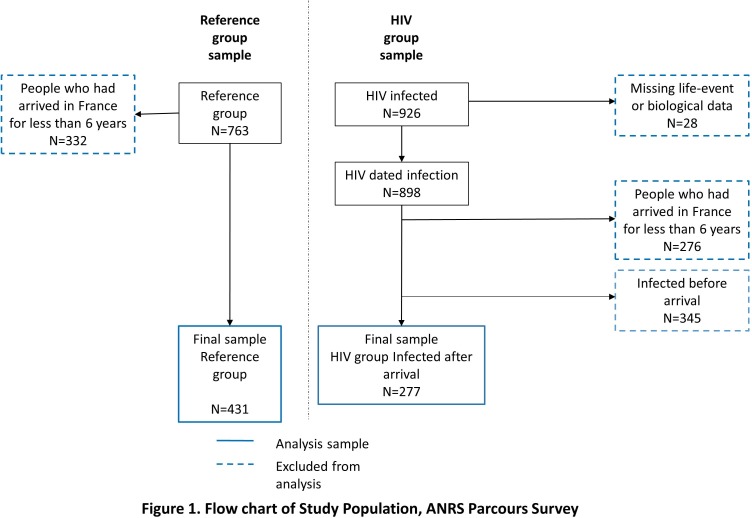
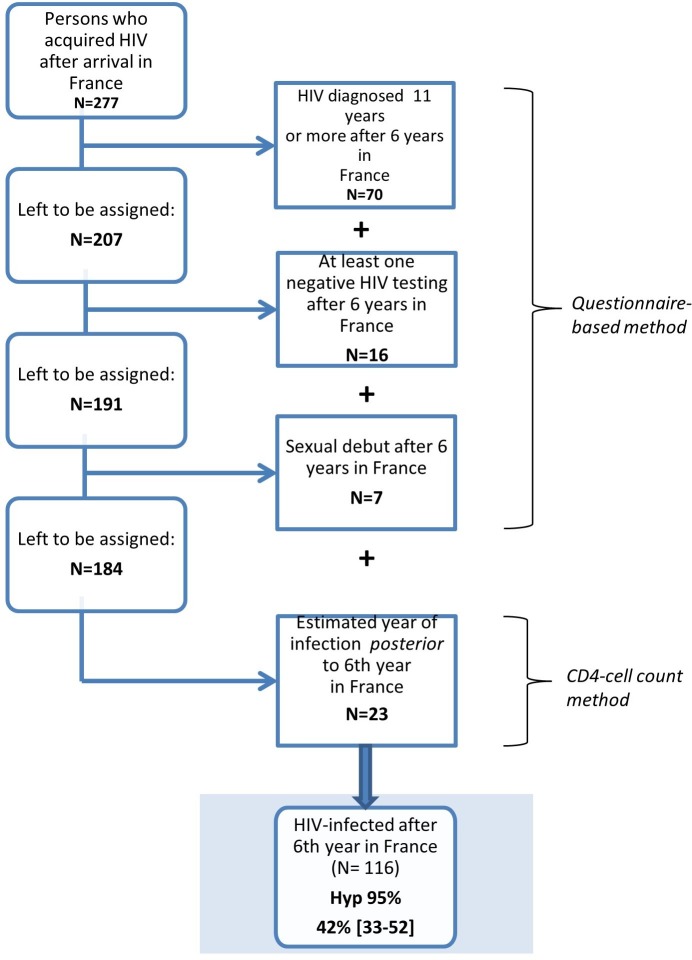
Within the PARCOURS retrospective survey conducted in 2012-2013 in 74 healthcare facilities in the Paris region, life-event data were collected among a random sample of 926 patients living with HIV in HIV services and 763 patients undiagnosed with HIV in primary care centres born in sub-Saharan Africa (reference group). Based on previous analysis, we considered the first 6 years in France after migration as a settlement period. Among the persons who acquired HIV after migration, we estimated the proportion of persons infected during settlement (0-6 years after migration) and after settlement (>6 years after migration) by using an algorithm that combines life-event data and a modelisation of CD4 T-cell count decline. We then assessed the determinants of HIV acquisition during settlement and after settlement using bivariate logistic regression models.
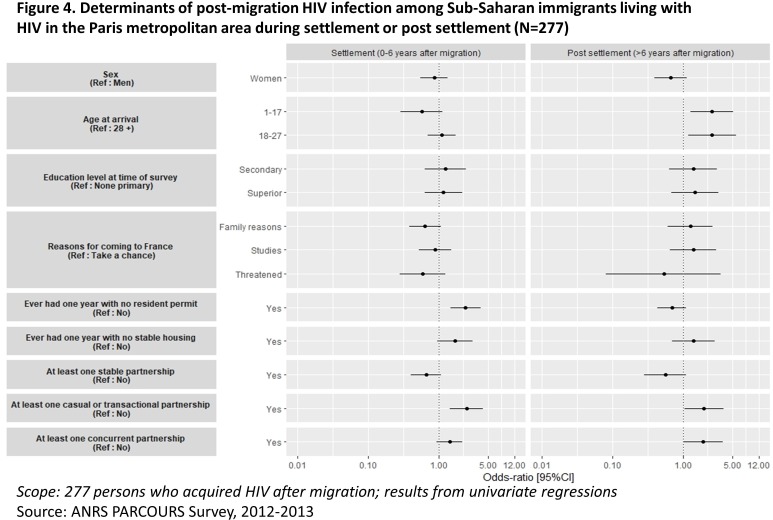
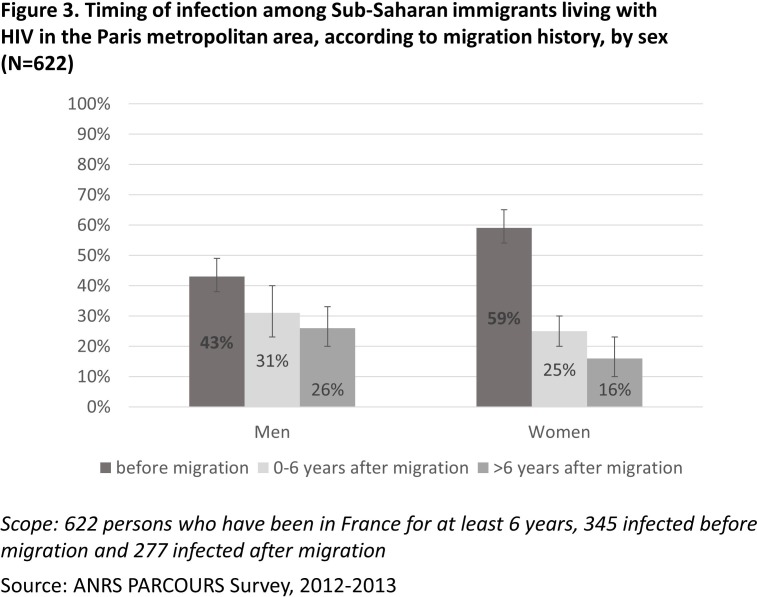
Overall, 58% of sub-Saharan migrants who acquired HIV after migration were infected during the first 6 years in France. HIV acquisition during settlement was found to be linked to short/transactional partnerships and lack of a resident permit. 42% of migrants had contracted HIV after settlement. After settlement, HIV acquisition was associated with short/transactional but also with concurrent partnerships and not with social hardship.
Two profiles of HIV post-migration acquisition emerged. The majority of HIV post-migration acquisition occurs during the settlement period: comprehensive combination prevention programmes among recently arrived migrants are needed. However, long-term migrants are also at risk for HIV through multiple partnerships. Prevention programmes should address the different profiles of migrants at risk for post-migration HIV acquisition.
最近的研究强调,欧洲许多感染 HIV 的移民是在移民后感染的。然而,这些感染的时间并不总是已知的。本研究旨在估计法国撒哈拉以南移民的移民后 HIV 感染的时间,并了解移民后感染的相关因素。
在 2012-2013 年在巴黎地区 74 家医疗保健机构进行的 PARCOURS 回顾性调查中,对在 HIV 服务中心生活的 HIV 感染者(随机样本 926 人)和在初级保健中心未诊断出 HIV 的撒哈拉以南非洲出生者(参考组 763 人)进行了生活事件数据收集。基于先前的分析,我们认为移民后最初 6 年为定居期。在移民后感染 HIV 的人群中,我们使用一种结合生活事件数据和 CD4 T 细胞计数下降模型的算法,估计定居期间(移民后 0-6 年)和定居后(移民后 6 年以上)感染的人数比例。然后,我们使用双变量逻辑回归模型评估定居期间和定居后 HIV 感染的决定因素。
总体而言,移民后感染 HIV 的撒哈拉以南移民中,有 58%是在法国的前 6 年感染的。定居期间的 HIV 感染与短期/交易性伴侣关系和缺乏居民许可证有关。42%的移民在定居后感染了 HIV。定居后,HIV 感染与短期/交易性伴侣关系有关,但也与同时性伴侣关系有关,而与社会困难无关。
出现了两种移民后 HIV 感染的模式。大多数移民后 HIV 感染发生在定居期间:需要为最近抵达的移民提供全面的组合预防方案。然而,长期移民也面临着通过多种伴侣关系感染 HIV 的风险。预防方案应针对移民后 HIV 感染风险的不同模式的移民。