Mosnier Emilie, Artigas Fernanda, Richard Elodie, Hoyer Maxime, Michels David, Vandentorren Stephanie, Girard Gabriel, Nagot Nicolas, Regnault Hippolyte, Mosnier Marine, Inegbeze Grâce, Roux Perrine, Spire Bruno, Eldin Carole
Aix Marseille University, Inserm, IRD, Sciences Economiques & Sociales de la Santé & Traitement de l'Information Médicale (SESSTIM), Aix Marseille Institute of Public Health ISSPAM, Marseille, France.
University of Health and Science, ANRS | MIE site, Phnom Penh, Cambodia.
JMIR Res Protoc. 2023 Aug 4;12:e42844. doi: 10.2196/42844.
The World Health Organization recommends pre-exposure prophylaxis (PrEP) for all populations at substantial risk of HIV infection. However, at-risk women very rarely use PrEP in France-this represents a critical issue among migrant women sex workers (MWSWs). Previous studies on PrEP use among women sex workers or migrants focused on individual or social determinants of motivation. However, operational studies in real-word settings using a holistic population approach to maximize PrEP adherence among MWSWs are lacking.
FASSETS (ie, "Favoriser l'Accès à la Santé Sexuelle des Travailleuses du Sexe"; English: "facilitate the access to Sexual Health in women sex workers") is a participative, multilevel, mixed methods study aiming to improve global knowledge of and access to sexual health care and PrEP among MWSWs through targeted empowerment strategies.
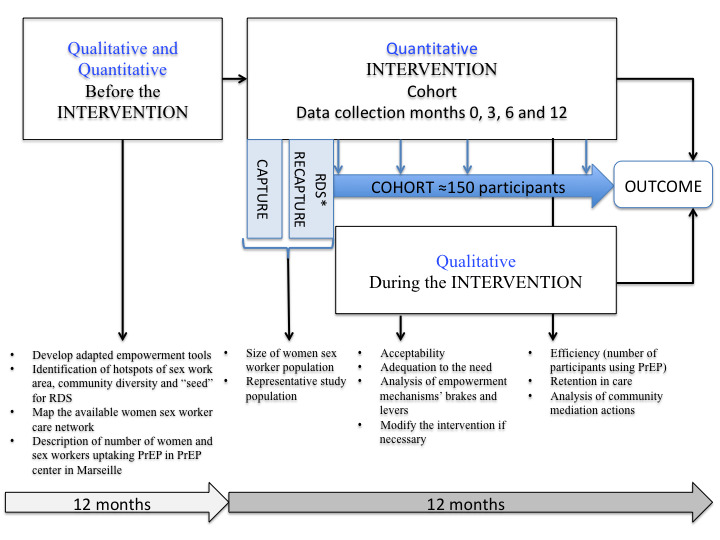
This study comprises several phases: (1) phase 1: an initial qualitative study combining semistructured interviews, informal interviews, and participative observations will be performed among MWSWs, local community nongovernmental organizations, and institutions providing sexual reproductive health services to identify the determinants of PrEP access among MWSWs and for respondent-driven sampling (RDS); (2) phase 2: the size of the hidden MWSW population is estimated in Marseille through capture-recapture (the RDS survey will serve as "recapture"); (3) phase 3: a longitudinal cohort will be formed through RDS to represent the MWSW population with a goal of 150 inclusions-this cohort will be followed up for 12 months, and sequential questionnaires exploring medical history; knowledge of sexual health, HIV, and sexually transmitted infections; migration route; and current living conditions will be administered at inclusion (month 0) and months 3, 6, and 12 to measure the following interventional phase's outcomes; and (4) phase 4: an interventional study with community empowerment actions about sexual health and PrEP will be conducted with community health workers; standardized questionnaires and semistructured interviews, observations, and focus groups will highlight MWSWs' experiences with empowerment resources, concerns about sexual health, and especially PrEP use or uptake, and we will evaluate whether and how community-adapted empowerment actions conducted by community health workers are effective in increasing access to sexual health, prevention and screening of sexually transmitted infections, and PrEP knowledge and access among MWSWs.
Recruitment commenced on March 1, 2022. We estimate the follow-up period to end on September 30, 2023.
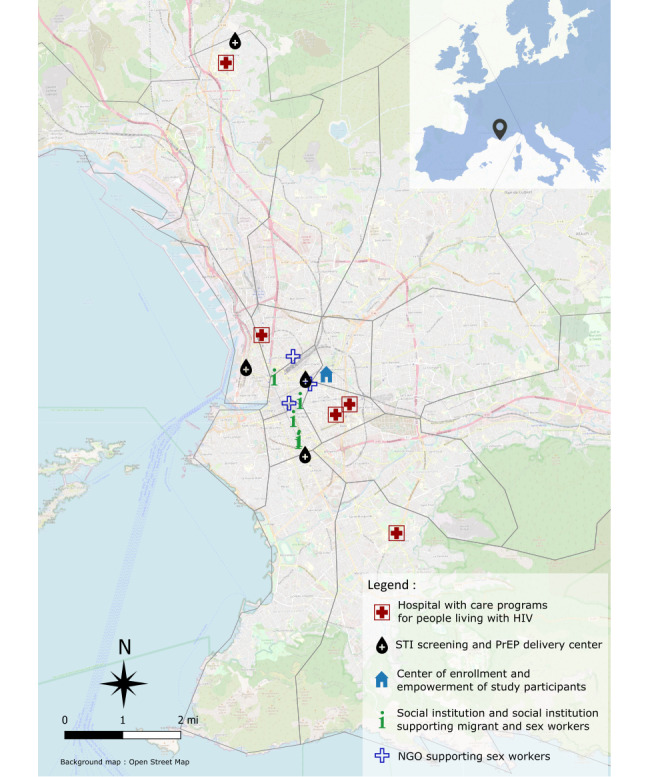
This multiphase study will provide robust evidence about the magnitude of the MWSW population in Marseille (the second largest town in France) and their current conditions of living, access to and knowledge of sexual health, and PrEP access. Using a mixed methods analysis, we will investigate whether individual and collective community health empowerment approaches can facilitate access to PrEP and its initiation, use, and adherence in this vulnerable population.
INTERNATIONAL REGISTERED REPORT IDENTIFIER (IRRID): DERR1-10.2196/42844.
世界卫生组织建议对所有有感染艾滋病毒高风险的人群进行暴露前预防(PrEP)。然而,在法国,有风险的女性很少使用PrEP,这在移民女性性工作者(MWSWs)中是一个关键问题。先前关于女性性工作者或移民中PrEP使用情况的研究侧重于动机的个体或社会决定因素。然而,缺乏在现实环境中使用整体人群方法以最大化MWSWs中PrEP依从性的操作性研究。
FASSETS(即“促进女性性工作者获得性健康”;英文:“facilitate the access to Sexual Health in women sex workers”)是一项参与性、多层次、混合方法研究,旨在通过有针对性的赋权策略,提高对MWSWs中性健康护理和PrEP的全面认识及可及性。
本研究包括几个阶段:(1)第一阶段:将在MWSWs、当地社区非政府组织以及提供性生殖健康服务的机构中进行一项初步定性研究,结合半结构化访谈、非正式访谈和参与性观察,以确定MWSWs中PrEP可及性的决定因素,并用于应答驱动抽样(RDS);(2)第二阶段:通过捕获再捕获法估计马赛隐藏的MWSW人群规模(RDS调查将作为“再捕获”);(3)第三阶段:通过RDS形成一个纵向队列,以代表MWSW人群,目标纳入150人,该队列将随访12个月,并在纳入时(第0个月)以及第3、6和12个月发放连续问卷,探索病史、性健康、艾滋病毒和性传播感染知识、移民路线以及当前生活条件,以测量下一干预阶段的结果;(4)第四阶段:将与社区卫生工作者开展一项关于性健康和PrEP的社区赋权行动的干预研究;标准化问卷、半结构化访谈、观察和焦点小组将突出MWSWs在赋权资源方面的经历、对性健康的担忧,尤其是PrEP的使用或接受情况,并且我们将评估社区卫生工作者开展的社区适应性赋权行动是否以及如何有效地增加MWSWs获得性健康、性传播感染预防和筛查以及PrEP知识和可及性的机会。
招募工作于2022年3月1日开始。我们估计随访期将于2023年9月30日结束。
这项多阶段研究将为马赛(法国第二大城市)MWSW人群的规模及其当前生活状况、性健康可及性和知识以及PrEP可及性提供有力证据。通过混合方法分析,我们将调查个体和集体社区卫生赋权方法是否能够促进这一弱势群体获得PrEP及其启动、使用和依从性。
国际注册报告识别码(IRRID):DERR1-10.2196/42844