Blanco Carlos, Wall Melanie M, Hoertel Nicolas, Krueger Robert F, Liu Shang-Min, Grant Bridget F, Olfson Mark
National Institute on Drug Abuse, Bethesda, MD, 20892, USA.
Department of Psychiatry, Columbia University/New York State Psychiatric Institute, 1051 Riverside Drive, Unit 69, New York, NY, 10032, USA.
Mol Psychiatry. 2021 Mar;26(3):907-916. doi: 10.1038/s41380-019-0459-4. Epub 2019 Jul 26.
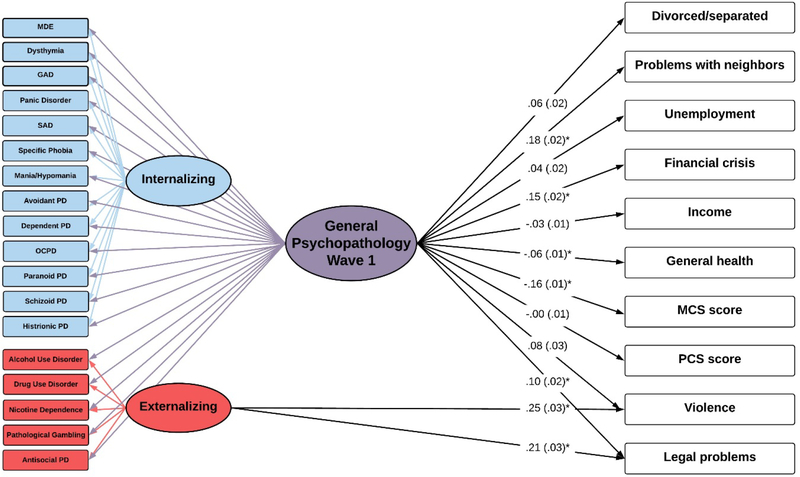
Most psychiatric disorders, when examined individually, are associated with a broad range of adverse outcomes. However, psychiatric disorders often co-occur and their co-occurrence is well explained by a limited number of transdiagnostic factors. Yet it remains unclear whether the risk of these adverse outcomes is due to specific psychiatric disorders, specific dimensions of psychopathology (i.e., internalizing and externalizing dimensions), a general psychopathology factor, or a combination of these explanations. In a large nationally representative prospective survey, the National Epidemiologic Survey on Alcohol and Related Conditions (NESARC), we used structural equation modeling to examine the shared and specific effects of common Axis I and Axis II disorders on the risk of ten adverse outcomes (unemployment; financial crisis; low income; poorer general health; worse mental and physical health; legal problems; divorce; problems with a neighbor, friend, or relative; and violence) in the general adult population. Effects of psychiatric disorders were exerted mostly through a general psychopathology factor representing the shared effect across all disorders, independent of sociodemographic characteristics and the presence of the adverse outcomes at baseline. Violence and legal problems were further associated with the externalizing factor, but there were no independent associations of the internalizing factor or any individual psychiatric disorders with any of the adverse outcomes. Our findings reveal that associations between psychiatric disorders and adverse outcomes occur through broad psychological dimensions. Understanding the biological and psychological mechanisms underlying these dimensions should yield key intervention targets to decrease the individual suffering and societal burden associated with common psychiatric disorders.
大多数精神疾病单独来看,都与一系列广泛的不良后果相关。然而,精神疾病常常同时出现,而它们的共病现象可以通过有限的几个跨诊断因素得到很好的解释。然而,这些不良后果的风险究竟是由于特定的精神疾病、精神病理学的特定维度(即内化和外化维度)、一个一般的精神病理学因素,还是这些解释的组合,仍不清楚。在一项具有全国代表性的大型前瞻性调查——全国酒精及相关状况流行病学调查(NESARC)中,我们使用结构方程模型来检验常见的轴I和轴II障碍对一般成年人群中十种不良后果(失业;金融危机;低收入;总体健康状况较差;精神和身体健康状况更差;法律问题;离婚;与邻居、朋友或亲戚的问题;以及暴力)风险的共同和特定影响。精神疾病的影响主要通过一个代表所有障碍共同效应的一般精神病理学因素来发挥作用,该因素独立于社会人口学特征和基线时不良后果的存在情况。暴力和法律问题还与外化因素相关,但内化因素或任何个体精神疾病与任何不良后果之间均无独立关联。我们的研究结果表明,精神疾病与不良后果之间的关联是通过广泛的心理维度发生的。了解这些维度背后的生物学和心理学机制,应该能产生关键的干预靶点,以减轻与常见精神疾病相关的个体痛苦和社会负担。