CSR Incorporated, Arlington, VA 22201, USA.
J Psychiatr Res. 2013 Nov;47(11):1708-16. doi: 10.1016/j.jpsychires.2013.07.016. Epub 2013 Aug 7.
Although associations between personality disorders and psychiatric disorders are well established in general population studies, their association with liability dimensions for externalizing and internalizing disorders has not been fully assessed. The purpose of this study is to examine associations between personality disorders (PDs) and lifetime externalizing and internalizing Axis I disorders.
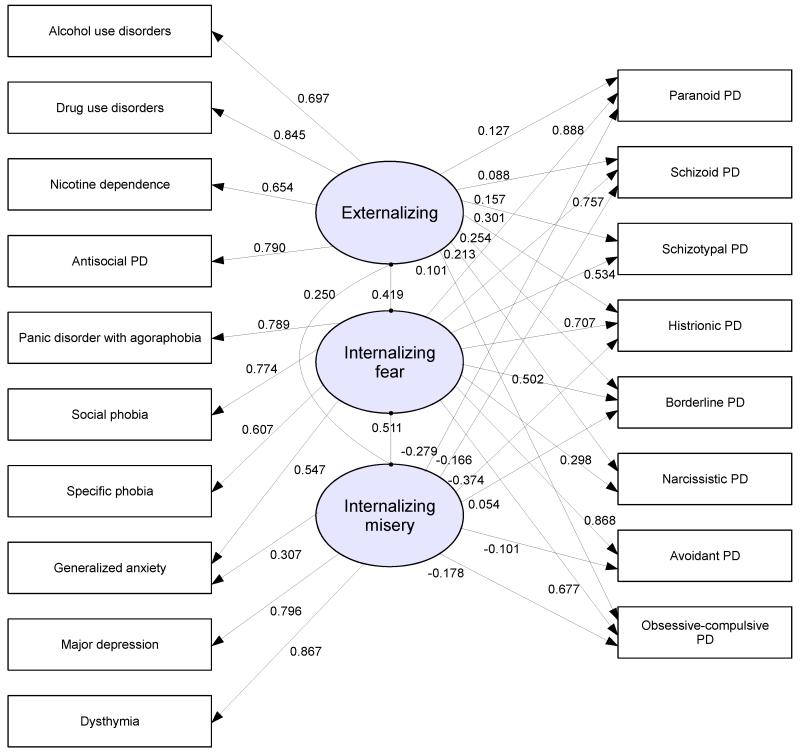
Data were obtained from the total sample of 34,653 respondents from Wave 2 of the National Epidemiologic Survey on Alcohol and Related Conditions (NESARC). Drawing on the literature, a 3-factor exploratory structural equation model was selected to simultaneously assess the measurement relations among DSM-IV Axis I substance use and mood and anxiety disorders and the structural relations between the latent internalizing-externalizing dimensions and DSM-IV PDs, adjusting for gender, age, race/ethnicity, and marital status.
Antisocial, histrionic, and borderline PDs were strong predictors for the externalizing factor, while schizotypal, borderline, avoidant, and obsessive-compulsive PDs had significantly larger effects on the internalizing fear factor when compared to the internalizing misery factor. Paranoid, schizoid, narcissistic, and dependent PDs provided limited discrimination between and among the three factors. An overarching latent factor representing general personality dysfunction was significantly greater on the internalizing fear factor followed by the externalizing factor, and weakest for the internalizing misery factor.
Personality disorders offer important opportunities for studies on the externalizing-internalizing spectrum of common psychiatric disorders. Future studies based on panic, anxiety, and depressive symptoms may elucidate PD associations with the internalizing spectrum of disorders.
尽管人格障碍与一般人群研究中的精神障碍之间存在关联,但它们与外化和内化障碍的 Liability 维度之间的关联尚未得到充分评估。本研究的目的是探讨人格障碍(PD)与终生外化和内化轴 I 障碍之间的关联。
数据来自国家酒精和相关条件流行病学调查(NESARC)第 2 波的 34653 名受访者的总样本。根据文献,选择了一个 3 因素探索性结构方程模型,以同时评估 DSM-IV 轴 I 物质使用和情绪及焦虑障碍的测量关系,以及潜在的内化-外化维度与 DSM-IV PD 之间的结构关系,同时调整性别、年龄、种族/民族和婚姻状况。
反社会、表现型和边缘型 PD 是外化因子的强预测因子,而精神分裂型、边缘型、回避型和强迫型 PD 与内化恐惧因子相比,对内化痛苦因子的影响更大。偏执型、分裂型、自恋型和依赖型 PD 在三个因子之间的区分度有限。一个代表一般人格功能障碍的综合潜在因子在内化恐惧因子上显著更大,其次是外化因子,而在内化痛苦因子上则较弱。
人格障碍为常见精神障碍的外化-内化谱研究提供了重要机会。基于惊恐、焦虑和抑郁症状的未来研究可能阐明 PD 与内化障碍谱的关联。