Amsterdam UMC, Heart Center, Department of Cardiology, Amsterdam Cardiovascular Sciences, University of Amsterdam, Meibergdreef 9, 1105, AZ, Amsterdam, The Netherlands.
Sahlgrenska University Hospital, Gothenburg, Sweden.
Eur Radiol. 2020 Jan;30(1):600-608. doi: 10.1007/s00330-019-06338-x. Epub 2019 Jul 26.
Global left ventricular (LV) function is routinely used to assess cardiac function; however, myocardial strain is able to identify more subtle dysfunction. We aimed to determine the recovery and prognostic value of featuring tracking (FT) cardiovascular magnetic resonance (CMR) strain in ST-segment elevation myocardial infarction (STEMI) patients with a concurrent chronic total occlusion (CTO).
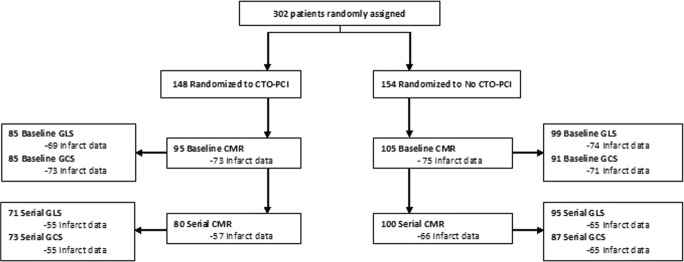
In the randomized EXPLORE trial, there was no significant difference in global LV function after percutaneous coronary intervention (PCI) of the CTO, compared with no-CTO PCI, post-STEMI. In the current study, we included 200 of the 302 EXPLORE patients with a baseline CMR, of which 180 also had 4-month follow-up (serial) CMR. Global longitudinal strain (GLS) was calculated from 3 long-axis views. Global circumferential strain (GCS) and segmental strain were calculated from 3 short-axis views (basal, mid, and apical).
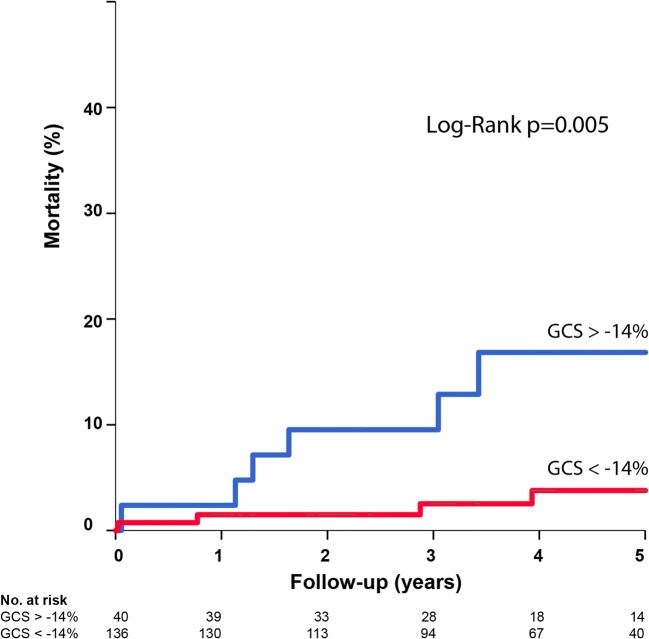
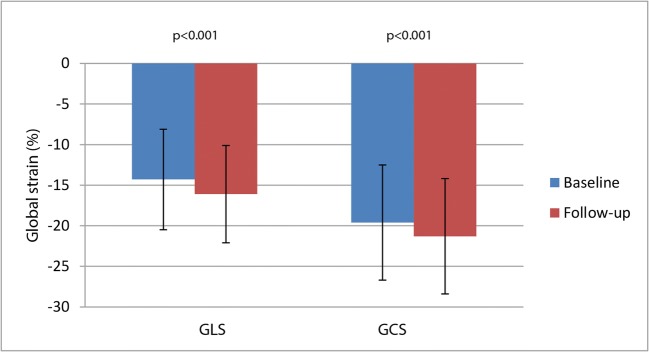
Global strain significantly improved at 4 months (GLS ∆ - 1.8 ± 4.3%, p < 0.001; GCS ∆ - 1.7 ± 4.7%, p < 0.001); however, there was no treatment effect of CTO-PCI on strain recovery. GLS was a significant predictor for 4 months of LV ejection fraction (p = 0.006), incremental to other CMR parameters including infarct size. For mortality, infarct size remained the strongest predictor. On regional level, segmental strain independently predicted recovery in the dysfunctional segments (p < 0.001).
Global and segmental myocardial strains significantly improved over time, with no effect of CTO-PCI. Global strain was associated with outcome and segmental strain was an independent predictor for regional LV recovery in the dysfunctional CTO territory. Further research is needed to determine the additional prognostic value of strain beyond routine CMR parameters.
• In STEMI patients with a concurrent CTO, strain significantly improves over time, regardless of CTO-PCI. • Global strain is an independent predictor for functional recovery, incremental to infarct size, LVEF, and clinical parameters. • Segmental strain was able to predict the recovery of wall thickening, incremental to transmural extent of infarction.
全球左心室(LV)功能通常用于评估心功能;然而,心肌应变能够识别更细微的功能障碍。我们旨在确定在伴有慢性完全闭塞(CTO)的ST 段抬高型心肌梗死(STEMI)患者中,特征追踪(FT)心血管磁共振(CMR)应变的恢复和预后价值。
在随机 EXPLORE 试验中,与非 CTO-PCI 相比,STEMI 后经皮冠状动脉介入治疗(PCI)对 CTO 的整体 LV 功能没有显著差异。在本研究中,我们纳入了 EXPLORE 试验中的 302 名患者中的 200 名基线 CMR 患者,其中 180 名患者还进行了 4 个月的随访(连续)CMR。从 3 个长轴视图计算整体纵向应变(GLS)。从 3 个短轴视图(基底、中间和心尖)计算整体周向应变(GCS)和节段应变。
4 个月时整体应变明显改善(GLS ∆ -1.8 ± 4.3%,p < 0.001;GCS ∆ -1.7 ± 4.7%,p < 0.001);然而,CTO-PCI 对应变恢复没有治疗作用。GLS 是 4 个月时左心室射血分数的显著预测因素(p = 0.006),与包括梗死面积在内的其他 CMR 参数增量相关。对于死亡率,梗死面积仍然是最强的预测因素。在区域水平上,节段应变独立预测了功能障碍节段的恢复(p < 0.001)。
全球和节段心肌应变随时间显著改善,CTO-PCI 无影响。整体应变与结果相关,节段应变是功能障碍 CTO 区域局部 LV 恢复的独立预测因子。需要进一步研究以确定应变除了常规 CMR 参数之外的额外预后价值。
在伴有 CTO 的 STEMI 患者中,应变随时间显著改善,无论 CTO-PCI 如何。
整体应变是功能恢复的独立预测因素,与梗死面积、LVEF 和临床参数增量相关。
节段应变能够预测壁增厚的恢复,与透壁性梗死程度增量相关。