Valente Filipa X, Gavara José, Gutierrez Laura, Rios-Navarro Cesar, Rello Pau, Maymi Manel, Fernandez-Galera Ruben, Monmeneu José V, Sao-Aviles Augusto, Lopez-Lereu Maria P, Gonzalez-Alujas M Teresa, Moratal David, Cuellar Hug, Barrabés José, Otaegui Imanol, Evangelista Artur, Ferreira Ignacio, Bodi Vicente, Rodriguez-Palomares José
Cardiology Department, Hospital Universitari Vall d'Hebron, 08035 Barcelona, Spain.
Centro de Biomateriales y Ingeniería de Tejidos, Universitat Politècnica de Valencia, 46022 Valencia, Spain.
J Clin Med. 2021 Nov 12;10(22):5261. doi: 10.3390/jcm10225261.
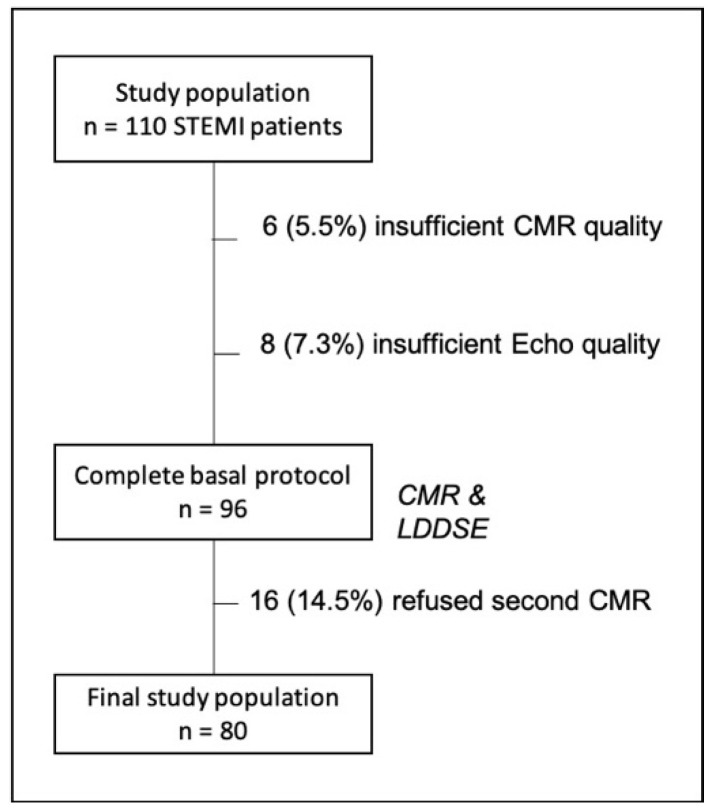
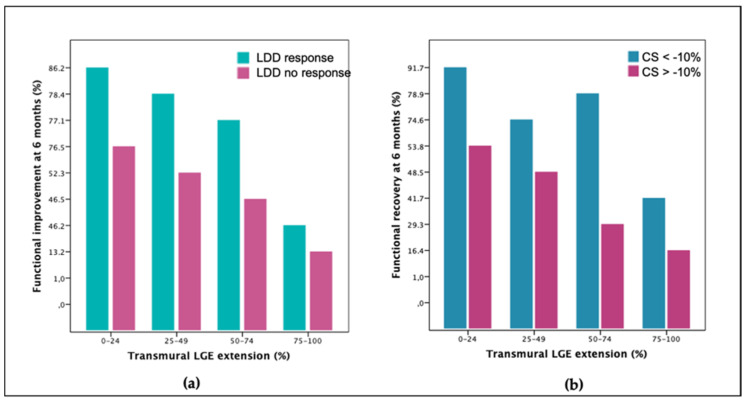
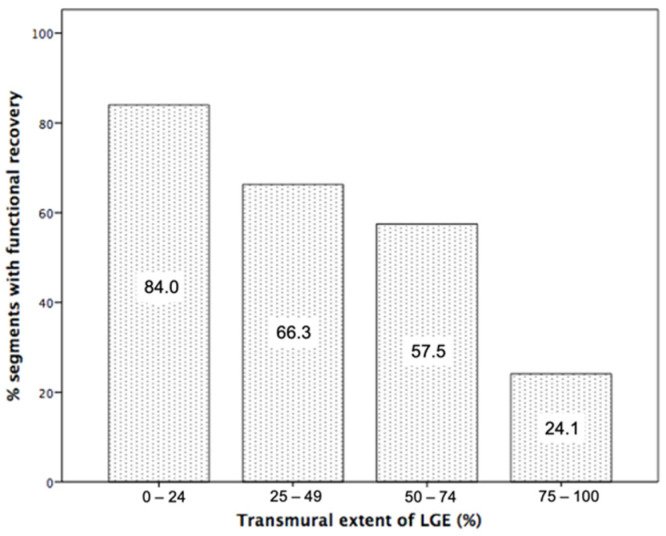
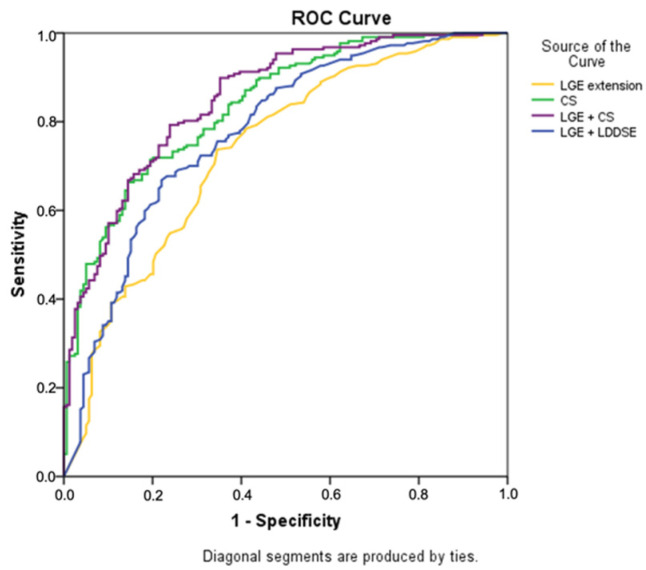
In acute ST-segment elevation myocardial infarction (STEMI) late gadolinium enhancement (LGE) may underestimate segmental functional recovery. We evaluated the predictive value of cardiac magnetic resonance (CMR) feature-tracking (FT) for functional recovery and whether it incremented the value of LGE compared to low-dose dobutamine stress echocardiography (LDDSE) and speckle-tracking echocardiography (STE). Eighty patients underwent LDDSE and CMR within 5-7 days after STEMI and segmental functional recovery was defined as improvement in wall-motion at 6-months CMR. Optimal conventional and FT parameters were analyzed and then also applied to an external validation cohort of 222 STEMI patients. Circumferential strain (CS) was the strongest CMR-FT predictor and addition to LGE increased the overall accuracy to 74% and was especially relevant in segments with 50-74% LGE (AUC 0.60 vs. 0.75, = 0.001). LDDSE increased the overall accuracy to 71%, and in the 50-74% LGE subgroup improved the AUC from 0.60 to 0.69 ( = 0.039). LGE + CS showed similar value as LGE + LDDSE. In the validation cohort, CS was also the strongest CMR-FT predictor of recovery and addition of CS to LGE improved overall accuracy to 73% although this difference was not significant (AUC 0.69, = 0.44). Conclusion: CS is the strongest CMR-FT predictor of segmental functional recovery after STEMI. Its incremental value to LGE is comparable to that of LDDSE whilst avoiding an inotropic stress agent. CS is especially relevant in segments with 50-74% LGE where accuracy is lower and further testing is frequently required to clarify the potential for recovery.
在急性ST段抬高型心肌梗死(STEMI)中,延迟钆增强(LGE)可能会低估节段性功能恢复情况。我们评估了心脏磁共振成像(CMR)特征追踪(FT)对功能恢复的预测价值,以及与小剂量多巴酚丁胺负荷超声心动图(LDDSE)和斑点追踪超声心动图(STE)相比,它是否增加了LGE的价值。80例患者在STEMI后5 - 7天内接受了LDDSE和CMR检查,节段性功能恢复定义为6个月CMR时壁运动改善。分析了最佳传统参数和FT参数,然后将其应用于222例STEMI患者的外部验证队列。圆周应变(CS)是最强的CMR - FT预测指标,将其添加到LGE中可使总体准确率提高到74%,在LGE为50 - 74%的节段中尤其相关(曲线下面积[AUC]为0.60对0.75,P = 0.001)。LDDSE可使总体准确率提高到71%,在LGE为50 - 74%的亚组中,AUC从0.60提高到0.69(P = 0.039)。LGE + CS显示出与LGE + LDDSE相似的价值。在验证队列中,CS也是恢复的最强CMR - FT预测指标,将CS添加到LGE中可使总体准确率提高到73%,尽管这种差异不显著(AUC为0.69,P = 0.44)。结论:CS是STEMI后节段性功能恢复的最强CMR - FT预测指标。其对LGE的增量价值与LDDSE相当,同时避免了使用正性肌力应激剂。CS在LGE为50 - 74%的节段中尤其相关,这些节段的准确率较低,通常需要进一步检查以明确恢复的可能性。