Tangsriwong Kanograt, Jitreetat Tastsanachart
Department of Radiation Oncology, Rajavithi Hospital, Rajavithi Hospital, College of Medicine, Rangsit University, Bangkok, Thailand. Email:
Department of Otolaryngology, Head and Neck Surgery, Rajavithi Hospital, College of Medicine, Rangsit University, Bangkok, Thailand.
Asian Pac J Cancer Prev. 2019 Jul 1;20(7):2051-2057. doi: 10.31557/APJCP.2019.20.7.2051.
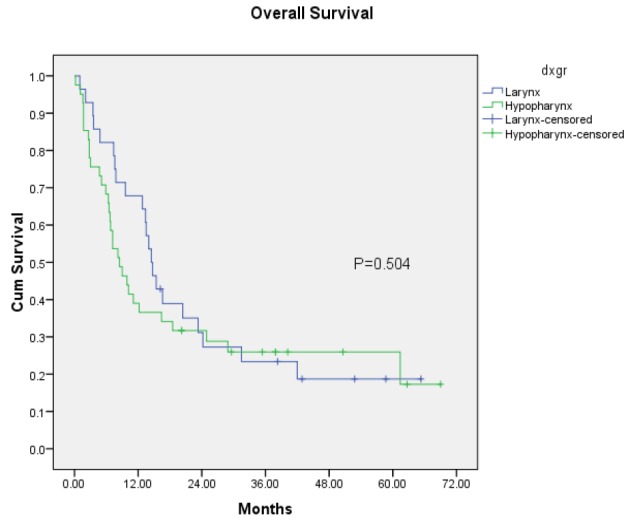
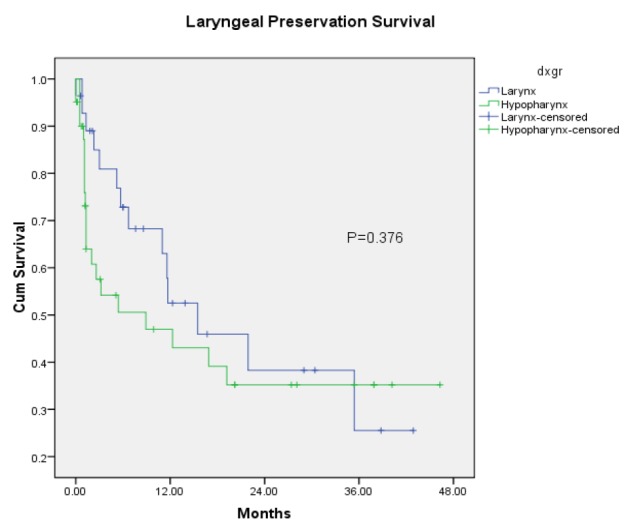
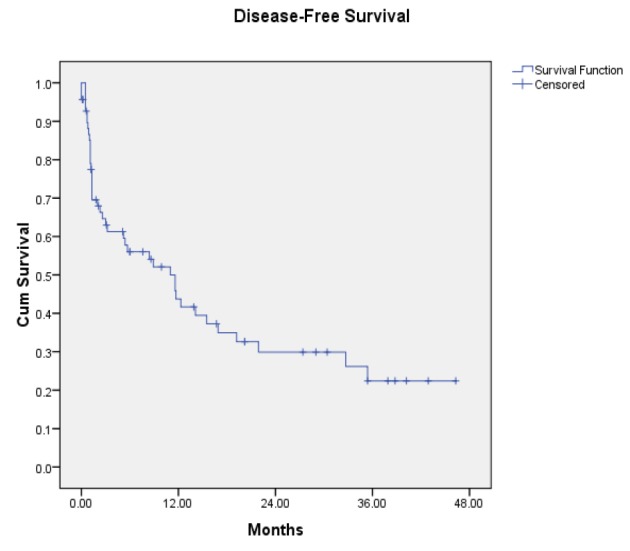
Purpose: To determine factors affecting laryngeal preservation rate in laryngeal and hypopharyngeal cancer patients treated with organ preservation. Material and Methods: Retrospective study examining stage III to IV laryngeal and hypopharyngeal cancer patients who have been treated with organ preservation. Conventional radiation must be applied in all patients with minimum dose of 45 Gray. Weekly or triweekly chemotherapy can be adding during radiation. Salvage surgery should be considered in residual disease or local recurrence. Kaplan-Meier was used for survival analysis and, Log rank test and Cox proportional hazard test were used for uni and multivariate analysis. Results: From January 2010 to October 2014, there were 69 patients treated with laryngeal preservation and 53 patients received radiation dose 61-70 Gray. After completing radiation, we found that 44 patients have no residual tumor within 6 months and 33 patients can preserve their functional larynx later with complete response (median follow up 6 mo, range 0-46.3 mo). The 1-year, 2-year and 3-year laryngeal preservation rate was 49%, 36 % and 32 % respectively. On univariate analysis, lower nodal stage (p = 0.008), stage III disease (p = 0.046), tumor volume <10 ml (p = 0.005), no true vocal cord involvement (p = 0.016), dose 61-70 Gray (p < 0.001) and no interruption of treatment (p = 0.017) have better laryngeal preservation rates. ECOG performance status 2, higher nodal stage, stage IV, presence of true vocal cord involvement, upper airway obstruction before/during radiation and radiation dose below 61-70 Gray had an effect on worse overall survival when evaluated with univariate analysis statistical significance. Conclusion: For factors that affected laryngeal preservation in our study were nodal stage, group stage, tumor volume, true vocal cord involvement, radiation dose and treatment break time more than one week with statistical significance.
确定影响接受器官保留治疗的喉癌和下咽癌患者喉保留率的因素。材料与方法:对接受器官保留治疗的Ⅲ至Ⅳ期喉癌和下咽癌患者进行回顾性研究。所有患者均须接受常规放疗,最小剂量为45格雷。放疗期间可每周或每三周加用化疗。对于残留病灶或局部复发患者应考虑挽救性手术。采用Kaplan-Meier法进行生存分析,采用对数秩检验和Cox比例风险检验进行单因素和多因素分析。结果:2010年1月至2014年10月,69例患者接受了喉保留治疗,53例患者接受了61 - 70格雷的放射剂量。完成放疗后,我们发现44例患者在6个月内无残留肿瘤,33例患者随后能够保留其功能性喉且达到完全缓解(中位随访6个月,范围0 - 46.3个月)。1年、2年和3年的喉保留率分别为49%、36%和32%。单因素分析显示,较低的淋巴结分期(p = 0.008)、Ⅲ期疾病(p = 0.046)、肿瘤体积<10 ml(p = 0.005)、未累及真声带(p = 0.016)、剂量61 - 70格雷(p < 0.001)以及无治疗中断(p = 0.017)具有更好的喉保留率。单因素分析评估时,东部肿瘤协作组(ECOG)体能状态2、较高的淋巴结分期、Ⅳ期、存在真声带受累、放疗前/放疗期间上呼吸道梗阻以及放射剂量低于61 - 70格雷对总生存期较差有影响,具有统计学意义。结论:在我们的研究中,影响喉保留的因素有淋巴结分期、分组分期、肿瘤体积、真声带受累、放射剂量以及治疗中断时间超过一周,具有统计学意义。