Conway Institute and School of Medicine, University College Dublin, Dublin 4, Ireland; Laboratory of Genetics, Genome Center of Wisconsin, Wisconsin Energy Institute, J.F. Crow Institute for the Study of Evolution, University of Wisconsin-Madison, Madison, WI 53706, USA; DOE Great Lakes Bioenergy Research Center, University of Wisconsin-Madison, Madison, WI 53706, USA.
Laboratory of Genetics, Genome Center of Wisconsin, Wisconsin Energy Institute, J.F. Crow Institute for the Study of Evolution, University of Wisconsin-Madison, Madison, WI 53706, USA; DOE Great Lakes Bioenergy Research Center, University of Wisconsin-Madison, Madison, WI 53706, USA.
Curr Biol. 2019 Aug 5;29(15):2555-2562.e8. doi: 10.1016/j.cub.2019.06.056. Epub 2019 Jul 25.
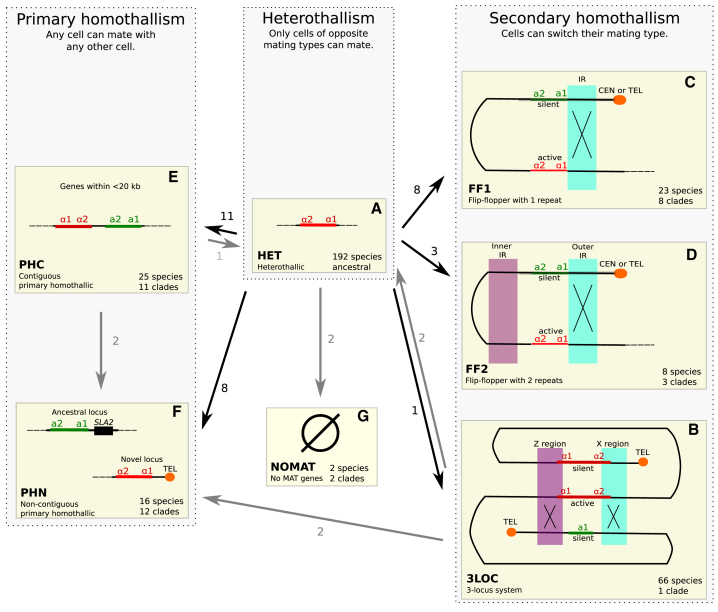
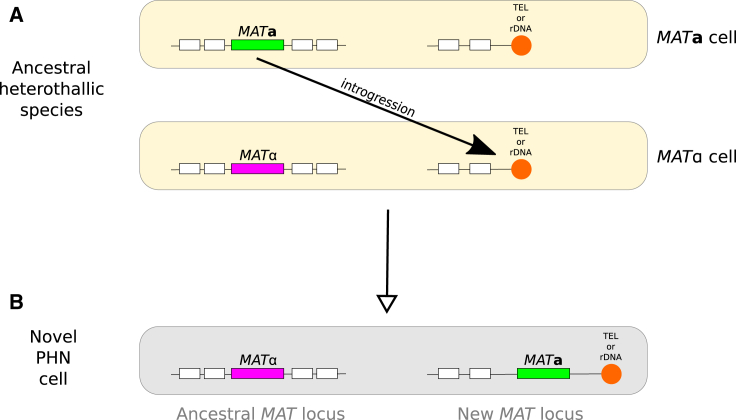
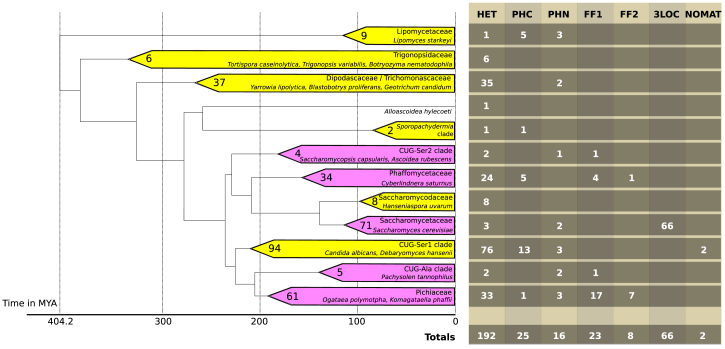
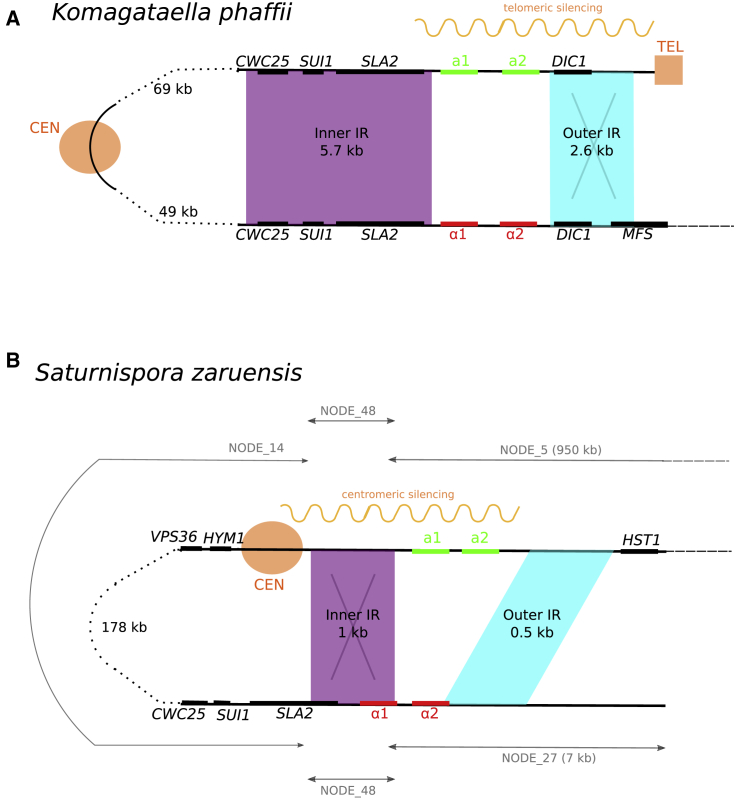
Cell type in budding yeasts is determined by the genotype at the mating-type (MAT) locus, but yeast species differ widely in their mating compatibility systems and life cycles. Among sexual yeasts, heterothallic species are those in which haploid strains fall into two distinct and stable mating types (MATa and MATα), whereas homothallic species are those that can switch mating types or that appear not to have distinct mating types [1, 2]. The evolutionary history of these mating compatibility systems is uncertain, particularly regarding the number and direction of transitions between homothallism and heterothallism, and regarding whether the process of mating-type switching had a single origin [3-5]. Here, we inferred the mating compatibility systems of 332 budding yeast species from their genome sequences. By reference to a robust phylogenomic tree [6], we detected evolutionary transitions between heterothallism and homothallism, and among different forms of homothallism. We find that mating-type switching has arisen independently at least 11 times during yeast evolution and that transitions from heterothallism to homothallism greatly outnumber transitions in the opposite direction (31 versus 3). Although the 3-locus MAT-HML-HMR mechanism of mating-type switching as seen in Saccharomyces cerevisiae had a single evolutionary origin in budding yeasts, simpler "flip/flop" mechanisms of switching evolved separately in at least 10 other groups of yeasts. These results point to the adaptive value of homothallism and mating-type switching to unicellular fungi.
在出芽酵母中,细胞类型由交配型(MAT)基因座的基因型决定,但酵母物种在交配相容性系统和生命周期方面差异很大。在有性酵母中,异核体物种是指其单倍体菌株分为两种不同且稳定的交配类型(MATa 和 MATα),而同核体物种是指可以转换交配类型或似乎没有明显交配类型的物种 [1,2]。这些交配相容性系统的进化历史尚不确定,特别是关于同核体和异核体之间的转变次数和方向,以及交配型转换过程是否具有单一起源[3-5]。在这里,我们从 332 个出芽酵母物种的基因组序列中推断出它们的交配相容性系统。通过参考一个稳健的系统发育基因组树[6],我们检测到了异核体和同核体之间以及不同形式的同核体之间的进化转变。我们发现,在酵母进化过程中,交配型转换至少独立发生了 11 次,并且从异核体到同核体的转变数量大大超过相反方向的转变(31 比 3)。尽管在出芽酵母中,交配型转换的 3 个基因座 MAT-HML-HMR 机制在酿酒酵母中具有单一的进化起源,但在至少 10 个其他酵母群中,单独进化出了更简单的“翻转/翻转”转换机制。这些结果表明同核体和交配型转换对单细胞真菌具有适应性价值。