Valsasina Paola, Hidalgo de la Cruz Milagros, Filippi Massimo, Rocca Maria A
Neuroimaging Research Unit, Institute of Experimental Neurology, Division of Neuroscience, IRCCS San Raffaele Scientific Institute, Milan, Italy.
Vita-Salute San Raffaele University, Milan, Italy.
Front Neurosci. 2019 Jul 10;13:618. doi: 10.3389/fnins.2019.00618. eCollection 2019.
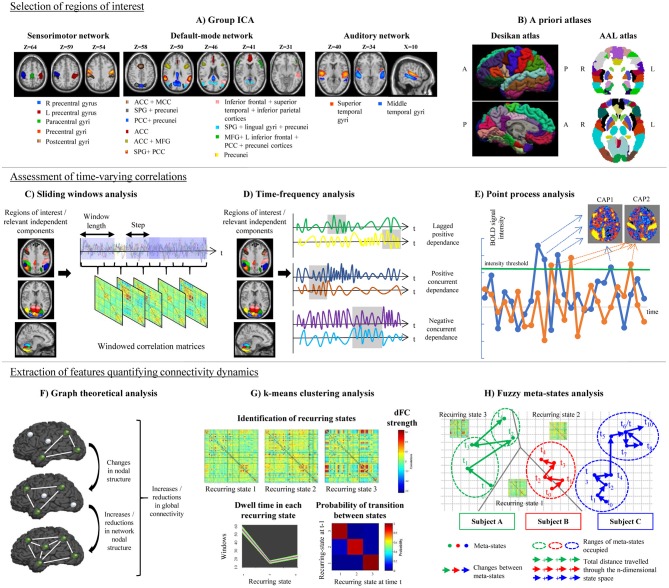
Functional magnetic resonance imaging (fMRI) at resting state (RS) has been widely used to characterize the main brain networks. Functional connectivity (FC) has been mostly assessed assuming that FC is static across the whole fMRI examination. However, FC is highly variable at a very fast time-scale, as demonstrated by neurophysiological techniques. Time-varying functional connectivity (TVC) is a novel approach that allows capturing reoccurring patterns of interaction among functional brain networks. Aim of this review is to provide a description of the methods currently used to assess TVC on RS fMRI data, and to summarize the main results of studies applying TVC in healthy controls and patients with multiple sclerosis (MS). An overview of the main results obtained in neurodegenerative and psychiatric conditions is also provided. The most popular TVC approach is based on the so-called "sliding windows," in which the RS fMRI acquisition is divided in small temporal segments (windows). A window of fixed length is shifted over RS fMRI time courses, and data within each window are used to calculate FC and its variability over time. Sliding windows can be combined with clustering techniques to identify recurring FC states or used to assess global TVC properties of large-scale functional networks or specific brain regions. TVC studies have used heterogeneous methodologies so far. Despite this, similar results have been obtained across investigations. In healthy subjects, the default-mode network (DMN) exhibited the highest degree of connectivity dynamism. In MS patients, abnormal global TVC properties and TVC strengths were found mainly in sensorimotor, DMN and salience networks, and were associated with more severe structural MRI damage and with more severe physical and cognitive disability. Conversely, abnormal TVC measures of the temporal network were correlated with better cognitive performances and less severe fatigue. In patients with neurodegenerative and psychiatric conditions, TVC abnormalities of the DMN, attention and executive networks were associated to more severe clinical manifestations. TVC helps to provide novel insights into fundamental properties of functional networks, and improves the understanding of brain reorganization mechanisms. Future technical advances might help to clarify TVC association with disease prognosis and response to treatment.
静息态功能磁共振成像(fMRI)已被广泛用于描绘主要脑网络的特征。功能连接性(FC)的评估大多假定其在整个fMRI检查过程中是静态的。然而,正如神经生理学技术所表明的,FC在非常快的时间尺度上具有高度变异性。时变功能连接性(TVC)是一种新颖的方法,它能够捕捉功能性脑网络之间反复出现的相互作用模式。本综述的目的是描述目前用于评估静息态fMRI数据上TVC的方法,并总结在健康对照者和多发性硬化症(MS)患者中应用TVC的研究的主要结果。还提供了神经退行性疾病和精神疾病中获得的主要结果的概述。最流行的TVC方法基于所谓的“滑动窗口”,即将静息态fMRI采集划分为小的时间片段(窗口)。一个固定长度的窗口在静息态fMRI时间序列上移动,每个窗口内的数据用于计算FC及其随时间的变异性。滑动窗口可以与聚类技术相结合,以识别反复出现的FC状态,或者用于评估大规模功能网络或特定脑区的全局TVC特性。到目前为止,TVC研究使用了多种不同的方法。尽管如此,各项研究仍获得了相似的结果。在健康受试者中,默认模式网络(DMN)表现出最高程度的连接动态性。在MS患者中,异常的全局TVC特性和TVC强度主要在感觉运动、DMN和突显网络中被发现,并且与更严重的结构MRI损伤以及更严重的身体和认知残疾相关。相反,颞叶网络的异常TVC测量与更好的认知表现和较轻的疲劳相关。在神经退行性疾病和精神疾病患者中,DMN、注意力和执行网络的TVC异常与更严重的临床表现相关。TVC有助于为功能网络的基本特性提供新的见解,并增进对脑重组机制的理解。未来的技术进步可能有助于阐明TVC与疾病预后及治疗反应的关联。