Dorr Michael, Kwon MiYoung, Lesmes Luis Andres, Miller Alexandra, Kazlas Melanie, Chan Kimberley, Hunter David G, Lu Zhong-Lin, Bex Peter J
Department of Electrical and Computer Engineering, Technical University Munich, Munich, Germany.
Department of Ophthalmology, School of Medicine, University of Alabama at Birmingham, Birmingham, AL, United States.
Front Hum Neurosci. 2019 Jul 12;13:234. doi: 10.3389/fnhum.2019.00234. eCollection 2019.
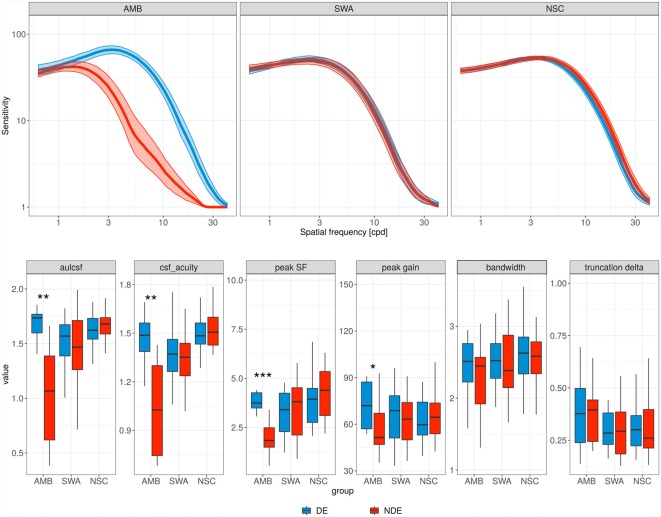
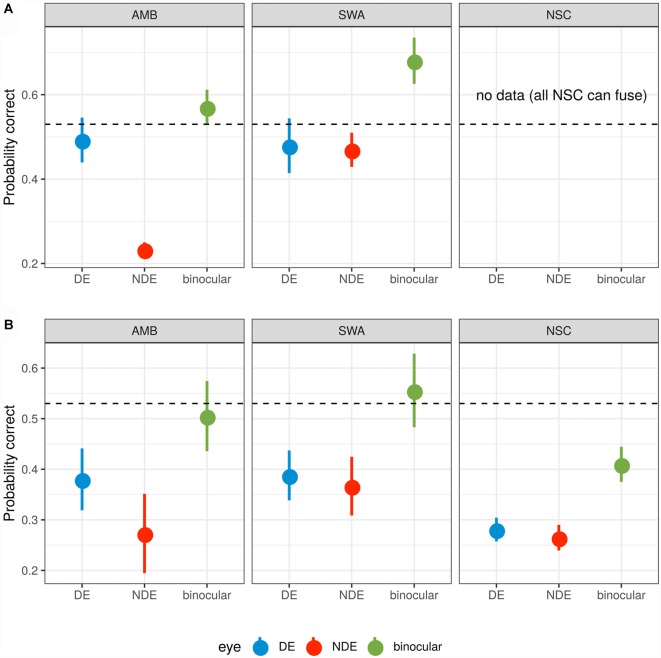
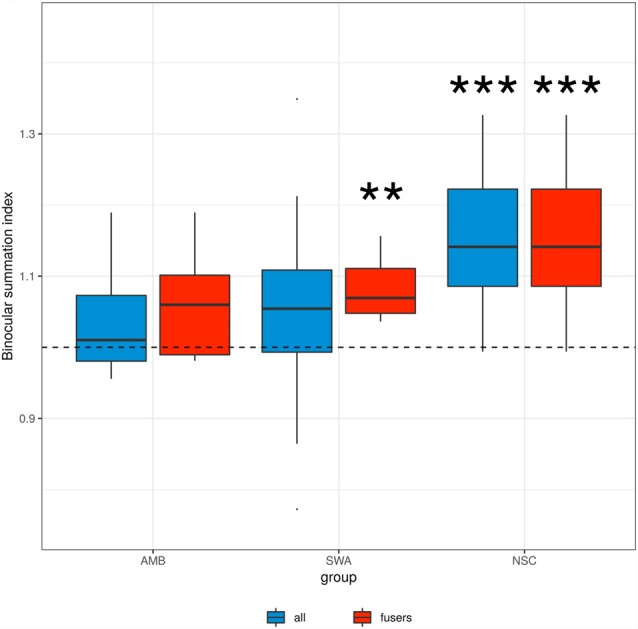
: Amblyopia and strabismus affect 2%-5% of the population and cause a broad range of visual deficits. The response to treatment is generally assessed using visual acuity, which is an insensitive measure of visual function and may, therefore, underestimate binocular vision gains in these patients. On the other hand, the contrast sensitivity function (CSF) generally takes longer to assess than visual acuity, but it is better correlated with improvement in a range of visual tasks and, notably, with improvements in binocular vision. The present study aims to assess monocular and binocular CSFs in amblyopia and strabismus patients. : Both monocular CSFs and the binocular CSF were assessed for subjects with amblyopia ( = 11), strabismus without amblyopia ( = 20), and normally sighted controls ( = 24) using a tablet-based implementation of the quick CSF, which can assess a full CSF in <3 min. Binocular summation was evaluated against a baseline model of simple probability summation. : The CSF of amblyopic eyes was impaired at mid-to-high spatial frequencies compared to fellow eyes, strabismic eyes without amblyopia, and control eyes. Binocular contrast summation exceeded probability summation in controls, but not in subjects with amblyopia (with or without strabismus) or strabismus without amblyopia who were able to fuse at the test distance. Binocular summation was less than probability summation in strabismic subjects who were unable to fuse. : We conclude that monocular and binocular contrast sensitivity deficits define important characteristics of amblyopia and strabismus that are not captured by visual acuity alone and can be measured efficiently using the quick CSF.
弱视和斜视影响2%-5%的人口,并导致广泛的视觉缺陷。通常使用视力来评估治疗反应,而视力是一种对视觉功能不敏感的测量方法,因此可能会低估这些患者双眼视觉的改善情况。另一方面,对比敏感度函数(CSF)的评估通常比视力评估所需时间更长,但它与一系列视觉任务的改善,特别是与双眼视觉的改善有更好的相关性。本研究旨在评估弱视和斜视患者的单眼和双眼CSF。
使用基于平板电脑的快速CSF实施方案,对弱视患者(n = 11)、无弱视的斜视患者(n = 20)和正常视力对照者(n = 24)进行单眼CSF和双眼CSF评估,该方案可在<3分钟内评估完整的CSF。根据简单概率总和的基线模型评估双眼总和。
与健眼、无弱视的斜视眼和对照眼相比,弱视眼在中高空间频率下的CSF受损。在对照组中,双眼对比总和超过概率总和,但在弱视患者(有或无斜视)或在测试距离能够融合的无弱视斜视患者中则不然。在无法融合的斜视受试者中,双眼总和小于概率总和。
我们得出结论,单眼和双眼对比敏感度缺陷定义了弱视和斜视的重要特征,这些特征不能仅通过视力来体现,并且可以使用快速CSF有效地进行测量。