Yuan Lin, Wang Minghua, Liu Tianqi, Lei Yinsheng, Miao Qiang, Li Quan, Wang Hongxing, Zhang Guoqing, Hou Yinglong, Chang Xiaotian
Medical Research Center of Qianfoshan Hospital Affiliated with Shandong University, Jinan, China.
Cardiac Surgery Department of Qianfoshan Hospital Affiliated with Shandong University, Jinan, China.
Front Pharmacol. 2019 Jul 10;10:766. doi: 10.3389/fphar.2019.00766. eCollection 2019.
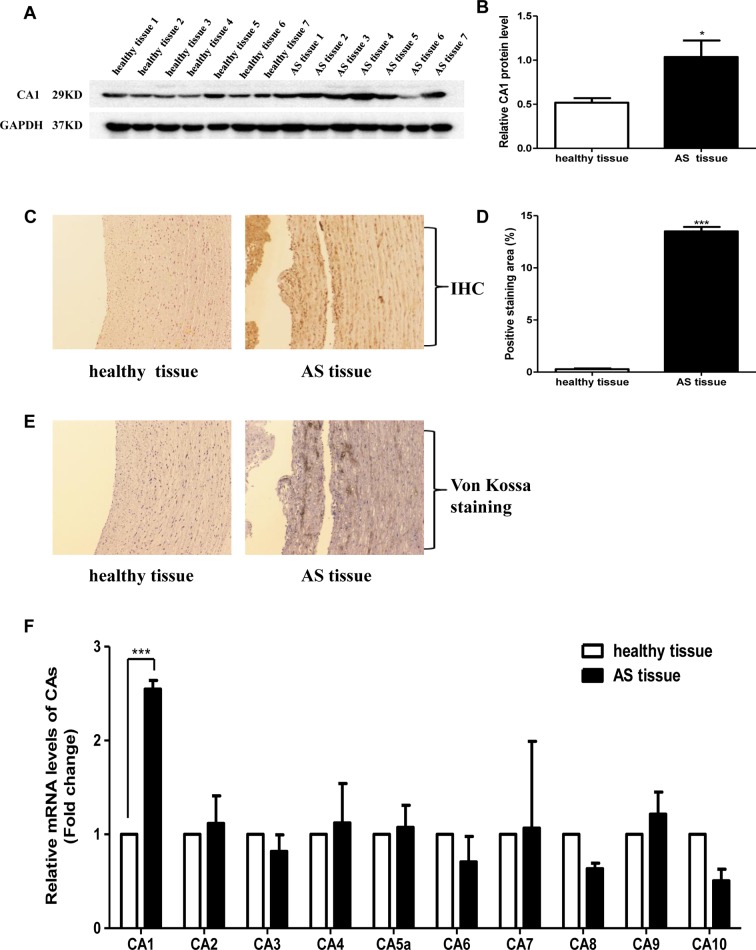
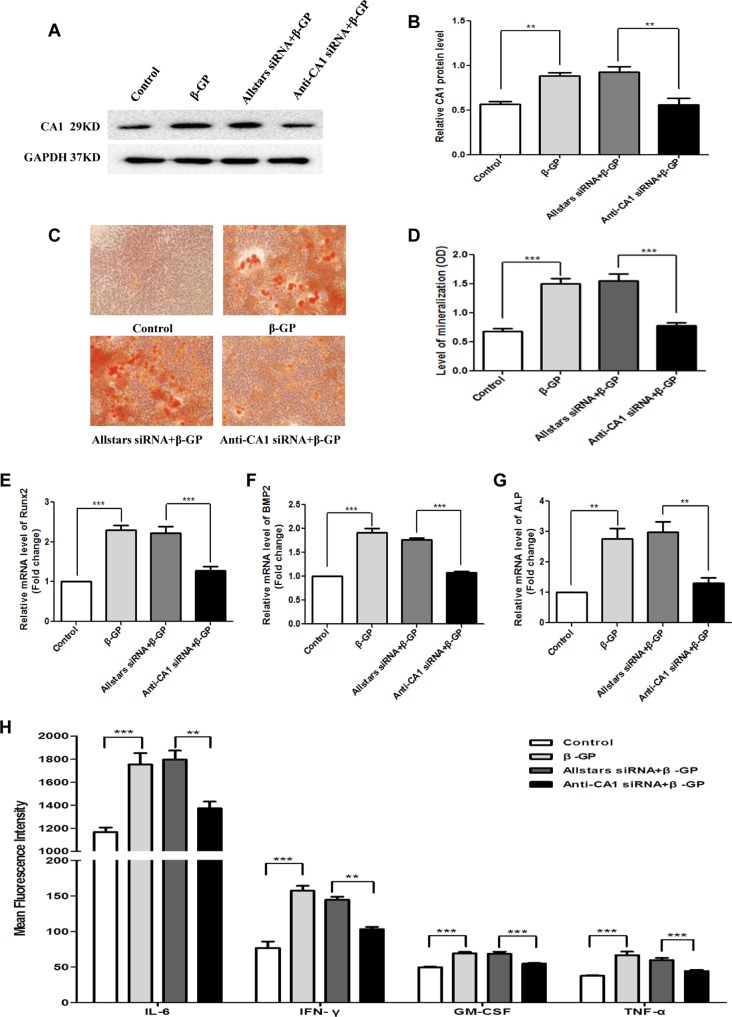
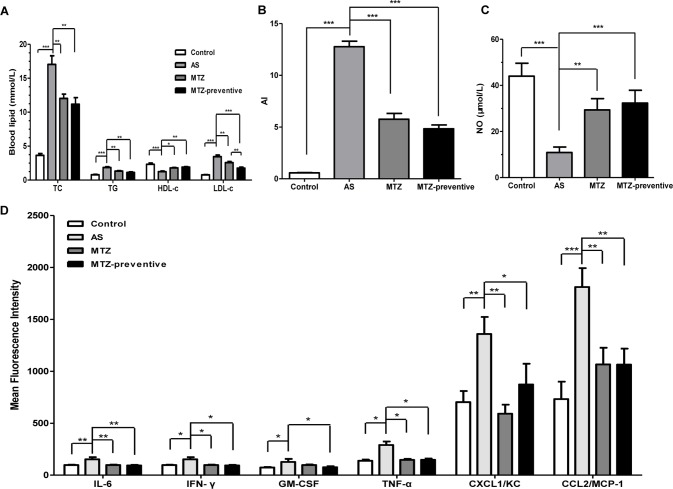
Vascular calcification is an important pathogenic process in atherosclerosis (AS); however, its immediate cause is unknown. Our previous study demonstrated that carbonic anhydrase 1 (CA1) stimulates ossification and calcification in ankylosing spondylitis and breast cancer. The current study investigated whether CA1 plays an important role in AS calcification and whether the CA inhibitor methazolamide (MTZ) has a therapeutic effect on AS. We successfully established an AS model by administration of a high-fat diet to apolipoprotein E (ApoE) mice. The treated animals had significantly increased serum levels of high-density lipoprotein cholesterol (HDL-c) and nitric oxide (NO) and decreased serum concentrations of total cholesterol (TC), triglycerides (TG), low-density lipoprotein cholesterol (LDL-c), interleukin (IL-6), interferon (IFN)-γ, granulocyte-macrophage colony-stimulating factor (GM-CSF), tumor necrosis factor-α (TNF-α), chemokine (C-X-C motif) ligand 1/keratinocyte-derived chemokine (CXCL1/KC), and C-C motif chemokine ligand 2 (CCL2)/monocyte chemoattractant protein 1 (MCP-1). The treated mice also had reduced AS plaque areas and fat accumulation, with no clear calcium deposition in the intima of the blood vessels. CA1 expression was significantly increased in the aortic lesions, particularly in calcified regions, but the expression was dramatically lower in the mice that received MTZ treatment or MTZ preventive treatment. CA1 was also highly expressed in human AS tissues and in rat vascular smooth muscle cells (VSMCs) with β-glycerophosphate (㒐β-GP)-induced calcification. Acetazolamide (AZ), a CA inhibitor with a chemical structure similar to MTZ, markedly suppressed calcification and reduced CA1, IL-6, IFN-γ, GM-CSF, and TNF-α expression in cultured VSMCs. Anti-CA1 small interfering ribonucleic acid (siRNA) significantly suppressed calcification, cell proliferation, and migration, promoted apoptosis, and reduced IL-6, IFN-γ, GM-CSF, and TNF-α secretion in cultured VSMCs. These results demonstrated that CA1 expression and CA1-mediated calcification are significantly associated with AS progression. MTZ significantly alleviated AS and suppressed CA1 expression and proinflammatory cytokine secretion, indicating the potential use of this drug for AS treatment.
血管钙化是动脉粥样硬化(AS)中的一个重要致病过程;然而,其直接原因尚不清楚。我们之前的研究表明,碳酸酐酶1(CA1)在强直性脊柱炎和乳腺癌中刺激骨化和钙化。本研究调查了CA1在AS钙化中是否起重要作用,以及CA抑制剂甲醋唑胺(MTZ)对AS是否具有治疗作用。我们通过给载脂蛋白E(ApoE)小鼠喂食高脂饮食成功建立了AS模型。接受治疗的动物血清高密度脂蛋白胆固醇(HDL-c)和一氧化氮(NO)水平显著升高,血清总胆固醇(TC)、甘油三酯(TG)、低密度脂蛋白胆固醇(LDL-c)、白细胞介素(IL-6)、干扰素(IFN)-γ、粒细胞-巨噬细胞集落刺激因子(GM-CSF)、肿瘤坏死因子-α(TNF-α)、趋化因子(C-X-C基序)配体1/角质形成细胞衍生趋化因子(CXCL1/KC)以及C-C基序趋化因子配体2(CCL2)/单核细胞趋化蛋白1(MCP-1)浓度降低。接受治疗的小鼠AS斑块面积和脂肪堆积也减少,血管内膜无明显钙沉积。CA1在主动脉病变中,特别是在钙化区域表达显著增加,但在接受MTZ治疗或MTZ预防性治疗的小鼠中表达显著降低。CA1在人AS组织以及经β-甘油磷酸(β-GP)诱导钙化的大鼠血管平滑肌细胞(VSMC)中也高表达。乙酰唑胺(AZ)是一种化学结构与MTZ相似的CA抑制剂,可显著抑制培养的VSMC中的钙化,并降低CA1、IL-6、IFN-γ、GM-CSF和TNF-α的表达。抗CA1小干扰核糖核酸(siRNA)可显著抑制培养的VSMC中的钙化、细胞增殖和迁移,促进细胞凋亡,并减少IL-6、IFN-γ、GM-CSF和TNF-α的分泌。这些结果表明,CA1表达和CA1介导的钙化与AS进展显著相关。MTZ显著减轻AS并抑制CA1表达和促炎细胞因子分泌,表明该药物在AS治疗中的潜在用途。